Tuesday, July 10, 2012
In the opinion of the Association of Learned and Professional Society Publishers
It is the opinion of the Association of Learned and Professional Society Publishers (ALPSP), that open access mandates with short embargoes will lead to journal cancellations and threaten the survive of scholarly journals. Audrey McCullough, Chief Executive of ALPSPs, admits that a recently released "report" by ALPSP purporting to claim evidence for this, is actually an opinion piece, as recorded in this interview by Richard Poynder. I am happy to have been able to help out a bit with research methods and history in this area; this piece is a fine example of the potential for academic / journalist collaboration. Whether this is fact or opinion is important, with open access policies under discussion. For example, the Research Councils in the UK is currently working on strengthening their OA policies.


Monday, July 09, 2012
Oxygen is not a free lunch (environmentalism for the free market believer)
The right wing think tank The Heartland Institute - one of the main funders of climate change denial - claims that we should look to free market solutions to environmental challenges. While I strongly disagree with their philosophy and this approach, free market belief systems are common in our society so it may be useful to develop arguments that this constituency can understand. Here is one such argument.
Those who are so indoctrinated in neoliberalism that they cannot see our world, the air we breathe, as the great gift (the free lunch) that it is, might benefit from considering the oxygen in the air we breathe from a labor perspective. This is not human labor, but rather the natural labor of plants and particularly trees.
The deforestation occurring around the world can be seen as a labor dispute - the trees are being locked out, deprived of the means of production, the soil and water that they need.
This is one labor dispute that the capitalist cannot win. While it may seem as though those who order the chainsaws or set the policies have all the power against these immobile, defenseless beings, ultimately it is these gentle creatures who have the ultimate power, collectively creating the air without which none of us (no matter how rich) cannot survive fOr more than a few minutes. Negotiation is crucial, and urgent, for both sides.
The image of the 99% is powerful, true, and important for social justice, but let's keep in mind that when it comes to te environment, we are the 100%. If we continue to destroy the environment, some of us will suffer more than others, but we will all suffer. If we wage war against the environment, we all lose.
Monday, July 02, 2012
June 30, 2012 Dramatic Growth of Open Access

The Bielefeld Academic Search Engine (BASE), operated by Bielefeld University Library, is described as "one of the world's most voluminous search engines especially for academic open access web resources". BASE's total document count is what I use as the best available surrogate for the number of open access resources currently available. This is far from an exact count (not all the resources in the archives harvested by BASE are open access, there is no deduplication, and the types of documents is difficult to discover). However, the sheer volume of BASE is a clear indication of dramatic growth of open access archives - with over 36 million documents in total, the real number would be impressive even if it were only a small portion of the total. This quarter, the just over 2,000 repositories harvested by BASE collectively added close to 2 million documents.
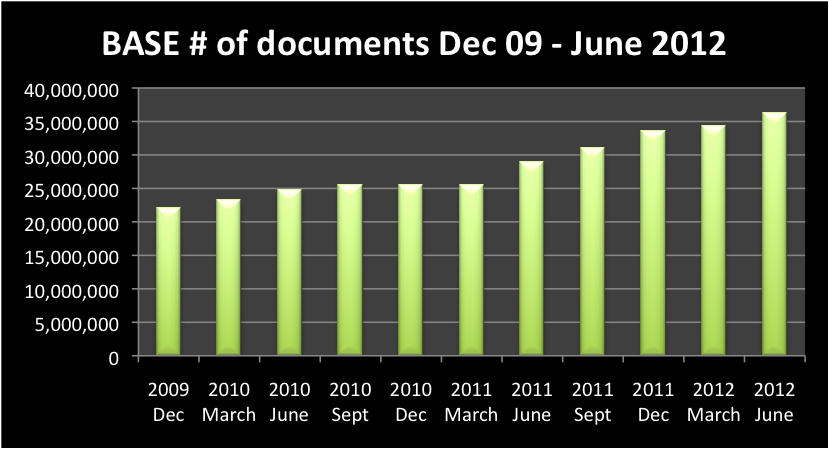
arXiv contains over 750,000 documents; RePEC, over 1 million, and the Social Sciences Research Network about 350,000 documents. These 4 repository services taken together add to over 5.5 million documents - and this is just 4 of the over 2,000 open access repositories available around the world.
The Directory of Open Access Journals is getting close to 8 thousand titles, and adding titles at a rate of over 3 per day. The newly launched Directory of Open Access Books already lists more than a thousand titles from 27 contributing publishers. The Electronic Journals Library, which collects free titles of interest to academics whether peer reviewed or not, and including titles that are not fully OA but provide free access to back issues, lists over 35,000 journals, and continues to add titles at an average rate of 15 per day.
The Internet Archive provides access to 670,000 movies, 100,000 concerts, 1.3 million audio recordings, and 3.5 million texts.
No wonder then that many people - and not just the usual suspects - are beginning to see that open access is inevitable! This issue of The Dramatic Growth of Open Access briefly explains the purpose of this series, highlights Shieber's collection of quotes on the inevitability of open access, discusses one of the less immediately visible indications of the growth of open access, the increasing citations of open access journals, and provides selected growth numbers. Full data for this series can be downloaded from SUMMIT.
The purpose of this series
It is important not to overstate the extent of open access today; the vast majority of scholarly peer-reviewed journal articles are still published in toll access journals. However, it is also important to notice and celebrate what has been accomplished to date, and that is the primary purpose of this series, The Dramatic Growth of Open Access.
Reasons why this recognition of accomplishments to date are important include:
- raising awareness of the resources already available for people to use
- increases usage and hence success of existing open access initiatives
- usage can raise awareness of the benefits of open access
- increase understanding that there is no need for any one region to consider a unilateral move to open access - it's happening everywhere
- countering misperceptions of lack of progress - for example, there is the occasional setback, but when a single journal reverts from open to toll access, let's keep in mind that the net growth for DOAJ that same day was about 3 titles
- celebrating success to date is good for morale!
The growing citation impact of open access journals
Thanks to Matt Cockerill for A striking example of a society journal improving its impact factor radically following a move to #openaccess

and to David Wardle for research illustrating that ecological papers in PLoS ONE have a greater impact than those published in the main ecological journals. Details:
ecological papers published in PLoS ONE, which accepts 69% of submissions, publishes work that on average has a greater impact than papers published in Oikos which accepts 15% of submissions,from:
and has a comparable impact to those in Ecology and Functional Ecology which respectively accept 20% and 15% of submissions. Ecological papers published in,PLoS ONE are on average cited less than those in Ecology Letters (with an 11% acceptance rate) but evenhere there is considerable overlap
Wardle, David A. On plummeting manuscript acceptance rates by the main ecological journals
and the progress of ecology. Ideas in Ecology and Evolution 5: 13–15, 2012
doi:10.4033/iee.2012.5.4.e "http://library.queensu.ca/ojs/index.php/IEE/article/view/4351/4346
Selected numbers
Directory of Open Access Journals
- 7,912 journals
- 305 added this quarter (3 per day)
- 1,098 academic peer-reviewed books
- 27 publishers
- 35,296 journals that can be read free of charge
- 1,312 added this quarter (15 per day)
For extensive detailed statistics on repositories see OpenDOAR and ROAR
- OpenDOAR 2,165 (decreased by 21 this quarter)
- Registry of Open Access Repositories (ROAR) 2,909 (increased by 175 this quarter)
For extensive statistics on items by repository including deposit rate see the Registry of Open Access Repositories
Global: Bielefeld Academic Search Engine
- 36 million documents
- 2 million documents added this quarter (22 thousand / day)
arXiv (physics)
- 766,772 documents
- 20,789 added this quarter (230 per day)
- 1 million downloadable documents
- 30 thousand added this quarter (333 per day)
- 350,000 fulltext documents
- 28,000 added this quarter (311 per day)
- 13,387 documents
- 460 added this quarter (5 per day)
- 330 policies listed
- 237 policies excluding thesis policies
- 10 institutional policies added this quarter
- Moving images (movies) 670,000 - 40,000 added this quarter (444 per day)
- Live music archive (concerts) 100,000 - 3,455 added this quarter (28 per day)
- Audio (recordings) 1.3 million - 128,000 added this quarter (1,400 per day)
- Texts 3.5 million - 150,000 added this quarter (1,600 per day)
- 1,347 journals actively participating in PMC (decrease of 13 this quarter)
- 1,092 journals deposit ALL articles in PMC (increase of 51 this quarter)
- 928 journals with immediate free access (increase of 49 this quarter)
- 792 journals with all articles open access (increase of 46 this quarter)
- 200,000 articles (74%) by NIH funded external researchers since 2008 Public Access Policy freely available
- 340,000 articles (58%) by NIH internal or external researchers freely available (no date limit)
- 150,000 articles (60%) within 3 years of publication
- 84,000 articles (50%) within 2 years of publication
- 16,000 articles (20%) within 1 year of publication
Tuesday, June 05, 2012
Publishers' Association survey on subscriptions: methodological critique
Correction June 6: the 2006 ALPSP report Survey of Librarians on Factors in Journal Cancellation is on the ALPSP website, here: http://www.alpsp.org/Ebusiness/ProductCatalog/Product.aspx?ID=26 Only the press release and the Summary and Conclusions are available to non-members.
The Association of Learned, Professional and Society Publishers (ALPSP) and the Publishers' Association just released the results of a survey asking if libraries would continue subscriptions if a majority of the content of research journals was freely available. The results of this study (downloadable from here) appear alarming - predicting catastrophic losses of subscriptions and subsequently journals and publishers! This post is a methodological critique. In summary, the recommendation of this study (against an OA mandate with a 6-month embargo) is not supported by the research presented - and most importantly, by the research omitted, which is in brief all of the considerable evidence that would counter this recommendation, including a 2006 study by ALPSP itself which is not cited and has apparently disappeared from the ALPSP website.
The recommendation from this study is:
The recommendation from this study is:
It is strongly recommended that no mandate is issued on making all or most journal articles available free of charge after a six month embargo until both libraries and publishers have had time to understand the issues better and have together taken steps to explore alternatives to a fully open access publishing model which could be mutually attractive.Here is the simply question asked by this ALPSP study:
If the (majority of) content of research journals was freely available within 6 months of publication, would you continue to subscribe? Please give a separate answer for a) Scientific, Technical and Medical journals and b) Humanities, Arts and Social Sciences Journals if your library has holdings in both of these categories.Methodological critique:
- The response rate to this study was 26%. With any survey, there is always the possibility of response bias. In the case of a study like this conducted in an environment of contested advocacy for public access policy, the chances of response bias to a survey conducted of librarians by publishers' groups is likely to be above normal.
- A 2006 ALPSP survey which found that cancellations by librarians would likely be minimal even with IMMEDIATE free access would be minimal appears to be absent from the ALPSP website. Thanks to Mel DeSart for posting conclusions to this study on the SCHOLCOMM list. For example, even if 79% of content were freely available immediately on publication, only 10% of libraries surveyed indicated that they would consider cancelling the journals. That this study, conducted by the same association, which found very different results, was not cited and does not appear on the ALPSP website, strongly supports the idea that the study was biased - only the results supporting ALPSP's preferred conclusion are presented.
- The recommendation of this study implies that the only possible source of revenue for scholarly journals is subscriptions. Even for traditional journals, this has never been the only source of revenue. For many a society publisher, for example, a key source of revenue has been association memberships rather than subscriptions, and many societies and associations have traditionally subsidized their journals (while in other cases the journals subsidize the association). Advertising is another source of revenue. In many countries (such as Canada), scholarly journal publishing is not seen as a profit-making venture, and so enjoys government subsidies. Article processing fees to provide for open access is a growing potential revenue source. A growing number of libraries provide funds to cover article processing fees for open access. Why did the study not ask libraries if they have such a fund, or would consider developing one if there was a mandate for open access within 6 months? Why not mention that there are now more than 7,000 fully open access journals - including profitable commercial journals, and hundreds of society journals as noted by Suber & Sutton?
- A key recommendation of this study is that "no mandate is issued on making all or most journal articles available free of charge after a six month embargo until both libraries and publishers have had time to understand the issues better and have together taken steps to explore alternatives to a fully open access publishing model which could be mutually attractive". This is puzzling. If the researchers think that libraries and publishers should work together (I agree), then why was was this a publisher-only study? Wouldn't a combined library / publisher / scholar study - like the PEER project - be a better approach? Further, this recommendation implies that the idea of libraries and publishers working together to make open access happen is a new one. As I've explained in a bit of detail in my previous post Society publishers: time to quit whining and make the leap to open access, these discussions have been going on for more than decade. Why not cite some of these discussions and related research, such as survey conducted by myself and other researchers across Canada to figure out how to help journals make the leap to open access? This is just one example!
Friday, June 01, 2012
Society publishers: time to quit whining and make the leap to open access
The Association of Learned and Professional Society Publishers (ALPSP) just released a report called: The potential effect of making journals free after a six month embargo. Conclusions are that: "the impact on all publishers’ revenues would be considerable" and "It is strongly recommended that no mandate is issued on making all or most journal articles available free of charge after a six month embargo until both libraries and publishers have had time to understand the issues better and have together taken steps to explore alternatives to a fully open access publishing model which could be mutually attractive".
Comment - in brief
This post will focus on the second argument, that time is needed to explore alternatives to a fully open access publishing model. In brief, both libraries and publishers have been in discussions about the need to transition to an appropriate publishing system for the World Wide Web for at least a decade and a half - ALPSP itself was talking about this at least as early as 1997. Most of us have moved far beyond the discussions stage. Libraries are actively providing support for open access publishing, including hosting and support services for faculty and society publishing and funds for article processing fees. There are close to 8,000 fully open access journals listed in DOAJ - many in the humanities and social sciences - including commercial journals that are turning a healthy profit, illustrating that open access is a viable business model. There are a great many supports available for publishers wishing to move to open access, including David Solomon's Developing open access journals: a practical guide and the SPARC guide on income models for open access. If publishers have not yet made the switch to open access, this is a clear indication that discussions and support for change is not enough; public policy is needed.
Details
ALPSP itself has been discussing the need for change arising from the World Wide Web, through its journal Learned Publishing, since the journal first began in 1997. In April 1997, ALPSP published an article by R. Charkin called Scholarly communities on the World Wide Web
in which the author points out that "Whatever happens it is clear that the world of scholarly publishing is
going to change beyond recognition in the next decade – and most of that
change is for the better". In 2000 - a full two years before the Budapest Open Access Initiative - R.S. Berry published an article in Learned Publishing called Full and open access to scientific information: an academic's view.
In 1998, the Scholarly Publishing and Academic Resources Coalition was formed: from the website:
- SPARC is a coalition of libraries, initiated by the Association of Research Libraries (ARL), that seeks to partner with scholarly publishers willing to enter markets where prices are highest and competition is needed. Through its activities, SPARC intends to reduce the risks to publisher-partners of entering the marketplace and to provide faculty with prestigious and responsive alternatives to current publishing vehicles.
Libraries, through SPARC and through other initiatives, have worked hard over the past decade and a half to help publishers transition to an optimal, sustainable approach to scholarly communication, with a primary focus on open access for approximately the last decade.
The majority of academic libraries in North America are now providing services for faculty and society publishing, as noted by Karla Hahn in 2008 and myself and my colleagues in 2010. There are now close to 8,000 fully open access journals listed in the Directory of Open Access Journals. Many libraries now have funds available to pay article processing fees for open access journals.
References
Scholarly communities on the World Wide Web
http://alpsp.publisher.ingentaconnect.com/content/alpsp/lp/1997/00000010/00000002/art00003Abstract:
Communities’ has become a buzzword in the strategy departments of publishing companies. It is clear – and becoming clearer – that the Internet is not merely a potential information delivery route but a vehicle for bringing together communities. One of the problems, however, is that much of the scholarly activity on the Web is driven by people with a traditional information delivery role – writers, publishers, booksellers and subscription agents and librarians. Nobody questions the importance of these roles but community creation is different and requires skills which are frequently closer to caterers or advertising agencies or hoteliers. Time will tell how communities will develop. Whatever happens it is clear that the world of scholarly publishing is going to change beyond recognition in the next decade – and most of that change is for the better.
http://alpsp.publisher.ingentaconnect.com/content/alpsp/lp/2000/00000013/00000001/art00005
Full and open access' to scientific information: an academic's view
Author: Berry R.S.
Source: Learned Publishing, Volume 13, Number 1, 1 January 2000 , pp. 37-42(6)
Abstract:
Stimulated by the potential of electronic distribution of information, discussions, sometimes rather tense, about the ownership and proprietary rights to scientific publications have generated something of a polarization of the communities that have stakes in this issue. There are some 'middle-grounders', but the intensity of the discourse has made them less visible than the spokesmen for the extremes. In this forum, we examine these positions and then present a case for a specific policy, in light of the views of the parties.
Thursday, May 31, 2012
Are strict CC-BY publishers shooting themselves in the foot?
This post asks whether open access publishers that practice strict adherence to the Creative Commons-Attribution license (CC-BY) are actually shooting themselves in the foot, that is, leaving plenty of room for competitors who will be able to use their works with no requirement to reciprocate. Note that it is not the competitors who are binding CC-BY publishers - they are voluntarily doing this to themselves! CC-BY publishers can easily avoid this situation, simply by adopting a flexible approach to licensing.
How can this be?
Let's compare CC-BY with what I would consider to be an enlightened approach to licensing for an open access publisher: the decision about licensing is left to the author, with the full range of creative commons license options made available, and provision made for sub-licensing portions of a work. An author can choose to publish a work with the CC option that I would consider optimal for ensuring open access not only for now, but into the future: CC-Attribution-Noncommercial-Sharealike (CC-BY-NC-SA). The author using this license can use CC-BY material, and even material with a different restrictive CC license, such as CC-BY-NoDerivatives (CC-BY-ND), as long as the material with the different license is marked with the appropriate CC license.
This flexible approach, leaving the choice with the author, supports one of the main philosophical arguments for open access: author's rights. With respect to choice of license, author's rights means that the author gets to choose, not the publisher. A publisher that forces a CC-BY choice is no more in support of authors' rights than a publisher that requires full transfer of copyright. Engaging authors in thinking about these choices is, from my perspective, an essential step towards articulating the commons - a discussion that we as an emerging global society need to have amongst ourselves.
A journal or book publisher using the flexible approach I recommend is free to publish material that a strict CC-BY publisher would not be able to publish - including the works that are published CC-BY.
To take another example: a publisher that uses CC-BY-NC as a default can publish whatever they like from the repertoire of a CC-BY publisher, but a strict CC-BY publisher will refuse to touch any work that is licensed CC-BY-NC. I predict that the more flexible approach will give new open access publishers (or traditional publishers transitioning to open access likely to consider more limited licenses) a competitive advantage over the strict CC-BY approach.
There is nothing to stop a CC-BY publisher from adopting a more flexible approach, with CC-BY as the default license, but permitting authors to use a different license if they prefer, and allowing for differential licenses for elements included in a CC-BY piece.
As a bit of context: Some of the early commercial and open access publishers, such as BioMedCentral and Hindawi, as well as the not-for-profit Public Library of Science, seem pretty strict about use of the Creative Commons-Attribution (CC-BY) license. For some people, this is the legal expression of the most open definition of open access from the Budapest Open Access Initiative. Klaus Graf expresses this point eloquently in the Journal of Librarianship and Scholarly Communication, with Sandy Thatcher expressing the counterpoint, the good reasons for considering more limited licenses. My own perspective is that CC-BY, while superficially appearing to be the expression of the most open form of open access, actually contains loopholes which make CC-BY a weak license for strong open access. For details of this argument, see the second chapter of my draft thesis - search for open access and creative commons. This post adds to and expands this argument, by suggesting that CC-BY publishers may be putting themselves at a competitive disadvantage. If your library or institution is supporting CC-BY publishers' article processing fees - I hope that you are storing the articles in your IR for preservation purposes, just in case...
Friday, May 25, 2012
Open Access and Copyright Issues Related to Knowledge Translation and Transfer for the OMAFRA-UofG Partnership
This post notes some reflections from a recent meeting of the Community of Practice of the Ontario Ministry of Agriculture, Food and Rural Affairs (OMAFRA) / University of Guelph's Knowledge Translation and Transfer (KTT) group. My role in this group is that of open access consultant. The OMAFRA / KTT group is doing some very interesting work in the area of developing intellectual property practices to support innovation, including both open access and patenting. Researchers include academics and also grower groups.
One of the projects involves growing the Ontario vegetable crop research repository in the University of Guelph's ATRIUM repository. The University of Guelph's Ridgetown Campus produces a lot of agricultural research, some of which has world level impact, particularly in the area of pesticide management for control of fusarium in corn which is published in the scientific literature. Many other research findings, however, remain in unpublished research reports stuck in filing cabinets. If these reports were digitized and made available through ATRIUM, the research would be useful to many people - including Ministry staff for developing policy and local farmers and gardeners wondering whether to use black plastic on their strawberries.
One of the challenges to developing the repository is dealing with rights issues. Much of this research is owned by growers' groups, who conducted the research for their own community. As agricultural entrepreneurs, the growers will want to retain an edge for competition and so are likely to want to retain commercial rights. Similarly, faculty members at Guelph own their own IP and may want to retain the rights for commercialization when applicable. Strategies to address these issues could include such tactics as defensive publishing.
My thoughts so far as shared in the meeting:
Engaging the growers' groups in open access is a strategy that I would highly recommend in this situation. Don't just ask for the license to their works, rather do some workshops or provide information to link people to some of the many open access resources that are already available to them. A message of people everywhere are sharing their work; won't you join us? strikes me as a message that is a little bit easier to listen to than won't you share your work? Include open access peer-reviewed journals on agriculture, of course - but don't neglect to mention some of the high-quality magazines written largely by people similar to the growers' groups, such as BC Grasslands. Focus on agriculture for sure, but not necessarily just agriculture - farmers and their families are people too, and are as likely as anyone to benefit from all the freely available health information or enjoy the many free texts, movies, and music available from the Internet Archive. Flickr can be a good resource for developing marketing materials, and open government resources can be useful, too.
One challenge for farmers in this area is that many still rely on dial-up access. This suggests to me another avenue for illustrating the benefits of open approaches. It can be difficult for people in rural communities to get the rest of us to pay attention to their issues (such as lack of broadband) and hence to gain political support. This is one area where the internet creates the possibility for a more level playing field; a rural newspaper can create an online presence with the same potential audience as an urban newspaper, and rural individuals, families and community groups can similarly create an online presence with the same potential impact as urban people.
Some potential venues for information sharing include practioners' peer-reviewed journals using tools such as Open Journal Systems - although the growers' groups might be more interested in using social networking tools like ning.
Our Community of Practice is just getting started! Watch for further posts on this topic.
Monday, May 07, 2012
Black Out Speak Out June 4th
Canadians: it is time to take a stand and speak out for nature and democracy. Please join this event coordinated by a number of environmental groups - and spread the word! http://www.blackoutspeakout.ca/
Wednesday, May 02, 2012
Journal price increases: the costlier the journal the more important smaller percentage increase
To state the obvious: the more expensive a journal is, the more an increase costs in dollars given the same percentage. A journal price increase for a costly journal can look small from a percentage perspective, but actually be quite large from a dollars perspective.
To illustrate, consider this hypothetical (but realistic) scenario):
Small society journal (SSJ) has been charging a subscription fee of $100. Unlike the large commercial scholarly publishers, this society has not raised prices every year. This fee has not covered costs for several years, and so the society has decided to increase the subscription rate for this year to $150.
Original cost: $100
New price: $150
Increase in %: 50%
Increase in $: $50
Commercial publisher journal (CPJ) has been charging a subscription fee of $10,000. One of the reasons for this high fee is that prices have been raised every year for the last few decades at rates above inflation. This year, CPJ is raising their prices again by 5%, to $10,500.
Original cost: $10,000
New price: $10,500
Increase in %: 5%
Increase in $: $500
Discussion: a 5% increase for a costly journal can easily cost ten times more, in dollar terms, than a 50% increase for an inexpensive journal.
Note that this analysis does not necessarily fit other formats such as scholarly monographs, where the diversion of funding from monographs to journals has distorted the market (less money for monographs means fewer copies bought and printed, raising prices on a per-copy basis).
Conclusion: when considering journal prices increases, dollar amounts are more important than percentages. Also, the more expensive the journal, the more important it is to negotiate lower or no price increases.
Sent to Liblicense-l May 2, 2012.
About 30% of peer-reviewed scholarly journals are now open access
Ass Professor Laura Czerniewicz of the University of Cape Town recently asked about the percentage of scholarly peer-reviewed journals that are now open access. In brief, my response is "about 30%" (apparently Heather Joseph from SPARC gave almost exactly the same response). This figure needs to be taken with a huge grain of salt, though. My full response illustrates why:
Any such figure would be a very rough ballpark, because we don't have a count of how many peer-reviewed journals there are in the world. We tend to use Ulrich's as a surrogate, however this list reflects a strong English-language / western bias, e.g. Ulrich's would only include a very
tiny fraction of the academic journals from China.
Something else to keep in mind is that is has become more difficult to assess the number of peer-reviewed journals in Ulrich's, because the default search does not deduplicate for multiple formats (i.e. a quick search for academic / peer-reviewed / scholarly journals will yield two titles when a journal is produced in both print and electronic form).
My latest count of active, peer-reviewed scholarly journals from Ulrich's using deduplication from Dec. 1, 2011 is 26,746. My method and calculations are shown here, in this appendix of my draft thesis:
http://pages.cmns.sfu.ca/heather-morrison/appendix-c-how-many-active-scholarly-peer-reviewed-journals/
If we take the DOAJ current figure of 7,665 journals as the number of OA journals, this gives a rough guesstimate of 28% of scholarly peer-reviewed journals that are fully open access. I would like to
emphasize that these numbers need to be taken with a grain of salt - my Ulrich's deduplication exercise is a quick and dirty one, and not all OA journals are necessarily in DOAJ (e.g. there is generally a delay in adding titles due to the vetting process).
Thursday, April 19, 2012
Unlock our knowledge about alternative energy and renewable technologies - now!
It is scandalous that much of our collective knowledge about alternative energy and renewable technologies is kept locked behind an Elsevier paywall! This is one area where clearly everyone anywhere on the planet with the inclination to read about the possibilities and push for solutions, whether through developing more basic knowledge or transferring knowledge to the business sector, should have immediate, barrier-free access. This is one area where the need is too great to permit for ANY embargo period.
Science works in step-wise fashion, like a detective mystery. One scientist discovers a clue; another builds on the discovery, until we have a new body of knowledge or real-world implementations, or both. If a useful discovery sequence takes six steps, with about 6 months of research for each step, then with no embargoes, the process takes 3 years. With a one-year embargo at each step, the whole sequence takes 9 years (3 years for research, 6 years for embargoes). Consider the impact of 6 more years of increasing greenhouse gases on climate change, and it is easy to see why the public good of rapid advancement in this area far outweighs an outmoded, print-based business model.
Here are the 29 journals Elsevier publishes in this area, from this page:

Total impact: a critical perspective
Total impact is a set of alternative metrics for scholarship. Total impact looks at a number of factors, including social networking tools such as Facebook and Twitter. As a research tool, Total Impact has a lot of potential, to explore how works are used and what impact they have. As an alternative metric to evaluate the quality of scholarship - an alternative to impact factor - there are a number of potential serious problems to consider.
First, there is the question of whether the current push towards quantitative metrics makes any sense at all. I have talked about the problems of this kind of instrumental rationality is my book chapter, The implications of usage statistics as an economic factor in scholarly communication https://circle.ubc.ca/handle/2429/954 (In brief, usage stats are likely to have significant negative impacts, from discouraging use to discouraging important but not necessarily popular entire fields of research); and the second chapter of my draft thesis http://pages.cmns.sfu.ca/heather-morrison/chapter-two-scholarly-communication-in-crisis/ (search for irrational rationalization).
One example, from an interview study of scholarly monograph publishers I did recently, is the impact of pushing scholars to publish more books to obtain tenure. This pressure is not consistent with the time it takes to write books that are really worth publishing and reading; so in this instance, we have a quantitative metric intended to improve quality and productivity (of our academic staff) which appears to be lowering quality (more mediocre books, more book production when the problem for all of us is not enough reading material, but rather not enough time to read).
Research, both quantitative and qualitative, is my recommendation before putting too much stock in Total Impact or other alternative metrics as a replacement for Impact Factor in evaluating the quality of scholarship. Note that I do not recommend retaining Impact Factor, but rather minimizing or eliminating quantitative approaches to evaluating the quality of scholarship.
The use of social networking tools may be particularly problematic. One research area that I recommend is examining the effects of traditional biases. I would hypothesize that social networking tools would be likely to exhibit the following biases prevalent in modern society:
Another area to consider (for all kinds of tools, not just social networking tools), is the impact of funding considerations. If universities are relying more on corporate funders at a time in society such as today when the political will seems to be on the side of the wealthy who wish to cut spending on social justice, it is reasonable to hypothesize that there will be a smaller proportion of funding for social justice issues. What happens to research on poverty issues and its impact if there is less funding for research and academic positions in this area (hence fewer researchers), at the same time that there is less funding for government services and social workers (fewer potential readers and tweeters), and many of those poverty research is meant to help have lost their homes and jobs and may find it difficult to get internet access?
First, there is the question of whether the current push towards quantitative metrics makes any sense at all. I have talked about the problems of this kind of instrumental rationality is my book chapter, The implications of usage statistics as an economic factor in scholarly communication https://circle.ubc.ca/handle/2429/954 (In brief, usage stats are likely to have significant negative impacts, from discouraging use to discouraging important but not necessarily popular entire fields of research); and the second chapter of my draft thesis http://pages.cmns.sfu.ca/heather-morrison/chapter-two-scholarly-communication-in-crisis/ (search for irrational rationalization).
One example, from an interview study of scholarly monograph publishers I did recently, is the impact of pushing scholars to publish more books to obtain tenure. This pressure is not consistent with the time it takes to write books that are really worth publishing and reading; so in this instance, we have a quantitative metric intended to improve quality and productivity (of our academic staff) which appears to be lowering quality (more mediocre books, more book production when the problem for all of us is not enough reading material, but rather not enough time to read).
Research, both quantitative and qualitative, is my recommendation before putting too much stock in Total Impact or other alternative metrics as a replacement for Impact Factor in evaluating the quality of scholarship. Note that I do not recommend retaining Impact Factor, but rather minimizing or eliminating quantitative approaches to evaluating the quality of scholarship.
The use of social networking tools may be particularly problematic. One research area that I recommend is examining the effects of traditional biases. I would hypothesize that social networking tools would be likely to exhibit the following biases prevalent in modern society:
- men would show more impact than women
- minorities would have lower impact
- developing country authors would have lower impact
- introverts would have lower impact than extraverts
- authors adept at social networking tools would have more impact than authors less comfortable with these media
Another area to consider (for all kinds of tools, not just social networking tools), is the impact of funding considerations. If universities are relying more on corporate funders at a time in society such as today when the political will seems to be on the side of the wealthy who wish to cut spending on social justice, it is reasonable to hypothesize that there will be a smaller proportion of funding for social justice issues. What happens to research on poverty issues and its impact if there is less funding for research and academic positions in this area (hence fewer researchers), at the same time that there is less funding for government services and social workers (fewer potential readers and tweeters), and many of those poverty research is meant to help have lost their homes and jobs and may find it difficult to get internet access?
Accelerating small business in BC: celebrating the success of enterpreneur / philanthropist Irving K. Barber
This week British Columbia is mourning the passing of notable citizen and philanthropist Irving K. Barber. This post celebrates a small part of the achievements made possible by his generosity, the Small Business Accelerator program of the Irving K. Barber Learning Centre.
The Small Business Accelerator program is a highly innovative program and partnership of the University of British Columbia with BC's public and other libraries and the BC business community.
From the website:
Business success depends on obtaining access to reliable information. The Small Business Accelerator is curated by business librarians and is your gateway to freely available business information, education, and assistance that is both current and trustworthy.
It is my hope that this small token of appreciation will encourage others to consider this model of cooperation, which is also a great model to illustrate how libraries and the business community can work together cooperatively, making use of open access resources, to benefit business and local communities (by making business accelerator programs available throughout the province.
[Disclosure: the Irving K. Barber Learning Centre is a key partner of the BC Electronic Library Network where I serve as Coordinator].
Monday, April 02, 2012
The impact of funding agency open access policies (March 31, 2012 Dramatic Growth of Open Access)
This post highlights a few bits of data suggesting the impact of selected funding agencies' open access mandate policies. We're definitely making some progress! By my method of calculation, compliance with the NIH Public Access Policy stands at 73%. On the other hand, there is still room for improvement - for example, how is it possible that more than a quarter of NIH funded authors have yet to comply with a requirement of their research grants? SURF has just posted a report showing that open access provision rates in the Netherlands are stagnating.
 This chart suggests that the N.I.H. Public Access policy may be having a transformative effect beyond the works that authors actually are required to make publicly accessible. Since the N.I.H. policy came into effect, the number of journals voluntarily making all of their articles freely available immediately has nearly tripled, from 321 in March 2008 to 897 today. In the first quarter of 2012, the number of journals actively participating in PMC grew by 58; 56 more journals began making their articles freely available immediately; and 44 more journals made all articles open access.
 This chart shows the difference in availability of free full-text for PubMed articles within 6 months of publication, by funding support. There is no difference between N.I.H. Extramural researchers and all articles in PubMed; in both cases, 13% of items in PubMed lead to free full-text. CIHR funded researchers are only 1% better, in spite of the CIHR Policy on Access to Research Outputs requiring open access within 6 months of publication. Even N.I.H.'s own intramural researchers have a record of fast free access that is only slightly higher than the overall rate. Only the Wellcome Trust has a noticeably higher track record, with 39% of works connecting with free full text. Since CIHR and Wellcome Trust have policies with the same permitted embargo (6 months), the threefold difference in results likely comes from a source other than the policy per se, such as the assertive implementation of the policy Wellcome Trust is known for.
Noteworthy this quarter: the beginning of 2012 has definitely been dramatic, with the Research Works Act proposed in the U.S. and subsequently dropped, a remarkable turnaround. This came after Elsevier dropped its support for RWA, thanks to the still growing Elsevier boycott, with over 8,900 signatories. This pushback was likely inspired by the highly successful protests against SOPA and PIPA, particularly the January 18, 2012 Internet Blackout. Peter Suber wrote about RWA and the recently re-introduced Federal Research Public Access Act (FRPAA) in the March 2012 SPARC Open Access Newsletter. The Research Councils UK, an early leader in open access policy, is moving to the next level with a consultation underway on their draft new open access policy - my comments can be found here.
Growth this quarter (selected)
Open access journals
DOAJ: 7,607 journals. Up by 235 this quarter, a growth rate of 2.6 titles per day (a lower growth rate than the average for the past year of 4 titles per day).
Electronic Journals Library: 33,984 free journals, an increase of 1,600 this quarter (growth rate 18 titles per day).
DOAJ searchable articles increased by 62,831. Highwire added 17,226 free articles, about 17% of the total of 97,017 articles added by Highwire in total.
Open access archives
OpenDOAR added 22 repositories, for a total of 2,186.
The Registry of Open Access Repositories added 124 repositories, for a total of 2,734.
A Bielefeld Academic Search Engine (BASE) search encompassed close to 7 hundred thousand more documents, for a total of over 34 million documents.
arXiv added 20,000 documents for a total of 745,000.
RePEC has changed their statistics approach this quarter; to obtain numbers, I had to go to the LogEC site, download (messy) and calculate a total of 31,466 downloadable fulltext, for a total of over a million.
The Social Sciences Research Network (SSRN) added over 16,000 papers, for a total of close to 400,000 papers.
The number of Open Journal Systems installations hit 11,500 sometime last December.
The Internet Archive now makes freely available more than 600,000 moving images, 100,000 concerts, 1.2 million audio recordings, and 3.3 million texts.
This post is part of the Dramatic Growth of Open Access series.To download the data see google docs for the current full data version and the current show growth version. The Dramatic Growth of Open Access dataverse is the place to look for archived data versions.
Housekeeping: if anyone would like to use the charts from this post, I recommend getting in touch with me - for technical not permissions reasons.
Saturday, March 31, 2012
Housekeeping: Dramatic Growth of Open Access timing
Today (March 31) is data capture day, however in exception to my usual practice, release will be delayed until next week. This step is meant to help me, and everyone else, fully participate in Earth Hour.
Tuesday, March 27, 2012
Elsevier Cell Reports OA: confused or fake?
Update: a closer look suggests genuine confusion.
 Here is the paragraph within the text that a google search immediately connected with the actual article:
Elsevier's Cell Reports has announced that they are offering authors two options for real open access in the form of two Creative Common license options, CC-BY (attribution only) or CC-BY-NC-ND (attribution- non commercial-no derivatives). In both cases, it is the authors that retain copyright, according to the announcement. This is important, as it signifies that with this journal at least, Elsevier is recognizing their obligation to give up commercial sale rights when paid for article production services. However, when I look at articles in Cell Reports, I see copyright (c sign) Authors, and a permissions link - which goes to Rightslink, not Creative Commons. Is Elsevier confused, or is this more pseudo-OA like Elsevier's sponsored articles?
When I click on the most recent article in Cell Reports, the following picture is what I see - on the left hand side, it says
[copyright sign] The Authors 2012. On the right hand side, there is a "Permissions" link which goes to Rightslink. The only other copyright related note I see on this page (not in the picture below) is the [copyright sign] Elsevier 2012. All rights reserved. In the actual article, at the very bottom of the article under "licensing information" is the Creative Commons license. The author copyright notice is also there - at the bottom of the page, not co-located with licensing information. A google search for a paragraph within the actual text immediately directs me to this article, which suggests that this Elsevier version of a no-derivatives article is available for text mining. (Details below).

Next, we expressed an AMPAR subunit (GluA1, GluA2, or
GluA3) fused to Super Ecliptic pHluorin (SEP), a pH-sensitive
variant of EGFP, in hippocampal neurons cultured on the NRXcoated
glass in order to observe changes of the subunits during
LTP. SEP fluorescence is quenched by low pH inside cytoplasmic
vesicles such as endosomes
Elsevier's Cell Reports has announced that they are offering authors two options for real open access in the form of two Creative Common license options, CC-BY (attribution only) or CC-BY-NC-ND (attribution- non commercial-no derivatives). In both cases, it is the authors that retain copyright, according to the announcement. This is important, as it signifies that with this journal at least, Elsevier is recognizing their obligation to give up commercial sale rights when paid for article production services. However, when I look at articles in Cell Reports, I see copyright (c sign) Authors, and a permissions link - which goes to Rightslink, not Creative Commons. Is Elsevier confused, or is this more pseudo-OA like Elsevier's sponsored articles?
Sunday, March 25, 2012
Why accelerate discovery? reasons why we need open access now
One of the benefits of open access is accelerating discovery. This benefit is most evident with libre open access (allowing for re-use and machine assistance via text and data mining), and particularly in evidence with little or no delay from time of discovery to time of sharing of work.
There are always many reasons for accelerating discovery - here are just a few examples of why we need full, immediate, libre, OA, and why we need it NOW:
Multiple drug resistance: we have developed a range of drugs that has worked for us in the past few decades to combat bacteria, tuberculosis, and other diseases. Now we are seeing increasing levels of resistance to antibiotics and others drugs, including anti-malarial drugs. Maintaining the health gains of the past few decades will take more than continuing with current solutions; we need more research, and the faster we can do this, the better the odds of staving off the next epidemic.
Another example of why we need to accelerate discovery, and we need to move to accelerated discovery fast, is the need to find solutions to climate change and cleaner, more efficient energy. We literally cannot afford to wait.
So as much as some of us might wish to give current scholarly publishers time to adjust to a full libre open access environment, this is a luxury that we cannot afford.
These examples of acceleration will likely provide new business opportunities, too. If this happens, it is a welcome, albeit secondary, benefit.
Tuesday, March 20, 2012
Copyright for expression of ideas; patent law for ideas
This post is a second reply to a post David Prosser wrote on the GOAL list in response to my post on the RCUK consultation, highlighting the intellectual property issues. This post is a mixture of answers, my perspectives, and questions. In my opinion, David Prosser's brief example raises a number of issues which can help us to move forward with understanding libre open access. In brief, I argue that facilitating data and text mining and resulting works does not involve copyright at all (crawling text and data is simply normative in the context of the world wide web, for example), but rather making works openly available, and in a format that permits text and data mining.
On 18-Mar-12, at 5:07 AM, David Prosser wrote:
Say I wanted to data mine 10,000 articles. I'm at a university, but I am co-funded by a pharmaceutical company and there is a possibility that the research that I'm doing may result in a new drug discovery, which that company will want to take to market. The 10,000 articles are all 'open access', but they are under CC-BY-NC-SA licenses. What mechanism is there by which I can contact all 10,000 authors and gain permission for my research?
Comment
First, before I comment on intellectual property issues, I would like to point out that the concept of "intellectual property" is a relatively recent invention, and one that arguably should be challenged. For details, see the second chapter of my draft thesis; from here, search for: The invention of “intellectual property”: enclosure of knowledge. Also, a disclaimer that I am a scholar whose work intersects with intellectual property issues, but not a copyright lawyer or expert. Given that the arguably fictional "intellectual property" is legally nonfiction throughout most of the world, following are some reflections arising from David's example.
Copyright covers the expression of ideas, not the ideas themselves. If a researcher employed by a pharmaceutical firm were to read 10,000 articles and this research resulted in an idea for a new drug, the pharmaceutical firm would not need to seek permission from any of the authors of the articles in order to apply for a patent. Text-mining is merely an automated form of reading, so again, no need to seek permission from authors to apply for a patent. The World Intellectual Property Organization (WIPO) provides a brief overview of intellectual property which explains well the various forms. In brief, there are about 5 forms of intellectual property, many of which actually have opposing expectations. Patent law is a public declaration of rights to use an idea or procedure, and openness is appropriate. Patent law is designed to protect rights to private profit. Trade secret law is also designed to protect private property, however in this case the protection is achieved through secret, private means rather than a public, open process.
The question of whether copyright permissions are, or should be, necessary for data or text mining is an important issue to address when considering libre open access (including broader re-use rights in contrast to the free-to-read gratis open access). I argue that no special copyright related permissions are necessary. As evidence, here is a quick illustration:
Some subscription-based scholarly publishers do not allow text or data mining of their databases. It seems likely that they are interpreting the multiple downloads often involved as pirating of their copyrighted content. That is, the basis for refusing to allow text or data mining is interpretation of the activity as a violation of copyright - or fear that the publisher cannot allow text or data mining while simultaneously preventing copyright violation - not because text or data mining actually violates copyright. If publishers' products contain DRM preventing text or data mining, that is a different matter. Legal protection for the publishers in this instance involves DMCA style laws and contract law - not copyright law. Within the context of library subscriptions, data and text mining can be included in contracts. Here is the relevant text from the BC Electronic Library Network model license: 3.1.11 "DATA and TEXT MINING. Members and Authorized Users may conduct research employing data or text mining of the Licensed Materials". This language is not original with BC ELN, but rather developed based on research on other model licenses, including those of JISC, CRKN, and OCUL. In the real world, copying this kind of work with informal permission but without attribution is actually the norm, as we all want to work towards standards and avoid re-inventing the wheel.
What is needed to provide for data and text mining, I argue, is not changes to copyright but rather content made available in formats that are easily crawled for these purposes, such as xhtml rather than locked-down PDFs, and made openly available over the World Wide Web.
I understand that Europe (as a whole, or just some countries) may have some odd laws that would prohibit text and data mining. This may help to explain why people are trying to use copyright law as a means of ensuring permissions for text and data mining. I would like to know more about this; if anyone can provide details, links, etc., that would be most helpful for all of us to really understand the issues.
My first response to David Prosser's question, challenging the underlying assumption that increasing corporatization of the university is acceptable, can be found here.
Discussion is welcome.
On 18-Mar-12, at 5:07 AM, David Prosser wrote:
Say I wanted to data mine 10,000 articles. I'm at a university, but I am co-funded by a pharmaceutical company and there is a possibility that the research that I'm doing may result in a new drug discovery, which that company will want to take to market. The 10,000 articles are all 'open access', but they are under CC-BY-NC-SA licenses. What mechanism is there by which I can contact all 10,000 authors and gain permission for my research?
Comment
First, before I comment on intellectual property issues, I would like to point out that the concept of "intellectual property" is a relatively recent invention, and one that arguably should be challenged. For details, see the second chapter of my draft thesis; from here, search for: The invention of “intellectual property”: enclosure of knowledge. Also, a disclaimer that I am a scholar whose work intersects with intellectual property issues, but not a copyright lawyer or expert. Given that the arguably fictional "intellectual property" is legally nonfiction throughout most of the world, following are some reflections arising from David's example.
Copyright covers the expression of ideas, not the ideas themselves. If a researcher employed by a pharmaceutical firm were to read 10,000 articles and this research resulted in an idea for a new drug, the pharmaceutical firm would not need to seek permission from any of the authors of the articles in order to apply for a patent. Text-mining is merely an automated form of reading, so again, no need to seek permission from authors to apply for a patent. The World Intellectual Property Organization (WIPO) provides a brief overview of intellectual property which explains well the various forms. In brief, there are about 5 forms of intellectual property, many of which actually have opposing expectations. Patent law is a public declaration of rights to use an idea or procedure, and openness is appropriate. Patent law is designed to protect rights to private profit. Trade secret law is also designed to protect private property, however in this case the protection is achieved through secret, private means rather than a public, open process.
The question of whether copyright permissions are, or should be, necessary for data or text mining is an important issue to address when considering libre open access (including broader re-use rights in contrast to the free-to-read gratis open access). I argue that no special copyright related permissions are necessary. As evidence, here is a quick illustration:
Try a google search for: "To pursue, within the limits of the STM Association's aims and objectives, the highest possible level of international protection of copyright works and of the services of publishers in making these works available" and it should be quite easy to find the Introduction to Copyright & Legal Affairs of the International Association of Scientific, Technical and Medical Publishers (STM): http://www.stm-assoc.org/copyright-legal-introduction/ There is nothing on the STM website to indicate that special rights have been granted for text mining. STM is certainly not naive or neutral about intellectual property rights; the founding reason for the existence of STM in protection of IP. Yet clearly Google, a commercial company, is crawling this site and returning results. There is nothing the slightest bit exceptional about this example. This is how the world wide web works! If anyone wants to post things on the web but not make them available for crawling, it is up to the website owner to opt out by indicating that they do not want their site crawled.
Some subscription-based scholarly publishers do not allow text or data mining of their databases. It seems likely that they are interpreting the multiple downloads often involved as pirating of their copyrighted content. That is, the basis for refusing to allow text or data mining is interpretation of the activity as a violation of copyright - or fear that the publisher cannot allow text or data mining while simultaneously preventing copyright violation - not because text or data mining actually violates copyright. If publishers' products contain DRM preventing text or data mining, that is a different matter. Legal protection for the publishers in this instance involves DMCA style laws and contract law - not copyright law. Within the context of library subscriptions, data and text mining can be included in contracts. Here is the relevant text from the BC Electronic Library Network model license: 3.1.11 "DATA and TEXT MINING. Members and Authorized Users may conduct research employing data or text mining of the Licensed Materials". This language is not original with BC ELN, but rather developed based on research on other model licenses, including those of JISC, CRKN, and OCUL. In the real world, copying this kind of work with informal permission but without attribution is actually the norm, as we all want to work towards standards and avoid re-inventing the wheel.
What is needed to provide for data and text mining, I argue, is not changes to copyright but rather content made available in formats that are easily crawled for these purposes, such as xhtml rather than locked-down PDFs, and made openly available over the World Wide Web.
I understand that Europe (as a whole, or just some countries) may have some odd laws that would prohibit text and data mining. This may help to explain why people are trying to use copyright law as a means of ensuring permissions for text and data mining. I would like to know more about this; if anyone can provide details, links, etc., that would be most helpful for all of us to really understand the issues.
My first response to David Prosser's question, challenging the underlying assumption that increasing corporatization of the university is acceptable, can be found here.
Discussion is welcome.
Monday, March 19, 2012
Is the purpose of scholarship private profits?
This post is a reply to a post David Prosser wrote on the GOAL list in response to my post on the RCUK consultation.
On 18-Mar-12, at 5:07 AM, David Prosser wrote:
Say I wanted to data mine 10,000 articles. I'm at a university, but I am co-funded by a pharmaceutical company and there is a possibility that the research that I'm doing may result in a new drug discovery, which that company will want to take to market. The 10,000 articles are all 'open access', but they are under CC-BY-NC-SA licenses. What mechanism is there by which I can contact all 10,000 authors and gain permission for my research?
Comment:
Many thanks for raising this question, David, which brings up a number of interesting points. There is one that I would like to highlight first off as a basic underlying assumption that from my perspective should be challenged. That is the assumption that the increasing corporate involvement in universities is desirable. I argue that it is not. Co-funding of university research by pharmaceutical companies is problematic. What I would recommend instead is reversal of the corporate and high income earner tax breaks brought in, in many countries, over the past few decades as part of the neoliberal ideology*. That way, the public will have enough resources so that universities can be funded by the public to conduct research in the public interest. This would likely need to happen at a global level - an appropriate role for international bodies, from my perspective - to avoid the current risk of capital flight (companies pick up and move to wherever tax rates, employment and environmental standards are lowest to achieve the highest profits) which is undermining western democracy as a whole.
To illustrate why I say that funding of university research by the corporate sector is problematic, here are just a few examples:
1. Why would pharmaceutical companies want to fund research that might challenge the claims of their successful drugs?
2. What incentive would a pharmaceutical company have to find a cheap or free alternative to their expensive drugs? For example, if a pharmaceutical company is making a lot of profit from selling drugs to combat colon cancer, why would it fund research on public campaigns to encourage preventive measures such as eating vegetables? In the U.K., my understanding is that recent cuts have hit the social sciences and humanities hard. This means universities need to rely more on funding sources such as pharmaceutical companies while at the same time there is less support for this kind of basic, public-oriented research.
3. Should research on the environment be conducted by and for the public interest - or report to the companies responsible for pollution?
* Note on neoliberal ideology: think Thatcherism / Reaganism, the idea that the invisible hand of the market will take care of everything, if only we give it free reign. The "invisible hand of the market" comes from a superficial skim of Adam Smith's The Wealth of Nations (superficial because proponents do not speak to Smith's simultaneous call for the strong hand of the state, or the basic underlying assumption of continuous growth, which many would argue is impossible given the real limits of our ecosphere). For more on neoliberalism, I recommend David Harvey's brief and highly readable "A brief history of neoliberalism". We've been giving this a try for four decades, and what are the results? The global financial crisis of 2008, the debt crisis in Greece (and other countries), the Citizens United decision in the U.S. giving corporate money a right to free speech - a significant blow to democracy. It is timely to question this basic assumption, not continue on our current path.
This message is posted here rather than to the GOAL list because this discussion is not permitted on the GOAL list. Further discussion is welcome from my perspective through many venues, however please note that I am no longer subscribing to GOAL
Wednesday, March 14, 2012
Research Councils UK draft new open access policy: my comments
Following are my comments to the Research Councils U.K. on the their proposed new open access policy
Dear RCUK Open Access Policy group,
First of all let me say congratulations and thank you to RCUK for your continuing inspiring leadership on open access policy. Following are my comments, based on many years of experience in open access policy advocacy, my work as a professional librarian and adjunct faculty at the University of British Columbia's School of Library, Archival and Information Studies, where I have developed and taught courses on scholarly communication, and my doctoral studies (communications, in progress) in the area of scholarly communication and open access.
Overall, from my perspective this draft policy introduces two important innovations: reducing the permitted embargo period, and pushing towards libre open access (e.g. allowing use for data and text-mining). In brief, I recommend strengthening the language on shortening embargo periods, and eliminating reference to CC-BY in favor of broader language against restrictions and requiring formats usable for text and data-mining purposes. Also, I recommend that the policy specify immediate deposit, with optional delayed release to accommodate the permitted embargoes.
With respect to the embargo period, I recommend strengthening the language indicating that any permitted embargo periods are designed as a temporary measure to give publishers time to adjust to an open access environment, with a view to eventually requiring open access immediately on publication. This language can be found on page 4, I recommend including this in the introductory language to underscore this point.
Kudos to RCUK for adopting a leadership position on libre open access. However, I would recommend against specifying the Creative Commons CC-BY license. While many open access advocates understandably see CC-BY as the expression of the BOAI definition of open access, my considered opinion is that CC-BY is a weak license for libre OA which fails to protect OA downstream and will not accomplish the Budapest vision of open access,. My perspective is that the best license for libre open access is Creative Commons - Attribution - Noncommercial - Sharealike (CC-BY-NC-SA), as this protects OA downstream (recognizing that the current CC NC definition is problematic, and noting that commercial rights should be retained by authors, not publishers). As one example of where open access might need such protection, because CC-BY allows for resale of open access materials: if all of PubMedCentral were CC-BY, a commercial company could copy the whole thing, perhaps add some value, and sell their version of PMC. They could not legally stop PMC from providing free access. However, I very much doubt that CC-BY could prevent such a company from lobbying to remove funding for the public version. If this sounds ludicrous and unconscionable, may I present as evidence that just such a scenario is realistic: 1) the efforts a few years ago by the American Chemical Society to prevent the U.S. government from providing PubChem on the grounds that this was competition with a private entity; 2) the Research Works Act, and 3) the current anti-FRPAA lobbying in the U.S., which, similarly to the Research Works Act, claims that published research funded by the public is "private research works" which should belong solely to the publisher.
Another reason for avoiding CC-BY is that while the contributions of funders are very important, so are the contributions of scholar authors. Many scholars do not wish to see others who have contributed nothing to a scholarly work sell their work and pocket the money; I certainly don't. For example, Peter Suber recently posted this note to the SPARC Open Access Forum which expresses the distress of an author who published CC-BY in a BMC journal and then found a bogus publisher selling her article for $3. https://groups.google.com/a/arl.org/group/sparc-oaforum/browse_thread/thread/fc977cabd0d59bcc#. The more work that is published CC-BY, the more I believe we can expect to see this kind of scam, and this risks turning researchers off OA. Also, when faculty members develop their own open access policies (e.g. Harvard, MIT), they insist that articles not be sold for a profit. Links to these and other institutional repositories are available through the Registry of Open Access Material Archiving Policies (ROARMAP) at http://roarmap.eprints.org/.
To illustrate how CC-BY does not necessarily result in the Budapest open access initative's vision of "sharing of the poor with the rich and the rich with the poor": those who give away their work for commercial purposes may not be able to afford the results. For example, if a scholar from a poorer area gives away their medical articles as CC-BY, images and other elements from these articles could be used to develop point-of-care tools that could be sold at prices that the health care professionals serving the scholar and their families could not afford. That is, despite the best of intentions, CC-BY could easily result in a one-way sharing of the poor with the rich. This is one of the reasons why I strongly recommend that the developing world avoid CC-BY.
I cover this topic in more depth in the third chapter of my draft thesis - from the link below, search for open access and creative commons:
http://pages.cmns.sfu.ca/heather-morrison/chapter-3-open-access-as-solution-to-the-enclosure-of-knowledge/
For practical reasons, to further text and data-mining I would suggest that the article format is more to the point than licensing. An author's final manuscript may be more likely to meet this requirement than the so-called "Article of Record". For example, an author's own version in an open format that allows for text and data-mining, with no licensing language, is much better for text and data-mining purposes than a publisher's "Article of Record" in a locked-down PDF format with a CC-BY license. My recommendation is to specify useable format rather than license. Also, I would recommend against encouraging deposit of the "Article of Record", as scholarly communication needs to evolve beyond the print-based journal article format, and this specification may tend to further entrench a system that needs some shaking up.
Regarding p. 5 - working with individual institutions to develop open access funds from indirect costs - good!!! I recommend looking at the Compact for Open Access Publishing Equity http://www.oacompact.org/compact/ for guidance, and for institutions to join. When such funds are developed, it is very important to build in efficiencies to prevent against double dipping, avoid paying excessive costs, and planning for education about the growing pool of open access scam companies is an area that is growing in importance. I differ from some of my colleagues in recommending against funding agencies paying OA article processing fees.
What RCUK might want to consider if, similar to North America, some of the publishers experiencing difficulty transitioning are the smaller society publishers, is a journal subsidy program. Canada's Social Sciences and Humanities Research Council has such a program, called Aid to Scholarly Journals. If RCUK does not yet have such a program, that would make it much easier to start up with stronger OA expectations than SSHRC has been able to do to date. Canada also has a program to help scholarly journals transition to the online environment called Synergies which is a good model. In North America, most academic libraries nowadays are providing journal hosting and support services. This sector is by far the most efficient in scholarly publishing, with costs on average less than 10% of the current system. See chapter 4 of my draft thesis for details http://pages.cmns.sfu.ca/heather-morrison/chapter-4-economics-of-scholarly-communication-in-transition/).
Finally, a minor point: the introductory paragraph, talking about benefits of open access, appears to prioritize business interest. I fully agree that scholarship and open access to scholarship is a huge potential benefit to business, but would submit that this is not, nor should it be, the main point of scholarship and research. May I suggest that the final sentence of the first paragraph refer to the public first and foremost, and then perhaps speak to business benefits?
Many thanks for the opportunity to comment, and best wishes to RCUK in the next stage of your leadership on OA policy.
Heather Morrison
Doctoral Candidate, Simon Fraser University School of Communication
http://pages.cmns.sfu.ca/heather-morrison/
Subscribe to:
Posts (Atom)