The Open Access Scholarly Publishers' Association's "Why CC-BY page" http://oaspa.org/why-cc-by/ refers to an "emerging consensus on the adoption of CC-BY". My comment:
Re: CC-BY - emerging consensus. OASPA refers to an "emerging consensus" that CC-BY is the best license for open access. I argue that the evidence suggests that CC-BY is a peripheral phenomenon and very far from consensus.
From Peter Suber's SPARC Open Access Newsletter, June 2012 - in brief only 11% of the journals listed in DOAJ use CC-BY, and outside of full gold OA publishing as illustrated by the journals in DOAJ, the proportion of OA that is CC-BY is lower still.
"Libre OA through repositories has been rare because most repositories are not in a position to demand it or even to authorize it. Hence, you might think that libre OA through journals would be common because all journals are in a position to do both. But unfortunately that would be wrong. The power of journals to demand and authorize libre OA means that libre gold could be common, and should be common. But scandalously, it doesn't mean that libre gold is already common...Only 917 journals in the DOAJ have the SPARC Europe Seal of Approval, which requires CC-BY. That's only 11.8% of the full set".
http://www.doaj.org/?func=sealedJournals
Suber, Peter. SPARC Open Access Newsletter, June 2012 http://www.earlham.edu/~peters/fos/newsletter/06-02-12.htm#libre
Friday, November 23, 2012
Why open access does not need CC-BY: the Human Genome Project example
The Open Access Scholarly Publishers' Association explanation of Why CC-BY http://oaspa.org/why-cc-by/ presents the Human Genome Project as an illustration of why CC-BY is needed for open access. Following is my comment (not yet appearing on the OASPA site, no doubt awaiting moderation).
It is interesting that OASPA's explanation of "why CC-BY" points to the Human Genome Project as an example of why CC-BY is needed. The HGP ran for 13 years, ending in 2003. Creative Commons is looking forward to its 10th birthday in December. In other words, HGP was completed shortly after CC began. This means that HGP is an awesome example of how science can advance rapidly and in the spirit of libre open access, without any need for Creative Commons licensing at all. [emphasis added]
For HGP details see:
http://www.ornl.gov/sci/techresources/Human_Genome/home.shtml
It is interesting that OASPA's explanation of "why CC-BY" points to the Human Genome Project as an example of why CC-BY is needed. The HGP ran for 13 years, ending in 2003. Creative Commons is looking forward to its 10th birthday in December. In other words, HGP was completed shortly after CC began. This means that HGP is an awesome example of how science can advance rapidly and in the spirit of libre open access, without any need for Creative Commons licensing at all. [emphasis added]
For HGP details see:
http://www.ornl.gov/sci/techresources/Human_Genome/home.shtml


Delightful irony: students for free culture adamantly opposed to license used for Lessig's Free Culture
Larry Lessig's book, Free Culture, was the inspiration for the Free Culture movement, released as a paperback as well as a free online book, using the license CC-BY-NC 1.0 (
creativecommons.org/licenses/by-nc/1.0).
How ironic that Students for Free Culture consider the Noncommercial license to be "proprietary" and incompatible with free culture? http://freeculture.org/blog/2012/08/27/stop-the-inclusion-of-proprietary-licenses-in-creative-commons-4-0/
I wonder how many of them read the free online version - noncommercial license and all?
Thanks very much to Creative Commons for keeping up the fight for free culture; note that after fulsome discussion, CC has elected to retain the noncommercial license in version 4.0, with no change in definition.
How ironic that Students for Free Culture consider the Noncommercial license to be "proprietary" and incompatible with free culture? http://freeculture.org/blog/2012/08/27/stop-the-inclusion-of-proprietary-licenses-in-creative-commons-4-0/
I wonder how many of them read the free online version - noncommercial license and all?
Thanks very much to Creative Commons for keeping up the fight for free culture; note that after fulsome discussion, CC has elected to retain the noncommercial license in version 4.0, with no change in definition.
Monday, October 29, 2012
Show respect, share knowledge, acknowledge creators: good guidelines for public domain from Europeana
Noteworthy - good guidelines for using public domain materials from Europeana. Not legal requirements, just good advice. This is what I call articulating the commons. Thanks, Europeana! (and civicaccess.ca). This post is part of the Creative Commons and Open Access critique series.
Sunday, October 28, 2012
Open Access Week 2012 presentation
Open access: a critical perspective, a powerpoint presentation for my Communications 435 class (information rights in the information age), is posted on the CMNS 435 course blog here. To download, click where it says 435 2012 oa week (the link is not obvious).
Friday, October 26, 2012
Why CC-BY will sometimes be a violation of research ethics: weight loss ad on bus example
This example is meant to illustrate one of the reasons why I recommend AGAINST CC-BY as a default for open access. CC-BY is the Creative Commons - Attribution Only license, giving blanket permission, in advance, for anyone to re-use a work, including making derivatives, as long as the work is attributed. From the user's perspective, this is great! However, it is important to note that CC-BY opens up possibilities that are both positive and negative. I am focusing on the negative, because so many of my colleagues in the open access movement appear to focus exclusively on the positive. Here is one illustration of why CC-BY is not always a good idea.
Picture a research subject in an obesity study, who agrees to allow the researcher to use their picture in a published research article. The researcher, following traditional protocols for working with research subjects, will probably have said something about the publication. However, it is at present very unlikely that the researcher has told the subject that they plan to publish with a CC-BY license, which means that their picture will be available for anyone, anywhere, to use for commercial purposes, including making derivatives. A weight loss company could take this picture and use it in an advertisement on the side of a bus, a use of a CC-BY licensed work that is arguably quite appropriate. If this kind of consequence of publishing with CC-BY (very different from traditional academic publishing) is not explained to the subject in the process of requesting permission to publish the picture, then the researcher does not have informed consent, and will be in violation of research ethics protocol if the picture is published CC-BY.
In a case like this, there are legal as well as moral issues to consider. A research subject in this position might well want to sue someone - that someone could be the researcher, the university, the journal, and/or a research funder if the policy of the latter was the reason for publishing CC-BY.
This could happen without CC-BY. However, CC-BY makes this more likely - a commercial entity might well gather CC-BY licenses to create a database of images to sell (Springer Images already does this). A CC-BY-NC and/or ND license (NC = noncommercial, ND = no derivatives) would signal to a potential user of the image that a usage like this would be appropriate, and would protect the researcher, university, etc. from legal risk by making a lawsuit less likely (with CC-BY-NC and/or ND, the fault is clearly that of the weight loss company, so they are more likely to be sued), and gives a strong argument in the case that a lawsuit does proceed.
The BOAI 10 recommendation of CC-BY is one of the reasons that I cannot support BOAI 10 as a whole. This is not a small disagreement about priorities or preferences, but rather one element of BOAI 10 that I regard as a serious error to be avoided.
Updated October 27 correcting typos and some minor proofreading.
This post is part of the Creative Commons and Open Access critique series.
Discussion can be found on Google G+
Picture a research subject in an obesity study, who agrees to allow the researcher to use their picture in a published research article. The researcher, following traditional protocols for working with research subjects, will probably have said something about the publication. However, it is at present very unlikely that the researcher has told the subject that they plan to publish with a CC-BY license, which means that their picture will be available for anyone, anywhere, to use for commercial purposes, including making derivatives. A weight loss company could take this picture and use it in an advertisement on the side of a bus, a use of a CC-BY licensed work that is arguably quite appropriate. If this kind of consequence of publishing with CC-BY (very different from traditional academic publishing) is not explained to the subject in the process of requesting permission to publish the picture, then the researcher does not have informed consent, and will be in violation of research ethics protocol if the picture is published CC-BY.
In a case like this, there are legal as well as moral issues to consider. A research subject in this position might well want to sue someone - that someone could be the researcher, the university, the journal, and/or a research funder if the policy of the latter was the reason for publishing CC-BY.
This could happen without CC-BY. However, CC-BY makes this more likely - a commercial entity might well gather CC-BY licenses to create a database of images to sell (Springer Images already does this). A CC-BY-NC and/or ND license (NC = noncommercial, ND = no derivatives) would signal to a potential user of the image that a usage like this would be appropriate, and would protect the researcher, university, etc. from legal risk by making a lawsuit less likely (with CC-BY-NC and/or ND, the fault is clearly that of the weight loss company, so they are more likely to be sued), and gives a strong argument in the case that a lawsuit does proceed.
The BOAI 10 recommendation of CC-BY is one of the reasons that I cannot support BOAI 10 as a whole. This is not a small disagreement about priorities or preferences, but rather one element of BOAI 10 that I regard as a serious error to be avoided.
Updated October 27 correcting typos and some minor proofreading.
This post is part of the Creative Commons and Open Access critique series.
Discussion can be found on Google G+
Monday, October 15, 2012
Creative Commons and Open Access Critique series
This is a series of posts critiquing the trend towards adopting a particular CC license as a standard for open access. My own views are that we don't know what the best approach for sharing scholarly and other types of work will be in the future, and cannot know until we spend some time thinking and trying things out. By "time", I mean decades, or centuries. This view is expressed most clearly in the post Articulating the commons: a leaderful approach. This topic is also addressed, although not in full, in the defense draft of my thesis Freedom for Scholarship in the Internet Age (see the open access chapter and the conclusion).
Ceased and transferred publications and archiving: best practices and room for improvement
Provides evidence that current best practices of open access publishers for ceased journals (keep journal on list, archive content, provide explanation for readers) has room for improvement. The CLOCKSS archive (part of best practice) illustrates some common misperceptions of CC licenses (e.g. the licenses per se do not accomplish archiving; there is confusion about how owns the copyright and hence is the licensor - CLOCKSS itself (dangerous; this actually adds an additional layer of copyright); journal / publisher (problematic if not all content is CC licensed); author copyright, although frequently referred to in OA practice, is not mentioned.
Editorial: open access, copyright and licensing: basics for open access publishers
Author copyright in name only
The Elsevier website provides a clear example of how author copyright can be in name only, with all rights other than nominal transferred to the publisher.
Open access publishing: current issues in copyright and licensing
This is a post for recording some of the issues I come across in the May 2015 OA APC survey.
A case for strong fair use / fair dealing with restrictive licenses for scholarship
One of the problems with the push for ubiquitous CC-BY is that it overlooks the needs of scholars to include works that are not scholarly in nature. If every scholarly article in the world were released as CC-BY, this would not only not be helpful to the communication scholar needing to include excerpts of commercially valuable or sensitive works, it would likely make it even more difficult to obtain permission to use this kind of material.
Creative Commons CC-BY confusions.Describes a CC mixter discussion about whether it is legal and/or ethical to sell compilations of CC-BY licensed songs, and whether the community understands the implications when licensing their work.
Chang vs. Virgin Mobile: the photo of a young minor age woman is posted CC-BY to flickr, becomes part of an advertising campaign without the family's knowledge or permission. Legal battles ensue.
The commercial overlords of scholarly rewrite copyright licenses to suit themselves
The Elsevier "open access" / exclusive license to publish hybrid
Rosie Redfield has posted results of an author survey and some of her own critique on RRResearch.
Attitudes and values regarding research dissemination and licenses
Is DOAJ inadvertently promoting publisher power over scholars?
A problem with CC-BY: permitting downstream use with no strings attached is the toll access model
Wikipedia, scholarship and CC-BY
A simple definition for open access: a proposal to open the discussion
UK BIS Committee submission
flickr and Creative Commons: the popularity of noncommercial
Why CC-BY will sometimes be a violation of research ethics
CC-BY: the wrong goal for open access, and neither necessary nor sufficient for data and text mining
PLooS, or contemplating new IJPE series: poking fun at CC-BUY
CC-BY - and/or versus - open access?
Dear Creative Commons: please drop the gratuitous insult
Are strict CC-BY publishers shooting themselves in the foot?
Copyright for expression of ideas; patent law for ideas
Research Councils UK draft new open access policy: my comments
A way of saying "this is open access"
PLoS ONE is in the lead - but could a well thought out noncommercial approach give a competitor an edge?
Should we copyleft our personal information - including our bodies?
Let's raise the floor - a proposal for Creative Commons
Is the OJS simple statement of open access enough, or should we do away with academic copyright altogether?
Why require attribution? A Creative Commons discussion item
Noncommercial means noncommercial (creative commons discussion)
Journals with good Creative Commons models
Three pictures, one small gift, to everyone, with love
To everyone, with love
Creative Commons, noncommercial and formats
Articulating the commons: a leaderful approach
Creative Commons and noncommercial: CC 4.0 discussion
Education is a public good - not a commercial activity!
Dissension in the open access ranks on CC licenses and strategy tips for publishers
Ceased and transferred publications and archiving: best practices and room for improvement
Provides evidence that current best practices of open access publishers for ceased journals (keep journal on list, archive content, provide explanation for readers) has room for improvement. The CLOCKSS archive (part of best practice) illustrates some common misperceptions of CC licenses (e.g. the licenses per se do not accomplish archiving; there is confusion about how owns the copyright and hence is the licensor - CLOCKSS itself (dangerous; this actually adds an additional layer of copyright); journal / publisher (problematic if not all content is CC licensed); author copyright, although frequently referred to in OA practice, is not mentioned.
Editorial: open access, copyright and licensing: basics for open access publishers
Author copyright in name only
The Elsevier website provides a clear example of how author copyright can be in name only, with all rights other than nominal transferred to the publisher.
Open access publishing: current issues in copyright and licensing
This is a post for recording some of the issues I come across in the May 2015 OA APC survey.
A case for strong fair use / fair dealing with restrictive licenses for scholarship
One of the problems with the push for ubiquitous CC-BY is that it overlooks the needs of scholars to include works that are not scholarly in nature. If every scholarly article in the world were released as CC-BY, this would not only not be helpful to the communication scholar needing to include excerpts of commercially valuable or sensitive works, it would likely make it even more difficult to obtain permission to use this kind of material.
Creative Commons CC-BY confusions.Describes a CC mixter discussion about whether it is legal and/or ethical to sell compilations of CC-BY licensed songs, and whether the community understands the implications when licensing their work.
Chang vs. Virgin Mobile: the photo of a young minor age woman is posted CC-BY to flickr, becomes part of an advertising campaign without the family's knowledge or permission. Legal battles ensue.
The commercial overlords of scholarly rewrite copyright licenses to suit themselves
The Elsevier "open access" / exclusive license to publish hybrid
Rosie Redfield has posted results of an author survey and some of her own critique on RRResearch.
Attitudes and values regarding research dissemination and licenses
Is DOAJ inadvertently promoting publisher power over scholars?
A problem with CC-BY: permitting downstream use with no strings attached is the toll access model
Wikipedia, scholarship and CC-BY
A simple definition for open access: a proposal to open the discussion
UK BIS Committee submission
flickr and Creative Commons: the popularity of noncommercial
Why CC-BY will sometimes be a violation of research ethics
CC-BY: the wrong goal for open access, and neither necessary nor sufficient for data and text mining
PLooS, or contemplating new IJPE series: poking fun at CC-BUY
CC-BY - and/or versus - open access?
Dear Creative Commons: please drop the gratuitous insult
Are strict CC-BY publishers shooting themselves in the foot?
Copyright for expression of ideas; patent law for ideas
Research Councils UK draft new open access policy: my comments
A way of saying "this is open access"
PLoS ONE is in the lead - but could a well thought out noncommercial approach give a competitor an edge?
Should we copyleft our personal information - including our bodies?
Let's raise the floor - a proposal for Creative Commons
Is the OJS simple statement of open access enough, or should we do away with academic copyright altogether?
Why require attribution? A Creative Commons discussion item
Noncommercial means noncommercial (creative commons discussion)
Journals with good Creative Commons models
Three pictures, one small gift, to everyone, with love
To everyone, with love
Creative Commons, noncommercial and formats
Articulating the commons: a leaderful approach
Creative Commons and noncommercial: CC 4.0 discussion
Education is a public good - not a commercial activity!
Dissension in the open access ranks on CC licenses and strategy tips for publishers
Friday, October 12, 2012
Gaming the scholarly metrics - lessons for altmetrics
Thanks to Scott Timcke for a pointer to this excellent article and great summary of how to game your impact factor. This is a timely discussion, not only for impact factor but even more important for the development of altmetrics (which could easily be even more susceptible to gaming). The potential for gaming needs to be addressed along with the development of the metrics, not only as a distortion in the metrics per se, but the impact of the need to score well in metrics in how people approach their research in the first place.
From Smeyers, P., and Burbules, N. C., (2011) How to Improve your Impact Factor: Questioning the Quantification of Academic Quality, Journal of Philosophy of Education 45(1) 1–17
http://onlinelibrary.wiley.com/doi/10.1111/j.1467-9752.2011.00787.x/full
Offers a solid critique of I.F. and bibliometrics in general.
BUT if you do want to know how to improve your I.F. then
"• Forget about society and education in general.
• Find a research area that is flourishing and blessed with a large number of ISI journals.
• Limit your research interest to a minute aspect that is distinctly associated with you, and which can be addressed empirically.
• While you need not limit yourself to quantitative methods, bear in mind that these are always to be preferred.
• If you can at all, avoid case studies.
• Look for friends with whom you can swap cites.
• Cite your own work often, and cite lots of articles from the journal in which you want to publish.
• Do good work by all means, but above all be sure to publish findings that are controversial and widely debated … Then sit back and watch your impact factor grow."
From Smeyers, P., and Burbules, N. C., (2011) How to Improve your Impact Factor: Questioning the Quantification of Academic Quality, Journal of Philosophy of Education 45(1) 1–17
http://onlinelibrary.wiley.com/doi/10.1111/j.1467-9752.2011.00787.x/full
Offers a solid critique of I.F. and bibliometrics in general.
BUT if you do want to know how to improve your I.F. then
"• Forget about society and education in general.
• Find a research area that is flourishing and blessed with a large number of ISI journals.
• Limit your research interest to a minute aspect that is distinctly associated with you, and which can be addressed empirically.
• While you need not limit yourself to quantitative methods, bear in mind that these are always to be preferred.
• If you can at all, avoid case studies.
• Look for friends with whom you can swap cites.
• Cite your own work often, and cite lots of articles from the journal in which you want to publish.
• Do good work by all means, but above all be sure to publish findings that are controversial and widely debated … Then sit back and watch your impact factor grow."
Thursday, October 11, 2012
Canada - ACT NOW if you care about democracy
Update October 14 in The Tyee - excerpt:
"By Nov. 1 three of China's national oil companies will have more power to shape Canada's energy markets as well as challenge the politics of this country than Canadians themselves…" Beers, The Tyee http://thetyee.ca/Blogs/TheHook/Federal-Politics/2012/10/14/China-Canada-Agreement/
Canadians - the Harper government is now involved in a number of secretive deals. Not only is the process undemocratic, but the results will be a very major erosion of our democracy. For example, the Canada-China Foreign Investment Promotion and Protection Act (FIPPA), according to Osgoode law professor Gus Von Harten the deal "allows Chinese companies to sue Canada outside of Canadian courts. Remarkably, the lawsuits can proceed behind closed doors. This shift to secrecy reverses a longstanding policy of the Canadian government." (Source: Tyee) .
This is only ONE of the major international non-democratic initiatives Harper and his government are committing Canada to - there is also the Trans-Pacific Partnership and CETA (the Canadian Europe Trade Association).
For the young people out there - before Canada entered into the North American Free Trade Agreement (NAFTA), there was extensive public debate for years. If you haven't heard about FIPPA, TPP, and CETA, it's not you - the government really is entering us into major international agreements with major impacts on all of us, without bothering to even tell us what they are doing.
Canadians, please ACT NOW to protect our democracy. If your MP is Conservative, it is time to tell them to cross the floor, in any direction, or to become independent. We're only a dozen seats or so away from going back to a minority government. Whatever the politics of your MP, tell them to support Elizabeth May's call for an emergency debate on FIPPA (otherwise automatically takes effect November 1).
"By Nov. 1 three of China's national oil companies will have more power to shape Canada's energy markets as well as challenge the politics of this country than Canadians themselves…" Beers, The Tyee http://thetyee.ca/Blogs/TheHook/Federal-Politics/2012/10/14/China-Canada-Agreement/
Canadians - the Harper government is now involved in a number of secretive deals. Not only is the process undemocratic, but the results will be a very major erosion of our democracy. For example, the Canada-China Foreign Investment Promotion and Protection Act (FIPPA), according to Osgoode law professor Gus Von Harten the deal "allows Chinese companies to sue Canada outside of Canadian courts. Remarkably, the lawsuits can proceed behind closed doors. This shift to secrecy reverses a longstanding policy of the Canadian government." (Source: Tyee) .
This is only ONE of the major international non-democratic initiatives Harper and his government are committing Canada to - there is also the Trans-Pacific Partnership and CETA (the Canadian Europe Trade Association).
For the young people out there - before Canada entered into the North American Free Trade Agreement (NAFTA), there was extensive public debate for years. If you haven't heard about FIPPA, TPP, and CETA, it's not you - the government really is entering us into major international agreements with major impacts on all of us, without bothering to even tell us what they are doing.
Canadians, please ACT NOW to protect our democracy. If your MP is Conservative, it is time to tell them to cross the floor, in any direction, or to become independent. We're only a dozen seats or so away from going back to a minority government. Whatever the politics of your MP, tell them to support Elizabeth May's call for an emergency debate on FIPPA (otherwise automatically takes effect November 1).
Tuesday, October 09, 2012
CC-BY: the wrong goal for open access, and neither necessary nor sufficient for data and text-mining
An argument that I see as important but missing: is CC-BY even an
appropriate goal for open access at all? This is a separate question
from whether it should be a short or long-term priority.
I argue that CC-BY is NOT an appropriate goal for open access. There are many reasons for this argument, too many for one post, so I'll start off by challenging the assumption that CC-BY is what is needed for data and text mining.
1. CC-BY is not necessary for data and text-mining. Internet search engines such as google and social media companies do extensive data and text mining, and they do not limit themselves to CC-BY material. This is true even in the EU, so is not prevented by the EU's support for copyright of data. To illustrate: if data and text-mining is not permissible without CC-BY, then Google must shut down, immediately.
2. CC-BY is not sufficient for data and text-mining. The Creative Commons licenses are designed as a means for creators to waive rights that they would otherwise have under copyright; they do not place any obligations on the Licensor. There is nothing to stop a creator from using a CC-BY license with a locked-down PDF with extra DRM designed to prevent data and text-mining.
One of the reasons that it is important to begin giving such questions greater attention and analysis is funders' policies requiring CC-BY. If authors and their publishers adopt CC-BY through coercion rather than choice, the actual practice may differ considerably from earlier open access initiatives involving voluntary use of this license.
This argument leaves aside the question of whether allowing for ubiquitous data and text-mining is actually beneficial for scholarship. My perspective is that this is unknown, and it is premature to prescribe data and text-mining for all scholarly works until after a fuller exploration of this question. As one counter-example, consider that allowing data-mining and remix of health information can compromise privacy.
This is one of the topics that I begin to address in my draft dissertation, Freedom for Scholarship in the Internet Age. The defence draft is available for download from here:
http://pages.cmns.sfu.ca/heather-morrison/2012/10/04/dissertation-defence-draft/
See chapter 4 on open access and chapter 8, conclusions. These arguments are not meant to be exhaustive, but rather an illustration of the potential of the societal trend that I call irrational rationality to actually make things worse for scholars and scholarly communication in the transition to open access.
best,
Heather G. Morrison
Open Access Advocate / Opponent of CC-BY Coercion
http://pages.cmns.sfu.ca/heather-morrison/
The Imaginary Journal of Poetic Economics
http://poeticeconomics.blogspot.com
This was posted today to the GOAL Open Access List.
I argue that CC-BY is NOT an appropriate goal for open access. There are many reasons for this argument, too many for one post, so I'll start off by challenging the assumption that CC-BY is what is needed for data and text mining.
1. CC-BY is not necessary for data and text-mining. Internet search engines such as google and social media companies do extensive data and text mining, and they do not limit themselves to CC-BY material. This is true even in the EU, so is not prevented by the EU's support for copyright of data. To illustrate: if data and text-mining is not permissible without CC-BY, then Google must shut down, immediately.
2. CC-BY is not sufficient for data and text-mining. The Creative Commons licenses are designed as a means for creators to waive rights that they would otherwise have under copyright; they do not place any obligations on the Licensor. There is nothing to stop a creator from using a CC-BY license with a locked-down PDF with extra DRM designed to prevent data and text-mining.
One of the reasons that it is important to begin giving such questions greater attention and analysis is funders' policies requiring CC-BY. If authors and their publishers adopt CC-BY through coercion rather than choice, the actual practice may differ considerably from earlier open access initiatives involving voluntary use of this license.
This argument leaves aside the question of whether allowing for ubiquitous data and text-mining is actually beneficial for scholarship. My perspective is that this is unknown, and it is premature to prescribe data and text-mining for all scholarly works until after a fuller exploration of this question. As one counter-example, consider that allowing data-mining and remix of health information can compromise privacy.
This is one of the topics that I begin to address in my draft dissertation, Freedom for Scholarship in the Internet Age. The defence draft is available for download from here:
http://pages.cmns.sfu.ca/heather-morrison/2012/10/04/dissertation-defence-draft/
See chapter 4 on open access and chapter 8, conclusions. These arguments are not meant to be exhaustive, but rather an illustration of the potential of the societal trend that I call irrational rationality to actually make things worse for scholars and scholarly communication in the transition to open access.
best,
Heather G. Morrison
Open Access Advocate / Opponent of CC-BY Coercion
http://pages.cmns.sfu.ca/heather-morrison/
The Imaginary Journal of Poetic Economics
http://poeticeconomics.blogspot.com
This was posted today to the GOAL Open Access List.
Saturday, October 06, 2012
Thank you, open access movement! September 30, 2012 Dramatic Growth of Open Access
 On this Canadian Thanksgiving weekend, this issue of the Dramatic Growth of Open Access is dedicated to all of the many millions of people around the world who make open access happen - the scholars who take the time for the few keystrokes to deposit their work in an open access archive and/or publish in open access journals; the editors and peer reviewers of thousands of open access journals; the journals and publishers who make their works open access, whether immediately on publication or after a bit of a delay; and all of the librarians, repository managers, research funders and advocates around the world who constantly work for a future of open access to all of our scholarly knowledge - and apologies to anyone whose important work I may be omitting.
 Highlighted this month is the dramatic growth of OpenDOAR, more than doubling from just over 800 repositories in 2006 to over 2,200 in 2012, representing substantial and impressive growth of the necessary infrastructure for open access archives.

The number of journals the Electronic Journals Library includes that can be read free-of-charge has more than doubled from 15,000 in 2007 to over 36,000 today. This collection includes both fully open access journals and a large and growing number of journals that make their works as freely available as they can, for example providing free access to back issues, commonly after a one-year embargo.

The most amazing growth this quarter - and a milestone since the end of September!: the Internet Archive's movie collection. 49% growth in the past quarter, and now just over a million free movies!
RePEC has been dropped for this quarter as I cannot figure out how many documents / fulltext they have. RePEC features rich statistics, but the emphasis seems to have changed from content to usage - not very useful for tracking growth of OA.
Selected numbers
Directory of Open Access Journals
- 8,242 titles
- 330 titles added this quarter
- growth rate 3.6 titles / day
- 1,215 books / 33 publishers
- 117 books / 6 publishers added this quarter
- growth rate 1 book / day
- 36,593 journals can be read free of charge
- 1,297 added this quarter
- growth rate 14 titles / day
- 2,207 repositories
- 42 added this quarter
- growth rate 3.5 / day
- 37 million documents
- 950,000 added this quarter
- growth rate 10 thousand / day
- 979 journals provide immediate free access
- 51 journals added this quarter for immediate free access
- growth rate 4 journals / week
- 787,000 documents
- 20,000 documents added this quarter
- growth rate 200 documents / day
- 13,841 documents
- 454 added this quarter
- growth rate 5 documents / day
- 360,000 full text papers
- 12,000 added this quarter
- growth rate 130 full text papers / day
- 997,158 movies
- 325,000 added this quarter
- growth rate 3,600 / day
Friday, September 21, 2012
PLooS, or contemplating new IJPE series: poking fun at CC-BUY
I am debating starting a new series on IJPE: poking fun at CC-BUY (a reference to those who confuse the Creative Commons Attribution-Only license with open access.
Where to start? Perhaps
PLooS U.S.
Open to Ridicule
This is a fine example of a derivative, with appropriate attribution (the PLooS link takes you right back to the source, fulfilling my obligations under the Attribution element!). I think one might argue that this violates the moral rights of PLoS - but PLoS US is in the country where arguing moral rights under circumstances like this would be a very tricky moral battle.
Future issues of the series could include such exciting novelties as PLooS PAYWALL (because after all none of the CC license require that CC licensed works be made available for free to anyone. Or, maybe we can explore the odds that any true blue CC-BUY devotee has actually READ THE LICENSE - which doesn't say anything at all about open access.
This is one series I really hope I don't actually need to write.
Where to start? Perhaps
PLooS U.S.
Open to Ridicule
This is a fine example of a derivative, with appropriate attribution (the PLooS link takes you right back to the source, fulfilling my obligations under the Attribution element!). I think one might argue that this violates the moral rights of PLoS - but PLoS US is in the country where arguing moral rights under circumstances like this would be a very tricky moral battle.
Future issues of the series could include such exciting novelties as PLooS PAYWALL (because after all none of the CC license require that CC licensed works be made available for free to anyone. Or, maybe we can explore the odds that any true blue CC-BUY devotee has actually READ THE LICENSE - which doesn't say anything at all about open access.
This is one series I really hope I don't actually need to write.
Will open access article processing fee publishers do the right thing and join OA advocates in calling for friendly amendment to the RCUK policy?
This summer the Research Councils U.K. adopted a stronger open access policy, as explained by Peter Suber in the September 2012 SPARC Open Access Newsletter. While the strong support for open access, including funding for open access publishing, is welcome news, this policy includes some ill-thought-out provisions and open access advocates are calling for revisions before the policy is implemented; see Peter's article for some objections and recommendations.
In brief, the reason this is a bad policy is because it requires researchers to select a gold open access option when one is available, and provides block funding to UK universities to pay article processing fees. This gives publishers a strong incentive to backtrack on green self-archiving policies, adding to the delay or embargo period or removing this option altogether. By making this requirement and providing funding, this is in effect a "blank cheque" policy which is certain to raises the costs of scholarly publishing.
This is why: if you had a business and customers had to buy what you sold regardless of the cost, how might this impact your pricing policy? What if you're a corporation and legally bound to provide shareholders with the best profit returns that you can? This, from my perspective, is an example of a government just throwing money at a problem without thinking it through - very out of character for the current UK government. If they have cash to spare, for heaven's sakes why do they not use it to subsidize students rather than publishers?
Others have made similar points. The main reason for this post is to ask open access publishers involved in lobbying for this whether they are shooting themselves in the foot, and whether it might be in their own best interests in the long run to join open access advocates in calling for improvements to the RCUK policy before implementation.
Why? The primary reason is that this would be better for open access.
In case any OA publishers are finding it difficult to put the unprecedented public good that is open access at the top of their priority list, they should not that in the medium to long term, changes to this policy are in their own best interests, too.
The vast majority of funding for scholarly journals at present - percentages range from 68 - 90% (see my draft dissertation for details) comes from academic library budgets. The UK is a major sponsor of research, but even so only 6% of the world's scholarly research comes from the UK. If the UK goes ahead with this obviously unsustainable approach to supporting OA publishing, OA publishers should be aware that this is highly likely to result in a drop in support from academic libraries around the world. For example, price inflation to fit this exceptional UK market will likely result in a drop in support for article processing fees by libraries around the world - a relatively new trend that has the potential to grow, but is likely to be nipped in the bud if this policy is not fixed. Also, if funding is diverted from research budgets to open access article processing fees, OA publishers should expect well-deserved backlash from scholars and universities. I'll be on their side; my draft thesis is called Freedom for Scholarship in the Internet Age, not Give Money to OA Publishers. Cash from the RCUK for article processing fees might seem like a really good thing right now, but a portion of 6% of the revenue from the world's scholarly publishing is not a good reason to jeopardize transitioning the 68-90% from subscriptions to OA publishing.
To conclude: I recommend that open access publishers working with the article processing fee approach join the rest of the open access movement in calling for the RCUK to fix the flaws in their open access policy before implementation, to remove the blank cheque that forces scholars and universities to pay for OA. Perhaps, as a long-time open access advocacy leader, not-for-profit publisher and open access advocacy organization, Public Library of Science should take the lead in calling for this change. An open letter to this effect posted prominently on the PLoS website would be a welcome development.
In brief, the reason this is a bad policy is because it requires researchers to select a gold open access option when one is available, and provides block funding to UK universities to pay article processing fees. This gives publishers a strong incentive to backtrack on green self-archiving policies, adding to the delay or embargo period or removing this option altogether. By making this requirement and providing funding, this is in effect a "blank cheque" policy which is certain to raises the costs of scholarly publishing.
This is why: if you had a business and customers had to buy what you sold regardless of the cost, how might this impact your pricing policy? What if you're a corporation and legally bound to provide shareholders with the best profit returns that you can? This, from my perspective, is an example of a government just throwing money at a problem without thinking it through - very out of character for the current UK government. If they have cash to spare, for heaven's sakes why do they not use it to subsidize students rather than publishers?
Others have made similar points. The main reason for this post is to ask open access publishers involved in lobbying for this whether they are shooting themselves in the foot, and whether it might be in their own best interests in the long run to join open access advocates in calling for improvements to the RCUK policy before implementation.
Why? The primary reason is that this would be better for open access.
In case any OA publishers are finding it difficult to put the unprecedented public good that is open access at the top of their priority list, they should not that in the medium to long term, changes to this policy are in their own best interests, too.
The vast majority of funding for scholarly journals at present - percentages range from 68 - 90% (see my draft dissertation for details) comes from academic library budgets. The UK is a major sponsor of research, but even so only 6% of the world's scholarly research comes from the UK. If the UK goes ahead with this obviously unsustainable approach to supporting OA publishing, OA publishers should be aware that this is highly likely to result in a drop in support from academic libraries around the world. For example, price inflation to fit this exceptional UK market will likely result in a drop in support for article processing fees by libraries around the world - a relatively new trend that has the potential to grow, but is likely to be nipped in the bud if this policy is not fixed. Also, if funding is diverted from research budgets to open access article processing fees, OA publishers should expect well-deserved backlash from scholars and universities. I'll be on their side; my draft thesis is called Freedom for Scholarship in the Internet Age, not Give Money to OA Publishers. Cash from the RCUK for article processing fees might seem like a really good thing right now, but a portion of 6% of the revenue from the world's scholarly publishing is not a good reason to jeopardize transitioning the 68-90% from subscriptions to OA publishing.
To conclude: I recommend that open access publishers working with the article processing fee approach join the rest of the open access movement in calling for the RCUK to fix the flaws in their open access policy before implementation, to remove the blank cheque that forces scholars and universities to pay for OA. Perhaps, as a long-time open access advocacy leader, not-for-profit publisher and open access advocacy organization, Public Library of Science should take the lead in calling for this change. An open letter to this effect posted prominently on the PLoS website would be a welcome development.
Friday, August 17, 2012
CC-BY and - or versus? - open access
Many in the open access movement consider CC-BY, the Creative Commons Attribution license, to be the very embodiment of the spirit of the Budapest Open Access Initiative - giving away all rights to one's work, including commercial rights, for open access. My own take on this is that while CC-BY can provide a useful tool for those fully engaged in the open access spirit, the license is problematic for open access. This is important now that funding agencies in the U.K. are beginning to require CC-BY licenses when they fund open access article processing fees. That is to say, we are now looking at a situation where organizations that do not have any commitment to (or even liking for) open access, may be required to use this license.
Some questions that I think should be raised at this point:
The CC-BY legal code, as I read it, does not mention open access, nor is there any wording to suggest that the license can only be applied to works that are open access. Here is the URL for the legal code:
http://creativecommons.org/licenses/by/3.0/legalcode
Questions:
1. Am I missing something in the legal code, i.e. does it say somewhere that this license is only for open access works?
2. Is there any reason why a publisher could not use a CC-BY license on toll-access works? (Here I am talking about an original publisher, not a licensee).
3. Is there anything to stop a publisher that uses CC-BY from changing their license at a later point in time? (Assuming the license is the publisher's, not the author's).
4. Is there anything to stop a toll-access publisher from purchasing an open access publisher that uses CC-BY, and subsequently selling all the formerly open access journals under a toll-access model and dropping the open access versions? The license would not permit a third party to do this, but what I am asking about is if the original licensor sells to another publisher.
To sum up, my perspective is that CC-BY, while superficially appearing to be the embodiment of BOAI, is actually a problematic license with significant loopholes and serious thought should be given to this before it is recommended as a standard for open access.
For discussion on this topic, see one or more of the following lists: GOAL, the SPARC Open Access Forum, open-science, SCHOLCOMM, or cc-community.
See also: Graf, Klaus and Sanford Thatcher: Point Counter Point: is CC-BY the best open access license? in Journal of Librarianship and Scholarly Communication, May 2012.
Some questions that I think should be raised at this point:
The CC-BY legal code, as I read it, does not mention open access, nor is there any wording to suggest that the license can only be applied to works that are open access. Here is the URL for the legal code:
http://creativecommons.org/licenses/by/3.0/legalcode
Questions:
1. Am I missing something in the legal code, i.e. does it say somewhere that this license is only for open access works?
2. Is there any reason why a publisher could not use a CC-BY license on toll-access works? (Here I am talking about an original publisher, not a licensee).
3. Is there anything to stop a publisher that uses CC-BY from changing their license at a later point in time? (Assuming the license is the publisher's, not the author's).
4. Is there anything to stop a toll-access publisher from purchasing an open access publisher that uses CC-BY, and subsequently selling all the formerly open access journals under a toll-access model and dropping the open access versions? The license would not permit a third party to do this, but what I am asking about is if the original licensor sells to another publisher.
To sum up, my perspective is that CC-BY, while superficially appearing to be the embodiment of BOAI, is actually a problematic license with significant loopholes and serious thought should be given to this before it is recommended as a standard for open access.
For discussion on this topic, see one or more of the following lists: GOAL, the SPARC Open Access Forum, open-science, SCHOLCOMM, or cc-community.
See also: Graf, Klaus and Sanford Thatcher: Point Counter Point: is CC-BY the best open access license? in Journal of Librarianship and Scholarly Communication, May 2012.
Wednesday, August 15, 2012
CBC Radio Interview August 13, 2012.
This clip of my CBC Radio Early Edition Interview August 13, 2012 with Kathryn Gretsinger (about 10 minutes) is a reflection on the significance of the University of British Columbia Library / Elsevier text-mining arrangement inspired by open data advocate Heather Piwowar. Thoughts on the potential for acceleration of discovery through text-mining from cancer research to humanities, the Elsevier boycott, the added work for libraries with open access.
Tuesday, August 14, 2012
Dear Creative Commons: please drop the gratuitous insult
Creative Commons has a new license chooser with an added feature: it tells us whether or not the license that we have selected is a "Free Culture License". For the record, I do not agree with whoever has decided what is or is not a free culture license. From my perspective, a truly free culture that uses the nifty Creative Commons tools that I like welcomes and respects people who wish to use licenses that include noncommercial and / or no derivatives terms. Also, a service that wishes to grow does not insult its friends in this manner. CC - please drop the insult.
Wiley moves toward broader open access
An important announcement from Wiley about their move to broader open access through use of the Creative Commons - Attribution (CC-BY) license for Wiley Open Access Journals. This is a strong indication that Wiley is joining a growing list of traditional commercial scholarly publishers to undertake serious competition for the growing open access environment for scholarly publishing - as is the title of Rachel Burley, Wiley's VP and Director, Open Access.
While I support the full range of CC licenses for open access, CC-BY is the simplest option for the profit-oriented commercial publisher wishing to be taken seriously about its commitment to open access publishing - important because this perception will help a publisher to be on the list of publishers / journals suitable for those funding open access article processing fees.
Next steps I would recommend to Wiley:
While I support the full range of CC licenses for open access, CC-BY is the simplest option for the profit-oriented commercial publisher wishing to be taken seriously about its commitment to open access publishing - important because this perception will help a publisher to be on the list of publishers / journals suitable for those funding open access article processing fees.
Next steps I would recommend to Wiley:
- a commitment to publishing journals in a format suitable for data and/or text-mining and that will facilitate re-use of portions of content (for example, a CC-BY license on a locked-down PDF removes legal barriers to re-use, but not technical barriers)
- a strengthened commitment to support for author self-archiving to allow authors more choice (not all authors have funding support for open access article processing fees)
- prepare to compete for high quality publishing services at reasonable prices - consider a range of possible future competitors that includes PeerJ with prices starting at $99 for a lifetime of publishing
Tuesday, July 10, 2012
In the opinion of the Association of Learned and Professional Society Publishers
It is the opinion of the Association of Learned and Professional Society Publishers (ALPSP), that open access mandates with short embargoes will lead to journal cancellations and threaten the survive of scholarly journals. Audrey McCullough, Chief Executive of ALPSPs, admits that a recently released "report" by ALPSP purporting to claim evidence for this, is actually an opinion piece, as recorded in this interview by Richard Poynder. I am happy to have been able to help out a bit with research methods and history in this area; this piece is a fine example of the potential for academic / journalist collaboration. Whether this is fact or opinion is important, with open access policies under discussion. For example, the Research Councils in the UK is currently working on strengthening their OA policies.
Monday, July 09, 2012
Oxygen is not a free lunch (environmentalism for the free market believer)
The right wing think tank The Heartland Institute - one of the main funders of climate change denial - claims that we should look to free market solutions to environmental challenges. While I strongly disagree with their philosophy and this approach, free market belief systems are common in our society so it may be useful to develop arguments that this constituency can understand. Here is one such argument.
Those who are so indoctrinated in neoliberalism that they cannot see our world, the air we breathe, as the great gift (the free lunch) that it is, might benefit from considering the oxygen in the air we breathe from a labor perspective. This is not human labor, but rather the natural labor of plants and particularly trees.
The deforestation occurring around the world can be seen as a labor dispute - the trees are being locked out, deprived of the means of production, the soil and water that they need.
This is one labor dispute that the capitalist cannot win. While it may seem as though those who order the chainsaws or set the policies have all the power against these immobile, defenseless beings, ultimately it is these gentle creatures who have the ultimate power, collectively creating the air without which none of us (no matter how rich) cannot survive fOr more than a few minutes. Negotiation is crucial, and urgent, for both sides.
The image of the 99% is powerful, true, and important for social justice, but let's keep in mind that when it comes to te environment, we are the 100%. If we continue to destroy the environment, some of us will suffer more than others, but we will all suffer. If we wage war against the environment, we all lose.
Monday, July 02, 2012
June 30, 2012 Dramatic Growth of Open Access

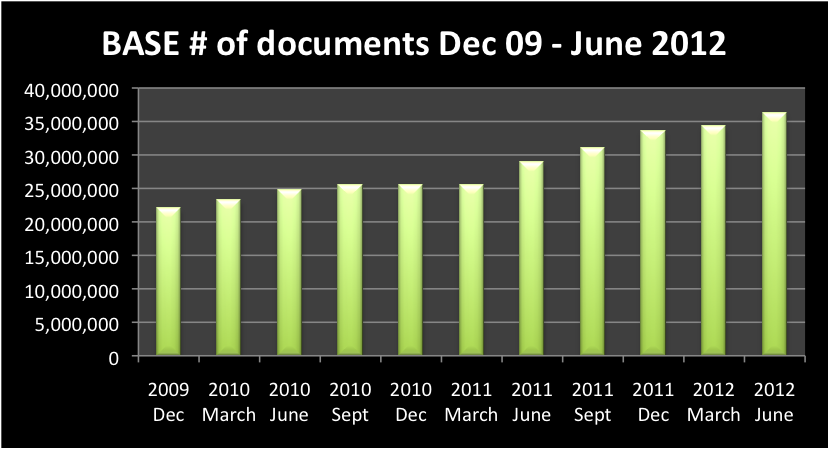
The Bielefeld Academic Search Engine (BASE), operated by Bielefeld University Library, is described as "one of the world's most voluminous search engines especially for academic open access web resources". BASE's total document count is what I use as the best available surrogate for the number of open access resources currently available. This is far from an exact count (not all the resources in the archives harvested by BASE are open access, there is no deduplication, and the types of documents is difficult to discover). However, the sheer volume of BASE is a clear indication of dramatic growth of open access archives - with over 36 million documents in total, the real number would be impressive even if it were only a small portion of the total. This quarter, the just over 2,000 repositories harvested by BASE collectively added close to 2 million documents.
arXiv contains over 750,000 documents; RePEC, over 1 million, and the Social Sciences Research Network about 350,000 documents. These 4 repository services taken together add to over 5.5 million documents - and this is just 4 of the over 2,000 open access repositories available around the world.
The Directory of Open Access Journals is getting close to 8 thousand titles, and adding titles at a rate of over 3 per day. The newly launched Directory of Open Access Books already lists more than a thousand titles from 27 contributing publishers. The Electronic Journals Library, which collects free titles of interest to academics whether peer reviewed or not, and including titles that are not fully OA but provide free access to back issues, lists over 35,000 journals, and continues to add titles at an average rate of 15 per day.
The Internet Archive provides access to 670,000 movies, 100,000 concerts, 1.3 million audio recordings, and 3.5 million texts.
No wonder then that many people - and not just the usual suspects - are beginning to see that open access is inevitable! This issue of The Dramatic Growth of Open Access briefly explains the purpose of this series, highlights Shieber's collection of quotes on the inevitability of open access, discusses one of the less immediately visible indications of the growth of open access, the increasing citations of open access journals, and provides selected growth numbers. Full data for this series can be downloaded from SUMMIT.
The purpose of this series
It is important not to overstate the extent of open access today; the vast majority of scholarly peer-reviewed journal articles are still published in toll access journals. However, it is also important to notice and celebrate what has been accomplished to date, and that is the primary purpose of this series, The Dramatic Growth of Open Access.
Reasons why this recognition of accomplishments to date are important include:
- raising awareness of the resources already available for people to use
- increases usage and hence success of existing open access initiatives
- usage can raise awareness of the benefits of open access
- increase understanding that there is no need for any one region to consider a unilateral move to open access - it's happening everywhere
- countering misperceptions of lack of progress - for example, there is the occasional setback, but when a single journal reverts from open to toll access, let's keep in mind that the net growth for DOAJ that same day was about 3 titles
- celebrating success to date is good for morale!
The growing citation impact of open access journals
Thanks to Matt Cockerill for A striking example of a society journal improving its impact factor radically following a move to #openaccess

and to David Wardle for research illustrating that ecological papers in PLoS ONE have a greater impact than those published in the main ecological journals. Details:
ecological papers published in PLoS ONE, which accepts 69% of submissions, publishes work that on average has a greater impact than papers published in Oikos which accepts 15% of submissions,from:
and has a comparable impact to those in Ecology and Functional Ecology which respectively accept 20% and 15% of submissions. Ecological papers published in,PLoS ONE are on average cited less than those in Ecology Letters (with an 11% acceptance rate) but evenhere there is considerable overlap
Wardle, David A. On plummeting manuscript acceptance rates by the main ecological journals
and the progress of ecology. Ideas in Ecology and Evolution 5: 13–15, 2012
doi:10.4033/iee.2012.5.4.e "http://library.queensu.ca/ojs/index.php/IEE/article/view/4351/4346
Selected numbers
Directory of Open Access Journals
- 7,912 journals
- 305 added this quarter (3 per day)
- 1,098 academic peer-reviewed books
- 27 publishers
- 35,296 journals that can be read free of charge
- 1,312 added this quarter (15 per day)
For extensive detailed statistics on repositories see OpenDOAR and ROAR
- OpenDOAR 2,165 (decreased by 21 this quarter)
- Registry of Open Access Repositories (ROAR) 2,909 (increased by 175 this quarter)
For extensive statistics on items by repository including deposit rate see the Registry of Open Access Repositories
Global: Bielefeld Academic Search Engine
- 36 million documents
- 2 million documents added this quarter (22 thousand / day)
arXiv (physics)
- 766,772 documents
- 20,789 added this quarter (230 per day)
- 1 million downloadable documents
- 30 thousand added this quarter (333 per day)
- 350,000 fulltext documents
- 28,000 added this quarter (311 per day)
- 13,387 documents
- 460 added this quarter (5 per day)
- 330 policies listed
- 237 policies excluding thesis policies
- 10 institutional policies added this quarter
- Moving images (movies) 670,000 - 40,000 added this quarter (444 per day)
- Live music archive (concerts) 100,000 - 3,455 added this quarter (28 per day)
- Audio (recordings) 1.3 million - 128,000 added this quarter (1,400 per day)
- Texts 3.5 million - 150,000 added this quarter (1,600 per day)
- 1,347 journals actively participating in PMC (decrease of 13 this quarter)
- 1,092 journals deposit ALL articles in PMC (increase of 51 this quarter)
- 928 journals with immediate free access (increase of 49 this quarter)
- 792 journals with all articles open access (increase of 46 this quarter)
- 200,000 articles (74%) by NIH funded external researchers since 2008 Public Access Policy freely available
- 340,000 articles (58%) by NIH internal or external researchers freely available (no date limit)
- 150,000 articles (60%) within 3 years of publication
- 84,000 articles (50%) within 2 years of publication
- 16,000 articles (20%) within 1 year of publication
Subscribe to:
Posts (Atom)