I am debating starting a new series on IJPE: poking fun at CC-BUY (a reference to those who confuse the Creative Commons Attribution-Only license with open access.
Where to start? Perhaps
PLooS U.S.
Open to Ridicule
This is a fine example of a derivative, with appropriate attribution (the PLooS link takes you right back to the source, fulfilling my obligations under the Attribution element!). I think one might argue that this violates the moral rights of PLoS - but PLoS US is in the country where arguing moral rights under circumstances like this would be a very tricky moral battle.
Future issues of the series could include such exciting novelties as PLooS PAYWALL (because after all none of the CC license require that CC licensed works be made available for free to anyone. Or, maybe we can explore the odds that any true blue CC-BUY devotee has actually READ THE LICENSE - which doesn't say anything at all about open access.
This is one series I really hope I don't actually need to write.
Friday, September 21, 2012
Will open access article processing fee publishers do the right thing and join OA advocates in calling for friendly amendment to the RCUK policy?
This summer the Research Councils U.K. adopted a stronger open access policy, as explained by Peter Suber in the September 2012 SPARC Open Access Newsletter. While the strong support for open access, including funding for open access publishing, is welcome news, this policy includes some ill-thought-out provisions and open access advocates are calling for revisions before the policy is implemented; see Peter's article for some objections and recommendations.
In brief, the reason this is a bad policy is because it requires researchers to select a gold open access option when one is available, and provides block funding to UK universities to pay article processing fees. This gives publishers a strong incentive to backtrack on green self-archiving policies, adding to the delay or embargo period or removing this option altogether. By making this requirement and providing funding, this is in effect a "blank cheque" policy which is certain to raises the costs of scholarly publishing.
This is why: if you had a business and customers had to buy what you sold regardless of the cost, how might this impact your pricing policy? What if you're a corporation and legally bound to provide shareholders with the best profit returns that you can? This, from my perspective, is an example of a government just throwing money at a problem without thinking it through - very out of character for the current UK government. If they have cash to spare, for heaven's sakes why do they not use it to subsidize students rather than publishers?
Others have made similar points. The main reason for this post is to ask open access publishers involved in lobbying for this whether they are shooting themselves in the foot, and whether it might be in their own best interests in the long run to join open access advocates in calling for improvements to the RCUK policy before implementation.
Why? The primary reason is that this would be better for open access.
In case any OA publishers are finding it difficult to put the unprecedented public good that is open access at the top of their priority list, they should not that in the medium to long term, changes to this policy are in their own best interests, too.
The vast majority of funding for scholarly journals at present - percentages range from 68 - 90% (see my draft dissertation for details) comes from academic library budgets. The UK is a major sponsor of research, but even so only 6% of the world's scholarly research comes from the UK. If the UK goes ahead with this obviously unsustainable approach to supporting OA publishing, OA publishers should be aware that this is highly likely to result in a drop in support from academic libraries around the world. For example, price inflation to fit this exceptional UK market will likely result in a drop in support for article processing fees by libraries around the world - a relatively new trend that has the potential to grow, but is likely to be nipped in the bud if this policy is not fixed. Also, if funding is diverted from research budgets to open access article processing fees, OA publishers should expect well-deserved backlash from scholars and universities. I'll be on their side; my draft thesis is called Freedom for Scholarship in the Internet Age, not Give Money to OA Publishers. Cash from the RCUK for article processing fees might seem like a really good thing right now, but a portion of 6% of the revenue from the world's scholarly publishing is not a good reason to jeopardize transitioning the 68-90% from subscriptions to OA publishing.
To conclude: I recommend that open access publishers working with the article processing fee approach join the rest of the open access movement in calling for the RCUK to fix the flaws in their open access policy before implementation, to remove the blank cheque that forces scholars and universities to pay for OA. Perhaps, as a long-time open access advocacy leader, not-for-profit publisher and open access advocacy organization, Public Library of Science should take the lead in calling for this change. An open letter to this effect posted prominently on the PLoS website would be a welcome development.
In brief, the reason this is a bad policy is because it requires researchers to select a gold open access option when one is available, and provides block funding to UK universities to pay article processing fees. This gives publishers a strong incentive to backtrack on green self-archiving policies, adding to the delay or embargo period or removing this option altogether. By making this requirement and providing funding, this is in effect a "blank cheque" policy which is certain to raises the costs of scholarly publishing.
This is why: if you had a business and customers had to buy what you sold regardless of the cost, how might this impact your pricing policy? What if you're a corporation and legally bound to provide shareholders with the best profit returns that you can? This, from my perspective, is an example of a government just throwing money at a problem without thinking it through - very out of character for the current UK government. If they have cash to spare, for heaven's sakes why do they not use it to subsidize students rather than publishers?
Others have made similar points. The main reason for this post is to ask open access publishers involved in lobbying for this whether they are shooting themselves in the foot, and whether it might be in their own best interests in the long run to join open access advocates in calling for improvements to the RCUK policy before implementation.
Why? The primary reason is that this would be better for open access.
In case any OA publishers are finding it difficult to put the unprecedented public good that is open access at the top of their priority list, they should not that in the medium to long term, changes to this policy are in their own best interests, too.
The vast majority of funding for scholarly journals at present - percentages range from 68 - 90% (see my draft dissertation for details) comes from academic library budgets. The UK is a major sponsor of research, but even so only 6% of the world's scholarly research comes from the UK. If the UK goes ahead with this obviously unsustainable approach to supporting OA publishing, OA publishers should be aware that this is highly likely to result in a drop in support from academic libraries around the world. For example, price inflation to fit this exceptional UK market will likely result in a drop in support for article processing fees by libraries around the world - a relatively new trend that has the potential to grow, but is likely to be nipped in the bud if this policy is not fixed. Also, if funding is diverted from research budgets to open access article processing fees, OA publishers should expect well-deserved backlash from scholars and universities. I'll be on their side; my draft thesis is called Freedom for Scholarship in the Internet Age, not Give Money to OA Publishers. Cash from the RCUK for article processing fees might seem like a really good thing right now, but a portion of 6% of the revenue from the world's scholarly publishing is not a good reason to jeopardize transitioning the 68-90% from subscriptions to OA publishing.
To conclude: I recommend that open access publishers working with the article processing fee approach join the rest of the open access movement in calling for the RCUK to fix the flaws in their open access policy before implementation, to remove the blank cheque that forces scholars and universities to pay for OA. Perhaps, as a long-time open access advocacy leader, not-for-profit publisher and open access advocacy organization, Public Library of Science should take the lead in calling for this change. An open letter to this effect posted prominently on the PLoS website would be a welcome development.


Friday, August 17, 2012
CC-BY and - or versus? - open access
Many in the open access movement consider CC-BY, the Creative Commons Attribution license, to be the very embodiment of the spirit of the Budapest Open Access Initiative - giving away all rights to one's work, including commercial rights, for open access. My own take on this is that while CC-BY can provide a useful tool for those fully engaged in the open access spirit, the license is problematic for open access. This is important now that funding agencies in the U.K. are beginning to require CC-BY licenses when they fund open access article processing fees. That is to say, we are now looking at a situation where organizations that do not have any commitment to (or even liking for) open access, may be required to use this license.
Some questions that I think should be raised at this point:
The CC-BY legal code, as I read it, does not mention open access, nor is there any wording to suggest that the license can only be applied to works that are open access. Here is the URL for the legal code:
http://creativecommons.org/licenses/by/3.0/legalcode
Questions:
1. Am I missing something in the legal code, i.e. does it say somewhere that this license is only for open access works?
2. Is there any reason why a publisher could not use a CC-BY license on toll-access works? (Here I am talking about an original publisher, not a licensee).
3. Is there anything to stop a publisher that uses CC-BY from changing their license at a later point in time? (Assuming the license is the publisher's, not the author's).
4. Is there anything to stop a toll-access publisher from purchasing an open access publisher that uses CC-BY, and subsequently selling all the formerly open access journals under a toll-access model and dropping the open access versions? The license would not permit a third party to do this, but what I am asking about is if the original licensor sells to another publisher.
To sum up, my perspective is that CC-BY, while superficially appearing to be the embodiment of BOAI, is actually a problematic license with significant loopholes and serious thought should be given to this before it is recommended as a standard for open access.
For discussion on this topic, see one or more of the following lists: GOAL, the SPARC Open Access Forum, open-science, SCHOLCOMM, or cc-community.
See also: Graf, Klaus and Sanford Thatcher: Point Counter Point: is CC-BY the best open access license? in Journal of Librarianship and Scholarly Communication, May 2012.
Some questions that I think should be raised at this point:
The CC-BY legal code, as I read it, does not mention open access, nor is there any wording to suggest that the license can only be applied to works that are open access. Here is the URL for the legal code:
http://creativecommons.org/licenses/by/3.0/legalcode
Questions:
1. Am I missing something in the legal code, i.e. does it say somewhere that this license is only for open access works?
2. Is there any reason why a publisher could not use a CC-BY license on toll-access works? (Here I am talking about an original publisher, not a licensee).
3. Is there anything to stop a publisher that uses CC-BY from changing their license at a later point in time? (Assuming the license is the publisher's, not the author's).
4. Is there anything to stop a toll-access publisher from purchasing an open access publisher that uses CC-BY, and subsequently selling all the formerly open access journals under a toll-access model and dropping the open access versions? The license would not permit a third party to do this, but what I am asking about is if the original licensor sells to another publisher.
To sum up, my perspective is that CC-BY, while superficially appearing to be the embodiment of BOAI, is actually a problematic license with significant loopholes and serious thought should be given to this before it is recommended as a standard for open access.
For discussion on this topic, see one or more of the following lists: GOAL, the SPARC Open Access Forum, open-science, SCHOLCOMM, or cc-community.
See also: Graf, Klaus and Sanford Thatcher: Point Counter Point: is CC-BY the best open access license? in Journal of Librarianship and Scholarly Communication, May 2012.
Wednesday, August 15, 2012
CBC Radio Interview August 13, 2012.
This clip of my CBC Radio Early Edition Interview August 13, 2012 with Kathryn Gretsinger (about 10 minutes) is a reflection on the significance of the University of British Columbia Library / Elsevier text-mining arrangement inspired by open data advocate Heather Piwowar. Thoughts on the potential for acceleration of discovery through text-mining from cancer research to humanities, the Elsevier boycott, the added work for libraries with open access.
Tuesday, August 14, 2012
Dear Creative Commons: please drop the gratuitous insult
Creative Commons has a new license chooser with an added feature: it tells us whether or not the license that we have selected is a "Free Culture License". For the record, I do not agree with whoever has decided what is or is not a free culture license. From my perspective, a truly free culture that uses the nifty Creative Commons tools that I like welcomes and respects people who wish to use licenses that include noncommercial and / or no derivatives terms. Also, a service that wishes to grow does not insult its friends in this manner. CC - please drop the insult.
Wiley moves toward broader open access
An important announcement from Wiley about their move to broader open access through use of the Creative Commons - Attribution (CC-BY) license for Wiley Open Access Journals. This is a strong indication that Wiley is joining a growing list of traditional commercial scholarly publishers to undertake serious competition for the growing open access environment for scholarly publishing - as is the title of Rachel Burley, Wiley's VP and Director, Open Access.
While I support the full range of CC licenses for open access, CC-BY is the simplest option for the profit-oriented commercial publisher wishing to be taken seriously about its commitment to open access publishing - important because this perception will help a publisher to be on the list of publishers / journals suitable for those funding open access article processing fees.
Next steps I would recommend to Wiley:
While I support the full range of CC licenses for open access, CC-BY is the simplest option for the profit-oriented commercial publisher wishing to be taken seriously about its commitment to open access publishing - important because this perception will help a publisher to be on the list of publishers / journals suitable for those funding open access article processing fees.
Next steps I would recommend to Wiley:
- a commitment to publishing journals in a format suitable for data and/or text-mining and that will facilitate re-use of portions of content (for example, a CC-BY license on a locked-down PDF removes legal barriers to re-use, but not technical barriers)
- a strengthened commitment to support for author self-archiving to allow authors more choice (not all authors have funding support for open access article processing fees)
- prepare to compete for high quality publishing services at reasonable prices - consider a range of possible future competitors that includes PeerJ with prices starting at $99 for a lifetime of publishing
Tuesday, July 10, 2012
In the opinion of the Association of Learned and Professional Society Publishers
It is the opinion of the Association of Learned and Professional Society Publishers (ALPSP), that open access mandates with short embargoes will lead to journal cancellations and threaten the survive of scholarly journals. Audrey McCullough, Chief Executive of ALPSPs, admits that a recently released "report" by ALPSP purporting to claim evidence for this, is actually an opinion piece, as recorded in this interview by Richard Poynder. I am happy to have been able to help out a bit with research methods and history in this area; this piece is a fine example of the potential for academic / journalist collaboration. Whether this is fact or opinion is important, with open access policies under discussion. For example, the Research Councils in the UK is currently working on strengthening their OA policies.
Monday, July 09, 2012
Oxygen is not a free lunch (environmentalism for the free market believer)
The right wing think tank The Heartland Institute - one of the main funders of climate change denial - claims that we should look to free market solutions to environmental challenges. While I strongly disagree with their philosophy and this approach, free market belief systems are common in our society so it may be useful to develop arguments that this constituency can understand. Here is one such argument.
Those who are so indoctrinated in neoliberalism that they cannot see our world, the air we breathe, as the great gift (the free lunch) that it is, might benefit from considering the oxygen in the air we breathe from a labor perspective. This is not human labor, but rather the natural labor of plants and particularly trees.
The deforestation occurring around the world can be seen as a labor dispute - the trees are being locked out, deprived of the means of production, the soil and water that they need.
This is one labor dispute that the capitalist cannot win. While it may seem as though those who order the chainsaws or set the policies have all the power against these immobile, defenseless beings, ultimately it is these gentle creatures who have the ultimate power, collectively creating the air without which none of us (no matter how rich) cannot survive fOr more than a few minutes. Negotiation is crucial, and urgent, for both sides.
The image of the 99% is powerful, true, and important for social justice, but let's keep in mind that when it comes to te environment, we are the 100%. If we continue to destroy the environment, some of us will suffer more than others, but we will all suffer. If we wage war against the environment, we all lose.
Monday, July 02, 2012
June 30, 2012 Dramatic Growth of Open Access

The Bielefeld Academic Search Engine (BASE), operated by Bielefeld University Library, is described as "one of the world's most voluminous search engines especially for academic open access web resources". BASE's total document count is what I use as the best available surrogate for the number of open access resources currently available. This is far from an exact count (not all the resources in the archives harvested by BASE are open access, there is no deduplication, and the types of documents is difficult to discover). However, the sheer volume of BASE is a clear indication of dramatic growth of open access archives - with over 36 million documents in total, the real number would be impressive even if it were only a small portion of the total. This quarter, the just over 2,000 repositories harvested by BASE collectively added close to 2 million documents.
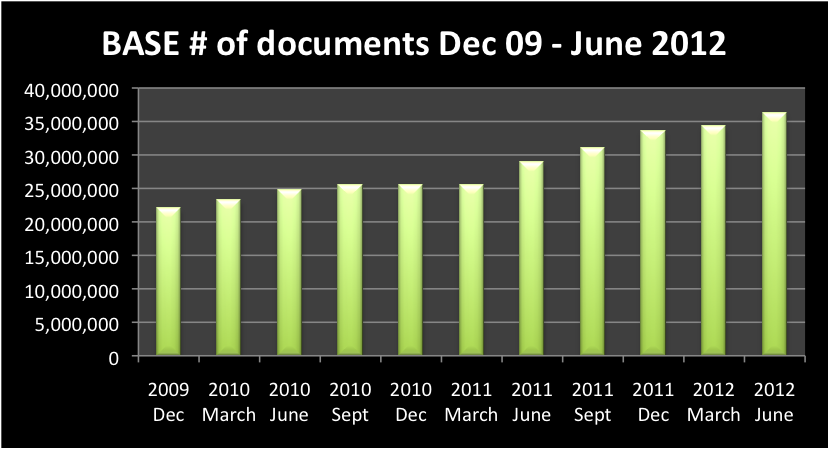
arXiv contains over 750,000 documents; RePEC, over 1 million, and the Social Sciences Research Network about 350,000 documents. These 4 repository services taken together add to over 5.5 million documents - and this is just 4 of the over 2,000 open access repositories available around the world.
The Directory of Open Access Journals is getting close to 8 thousand titles, and adding titles at a rate of over 3 per day. The newly launched Directory of Open Access Books already lists more than a thousand titles from 27 contributing publishers. The Electronic Journals Library, which collects free titles of interest to academics whether peer reviewed or not, and including titles that are not fully OA but provide free access to back issues, lists over 35,000 journals, and continues to add titles at an average rate of 15 per day.
The Internet Archive provides access to 670,000 movies, 100,000 concerts, 1.3 million audio recordings, and 3.5 million texts.
No wonder then that many people - and not just the usual suspects - are beginning to see that open access is inevitable! This issue of The Dramatic Growth of Open Access briefly explains the purpose of this series, highlights Shieber's collection of quotes on the inevitability of open access, discusses one of the less immediately visible indications of the growth of open access, the increasing citations of open access journals, and provides selected growth numbers. Full data for this series can be downloaded from SUMMIT.
The purpose of this series
It is important not to overstate the extent of open access today; the vast majority of scholarly peer-reviewed journal articles are still published in toll access journals. However, it is also important to notice and celebrate what has been accomplished to date, and that is the primary purpose of this series, The Dramatic Growth of Open Access.
Reasons why this recognition of accomplishments to date are important include:
- raising awareness of the resources already available for people to use
- increases usage and hence success of existing open access initiatives
- usage can raise awareness of the benefits of open access
- increase understanding that there is no need for any one region to consider a unilateral move to open access - it's happening everywhere
- countering misperceptions of lack of progress - for example, there is the occasional setback, but when a single journal reverts from open to toll access, let's keep in mind that the net growth for DOAJ that same day was about 3 titles
- celebrating success to date is good for morale!
The growing citation impact of open access journals
Thanks to Matt Cockerill for A striking example of a society journal improving its impact factor radically following a move to #openaccess

and to David Wardle for research illustrating that ecological papers in PLoS ONE have a greater impact than those published in the main ecological journals. Details:
ecological papers published in PLoS ONE, which accepts 69% of submissions, publishes work that on average has a greater impact than papers published in Oikos which accepts 15% of submissions,from:
and has a comparable impact to those in Ecology and Functional Ecology which respectively accept 20% and 15% of submissions. Ecological papers published in,PLoS ONE are on average cited less than those in Ecology Letters (with an 11% acceptance rate) but evenhere there is considerable overlap
Wardle, David A. On plummeting manuscript acceptance rates by the main ecological journals
and the progress of ecology. Ideas in Ecology and Evolution 5: 13–15, 2012
doi:10.4033/iee.2012.5.4.e "http://library.queensu.ca/ojs/index.php/IEE/article/view/4351/4346
Selected numbers
Directory of Open Access Journals
- 7,912 journals
- 305 added this quarter (3 per day)
- 1,098 academic peer-reviewed books
- 27 publishers
- 35,296 journals that can be read free of charge
- 1,312 added this quarter (15 per day)
For extensive detailed statistics on repositories see OpenDOAR and ROAR
- OpenDOAR 2,165 (decreased by 21 this quarter)
- Registry of Open Access Repositories (ROAR) 2,909 (increased by 175 this quarter)
For extensive statistics on items by repository including deposit rate see the Registry of Open Access Repositories
Global: Bielefeld Academic Search Engine
- 36 million documents
- 2 million documents added this quarter (22 thousand / day)
arXiv (physics)
- 766,772 documents
- 20,789 added this quarter (230 per day)
- 1 million downloadable documents
- 30 thousand added this quarter (333 per day)
- 350,000 fulltext documents
- 28,000 added this quarter (311 per day)
- 13,387 documents
- 460 added this quarter (5 per day)
- 330 policies listed
- 237 policies excluding thesis policies
- 10 institutional policies added this quarter
- Moving images (movies) 670,000 - 40,000 added this quarter (444 per day)
- Live music archive (concerts) 100,000 - 3,455 added this quarter (28 per day)
- Audio (recordings) 1.3 million - 128,000 added this quarter (1,400 per day)
- Texts 3.5 million - 150,000 added this quarter (1,600 per day)
- 1,347 journals actively participating in PMC (decrease of 13 this quarter)
- 1,092 journals deposit ALL articles in PMC (increase of 51 this quarter)
- 928 journals with immediate free access (increase of 49 this quarter)
- 792 journals with all articles open access (increase of 46 this quarter)
- 200,000 articles (74%) by NIH funded external researchers since 2008 Public Access Policy freely available
- 340,000 articles (58%) by NIH internal or external researchers freely available (no date limit)
- 150,000 articles (60%) within 3 years of publication
- 84,000 articles (50%) within 2 years of publication
- 16,000 articles (20%) within 1 year of publication
Tuesday, June 05, 2012
Publishers' Association survey on subscriptions: methodological critique
Correction June 6: the 2006 ALPSP report Survey of Librarians on Factors in Journal Cancellation is on the ALPSP website, here: http://www.alpsp.org/Ebusiness/ProductCatalog/Product.aspx?ID=26 Only the press release and the Summary and Conclusions are available to non-members.
The Association of Learned, Professional and Society Publishers (ALPSP) and the Publishers' Association just released the results of a survey asking if libraries would continue subscriptions if a majority of the content of research journals was freely available. The results of this study (downloadable from here) appear alarming - predicting catastrophic losses of subscriptions and subsequently journals and publishers! This post is a methodological critique. In summary, the recommendation of this study (against an OA mandate with a 6-month embargo) is not supported by the research presented - and most importantly, by the research omitted, which is in brief all of the considerable evidence that would counter this recommendation, including a 2006 study by ALPSP itself which is not cited and has apparently disappeared from the ALPSP website.
The recommendation from this study is:
The recommendation from this study is:
It is strongly recommended that no mandate is issued on making all or most journal articles available free of charge after a six month embargo until both libraries and publishers have had time to understand the issues better and have together taken steps to explore alternatives to a fully open access publishing model which could be mutually attractive.Here is the simply question asked by this ALPSP study:
If the (majority of) content of research journals was freely available within 6 months of publication, would you continue to subscribe? Please give a separate answer for a) Scientific, Technical and Medical journals and b) Humanities, Arts and Social Sciences Journals if your library has holdings in both of these categories.Methodological critique:
- The response rate to this study was 26%. With any survey, there is always the possibility of response bias. In the case of a study like this conducted in an environment of contested advocacy for public access policy, the chances of response bias to a survey conducted of librarians by publishers' groups is likely to be above normal.
- A 2006 ALPSP survey which found that cancellations by librarians would likely be minimal even with IMMEDIATE free access would be minimal appears to be absent from the ALPSP website. Thanks to Mel DeSart for posting conclusions to this study on the SCHOLCOMM list. For example, even if 79% of content were freely available immediately on publication, only 10% of libraries surveyed indicated that they would consider cancelling the journals. That this study, conducted by the same association, which found very different results, was not cited and does not appear on the ALPSP website, strongly supports the idea that the study was biased - only the results supporting ALPSP's preferred conclusion are presented.
- The recommendation of this study implies that the only possible source of revenue for scholarly journals is subscriptions. Even for traditional journals, this has never been the only source of revenue. For many a society publisher, for example, a key source of revenue has been association memberships rather than subscriptions, and many societies and associations have traditionally subsidized their journals (while in other cases the journals subsidize the association). Advertising is another source of revenue. In many countries (such as Canada), scholarly journal publishing is not seen as a profit-making venture, and so enjoys government subsidies. Article processing fees to provide for open access is a growing potential revenue source. A growing number of libraries provide funds to cover article processing fees for open access. Why did the study not ask libraries if they have such a fund, or would consider developing one if there was a mandate for open access within 6 months? Why not mention that there are now more than 7,000 fully open access journals - including profitable commercial journals, and hundreds of society journals as noted by Suber & Sutton?
- A key recommendation of this study is that "no mandate is issued on making all or most journal articles available free of charge after a six month embargo until both libraries and publishers have had time to understand the issues better and have together taken steps to explore alternatives to a fully open access publishing model which could be mutually attractive". This is puzzling. If the researchers think that libraries and publishers should work together (I agree), then why was was this a publisher-only study? Wouldn't a combined library / publisher / scholar study - like the PEER project - be a better approach? Further, this recommendation implies that the idea of libraries and publishers working together to make open access happen is a new one. As I've explained in a bit of detail in my previous post Society publishers: time to quit whining and make the leap to open access, these discussions have been going on for more than decade. Why not cite some of these discussions and related research, such as survey conducted by myself and other researchers across Canada to figure out how to help journals make the leap to open access? This is just one example!
Friday, June 01, 2012
Society publishers: time to quit whining and make the leap to open access
The Association of Learned and Professional Society Publishers (ALPSP) just released a report called: The potential effect of making journals free after a six month embargo. Conclusions are that: "the impact on all publishers’ revenues would be considerable" and "It is strongly recommended that no mandate is issued on making all or most journal articles available free of charge after a six month embargo until both libraries and publishers have had time to understand the issues better and have together taken steps to explore alternatives to a fully open access publishing model which could be mutually attractive".
Comment - in brief
This post will focus on the second argument, that time is needed to explore alternatives to a fully open access publishing model. In brief, both libraries and publishers have been in discussions about the need to transition to an appropriate publishing system for the World Wide Web for at least a decade and a half - ALPSP itself was talking about this at least as early as 1997. Most of us have moved far beyond the discussions stage. Libraries are actively providing support for open access publishing, including hosting and support services for faculty and society publishing and funds for article processing fees. There are close to 8,000 fully open access journals listed in DOAJ - many in the humanities and social sciences - including commercial journals that are turning a healthy profit, illustrating that open access is a viable business model. There are a great many supports available for publishers wishing to move to open access, including David Solomon's Developing open access journals: a practical guide and the SPARC guide on income models for open access. If publishers have not yet made the switch to open access, this is a clear indication that discussions and support for change is not enough; public policy is needed.
Details
ALPSP itself has been discussing the need for change arising from the World Wide Web, through its journal Learned Publishing, since the journal first began in 1997. In April 1997, ALPSP published an article by R. Charkin called Scholarly communities on the World Wide Web
in which the author points out that "Whatever happens it is clear that the world of scholarly publishing is
going to change beyond recognition in the next decade – and most of that
change is for the better". In 2000 - a full two years before the Budapest Open Access Initiative - R.S. Berry published an article in Learned Publishing called Full and open access to scientific information: an academic's view.
In 1998, the Scholarly Publishing and Academic Resources Coalition was formed: from the website:
- SPARC is a coalition of libraries, initiated by the Association of Research Libraries (ARL), that seeks to partner with scholarly publishers willing to enter markets where prices are highest and competition is needed. Through its activities, SPARC intends to reduce the risks to publisher-partners of entering the marketplace and to provide faculty with prestigious and responsive alternatives to current publishing vehicles.
Libraries, through SPARC and through other initiatives, have worked hard over the past decade and a half to help publishers transition to an optimal, sustainable approach to scholarly communication, with a primary focus on open access for approximately the last decade.
The majority of academic libraries in North America are now providing services for faculty and society publishing, as noted by Karla Hahn in 2008 and myself and my colleagues in 2010. There are now close to 8,000 fully open access journals listed in the Directory of Open Access Journals. Many libraries now have funds available to pay article processing fees for open access journals.
References
Scholarly communities on the World Wide Web
http://alpsp.publisher.ingentaconnect.com/content/alpsp/lp/1997/00000010/00000002/art00003Abstract:
Communities’ has become a buzzword in the strategy departments of publishing companies. It is clear – and becoming clearer – that the Internet is not merely a potential information delivery route but a vehicle for bringing together communities. One of the problems, however, is that much of the scholarly activity on the Web is driven by people with a traditional information delivery role – writers, publishers, booksellers and subscription agents and librarians. Nobody questions the importance of these roles but community creation is different and requires skills which are frequently closer to caterers or advertising agencies or hoteliers. Time will tell how communities will develop. Whatever happens it is clear that the world of scholarly publishing is going to change beyond recognition in the next decade – and most of that change is for the better.
http://alpsp.publisher.ingentaconnect.com/content/alpsp/lp/2000/00000013/00000001/art00005
Full and open access' to scientific information: an academic's view
Author: Berry R.S.
Source: Learned Publishing, Volume 13, Number 1, 1 January 2000 , pp. 37-42(6)
Abstract:
Stimulated by the potential of electronic distribution of information, discussions, sometimes rather tense, about the ownership and proprietary rights to scientific publications have generated something of a polarization of the communities that have stakes in this issue. There are some 'middle-grounders', but the intensity of the discourse has made them less visible than the spokesmen for the extremes. In this forum, we examine these positions and then present a case for a specific policy, in light of the views of the parties.
Source: Learned Publishing, Volume 13, Number 1, 1 January 2000 , pp. 37-42(6)
Abstract:
Stimulated by the potential of electronic distribution of information, discussions, sometimes rather tense, about the ownership and proprietary rights to scientific publications have generated something of a polarization of the communities that have stakes in this issue. There are some 'middle-grounders', but the intensity of the discourse has made them less visible than the spokesmen for the extremes. In this forum, we examine these positions and then present a case for a specific policy, in light of the views of the parties.
Thursday, May 31, 2012
Are strict CC-BY publishers shooting themselves in the foot?
This post asks whether open access publishers that practice strict adherence to the Creative Commons-Attribution license (CC-BY) are actually shooting themselves in the foot, that is, leaving plenty of room for competitors who will be able to use their works with no requirement to reciprocate. Note that it is not the competitors who are binding CC-BY publishers - they are voluntarily doing this to themselves! CC-BY publishers can easily avoid this situation, simply by adopting a flexible approach to licensing.
How can this be?
Let's compare CC-BY with what I would consider to be an enlightened approach to licensing for an open access publisher: the decision about licensing is left to the author, with the full range of creative commons license options made available, and provision made for sub-licensing portions of a work. An author can choose to publish a work with the CC option that I would consider optimal for ensuring open access not only for now, but into the future: CC-Attribution-Noncommercial-Sharealike (CC-BY-NC-SA). The author using this license can use CC-BY material, and even material with a different restrictive CC license, such as CC-BY-NoDerivatives (CC-BY-ND), as long as the material with the different license is marked with the appropriate CC license.
This flexible approach, leaving the choice with the author, supports one of the main philosophical arguments for open access: author's rights. With respect to choice of license, author's rights means that the author gets to choose, not the publisher. A publisher that forces a CC-BY choice is no more in support of authors' rights than a publisher that requires full transfer of copyright. Engaging authors in thinking about these choices is, from my perspective, an essential step towards articulating the commons - a discussion that we as an emerging global society need to have amongst ourselves.
A journal or book publisher using the flexible approach I recommend is free to publish material that a strict CC-BY publisher would not be able to publish - including the works that are published CC-BY.
To take another example: a publisher that uses CC-BY-NC as a default can publish whatever they like from the repertoire of a CC-BY publisher, but a strict CC-BY publisher will refuse to touch any work that is licensed CC-BY-NC. I predict that the more flexible approach will give new open access publishers (or traditional publishers transitioning to open access likely to consider more limited licenses) a competitive advantage over the strict CC-BY approach.
There is nothing to stop a CC-BY publisher from adopting a more flexible approach, with CC-BY as the default license, but permitting authors to use a different license if they prefer, and allowing for differential licenses for elements included in a CC-BY piece.
As a bit of context: Some of the early commercial and open access publishers, such as BioMedCentral and Hindawi, as well as the not-for-profit Public Library of Science, seem pretty strict about use of the Creative Commons-Attribution (CC-BY) license. For some people, this is the legal expression of the most open definition of open access from the Budapest Open Access Initiative. Klaus Graf expresses this point eloquently in the Journal of Librarianship and Scholarly Communication, with Sandy Thatcher expressing the counterpoint, the good reasons for considering more limited licenses. My own perspective is that CC-BY, while superficially appearing to be the expression of the most open form of open access, actually contains loopholes which make CC-BY a weak license for strong open access. For details of this argument, see the second chapter of my draft thesis - search for open access and creative commons. This post adds to and expands this argument, by suggesting that CC-BY publishers may be putting themselves at a competitive disadvantage. If your library or institution is supporting CC-BY publishers' article processing fees - I hope that you are storing the articles in your IR for preservation purposes, just in case...
How can this be?
Let's compare CC-BY with what I would consider to be an enlightened approach to licensing for an open access publisher: the decision about licensing is left to the author, with the full range of creative commons license options made available, and provision made for sub-licensing portions of a work. An author can choose to publish a work with the CC option that I would consider optimal for ensuring open access not only for now, but into the future: CC-Attribution-Noncommercial-Sharealike (CC-BY-NC-SA). The author using this license can use CC-BY material, and even material with a different restrictive CC license, such as CC-BY-NoDerivatives (CC-BY-ND), as long as the material with the different license is marked with the appropriate CC license.
This flexible approach, leaving the choice with the author, supports one of the main philosophical arguments for open access: author's rights. With respect to choice of license, author's rights means that the author gets to choose, not the publisher. A publisher that forces a CC-BY choice is no more in support of authors' rights than a publisher that requires full transfer of copyright. Engaging authors in thinking about these choices is, from my perspective, an essential step towards articulating the commons - a discussion that we as an emerging global society need to have amongst ourselves.
A journal or book publisher using the flexible approach I recommend is free to publish material that a strict CC-BY publisher would not be able to publish - including the works that are published CC-BY.
To take another example: a publisher that uses CC-BY-NC as a default can publish whatever they like from the repertoire of a CC-BY publisher, but a strict CC-BY publisher will refuse to touch any work that is licensed CC-BY-NC. I predict that the more flexible approach will give new open access publishers (or traditional publishers transitioning to open access likely to consider more limited licenses) a competitive advantage over the strict CC-BY approach.
There is nothing to stop a CC-BY publisher from adopting a more flexible approach, with CC-BY as the default license, but permitting authors to use a different license if they prefer, and allowing for differential licenses for elements included in a CC-BY piece.
As a bit of context: Some of the early commercial and open access publishers, such as BioMedCentral and Hindawi, as well as the not-for-profit Public Library of Science, seem pretty strict about use of the Creative Commons-Attribution (CC-BY) license. For some people, this is the legal expression of the most open definition of open access from the Budapest Open Access Initiative. Klaus Graf expresses this point eloquently in the Journal of Librarianship and Scholarly Communication, with Sandy Thatcher expressing the counterpoint, the good reasons for considering more limited licenses. My own perspective is that CC-BY, while superficially appearing to be the expression of the most open form of open access, actually contains loopholes which make CC-BY a weak license for strong open access. For details of this argument, see the second chapter of my draft thesis - search for open access and creative commons. This post adds to and expands this argument, by suggesting that CC-BY publishers may be putting themselves at a competitive disadvantage. If your library or institution is supporting CC-BY publishers' article processing fees - I hope that you are storing the articles in your IR for preservation purposes, just in case...
Friday, May 25, 2012
Open Access and Copyright Issues Related to Knowledge Translation and Transfer for the OMAFRA-UofG Partnership
This post notes some reflections from a recent meeting of the Community of Practice of the Ontario Ministry of Agriculture, Food and Rural Affairs (OMAFRA) / University of Guelph's Knowledge Translation and Transfer (KTT) group. My role in this group is that of open access consultant. The OMAFRA / KTT group is doing some very interesting work in the area of developing intellectual property practices to support innovation, including both open access and patenting. Researchers include academics and also grower groups.
One of the projects involves growing the Ontario vegetable crop research repository in the University of Guelph's ATRIUM repository. The University of Guelph's Ridgetown Campus produces a lot of agricultural research, some of which has world level impact, particularly in the area of pesticide management for control of fusarium in corn which is published in the scientific literature. Many other research findings, however, remain in unpublished research reports stuck in filing cabinets. If these reports were digitized and made available through ATRIUM, the research would be useful to many people - including Ministry staff for developing policy and local farmers and gardeners wondering whether to use black plastic on their strawberries.
One of the challenges to developing the repository is dealing with rights issues. Much of this research is owned by growers' groups, who conducted the research for their own community. As agricultural entrepreneurs, the growers will want to retain an edge for competition and so are likely to want to retain commercial rights. Similarly, faculty members at Guelph own their own IP and may want to retain the rights for commercialization when applicable. Strategies to address these issues could include such tactics as defensive publishing.
My thoughts so far as shared in the meeting:
Engaging the growers' groups in open access is a strategy that I would highly recommend in this situation. Don't just ask for the license to their works, rather do some workshops or provide information to link people to some of the many open access resources that are already available to them. A message of people everywhere are sharing their work; won't you join us? strikes me as a message that is a little bit easier to listen to than won't you share your work? Include open access peer-reviewed journals on agriculture, of course - but don't neglect to mention some of the high-quality magazines written largely by people similar to the growers' groups, such as BC Grasslands. Focus on agriculture for sure, but not necessarily just agriculture - farmers and their families are people too, and are as likely as anyone to benefit from all the freely available health information or enjoy the many free texts, movies, and music available from the Internet Archive. Flickr can be a good resource for developing marketing materials, and open government resources can be useful, too.
One challenge for farmers in this area is that many still rely on dial-up access. This suggests to me another avenue for illustrating the benefits of open approaches. It can be difficult for people in rural communities to get the rest of us to pay attention to their issues (such as lack of broadband) and hence to gain political support. This is one area where the internet creates the possibility for a more level playing field; a rural newspaper can create an online presence with the same potential audience as an urban newspaper, and rural individuals, families and community groups can similarly create an online presence with the same potential impact as urban people.
Some potential venues for information sharing include practioners' peer-reviewed journals using tools such as Open Journal Systems - although the growers' groups might be more interested in using social networking tools like ning.
Our Community of Practice is just getting started! Watch for further posts on this topic.
One of the projects involves growing the Ontario vegetable crop research repository in the University of Guelph's ATRIUM repository. The University of Guelph's Ridgetown Campus produces a lot of agricultural research, some of which has world level impact, particularly in the area of pesticide management for control of fusarium in corn which is published in the scientific literature. Many other research findings, however, remain in unpublished research reports stuck in filing cabinets. If these reports were digitized and made available through ATRIUM, the research would be useful to many people - including Ministry staff for developing policy and local farmers and gardeners wondering whether to use black plastic on their strawberries.
One of the challenges to developing the repository is dealing with rights issues. Much of this research is owned by growers' groups, who conducted the research for their own community. As agricultural entrepreneurs, the growers will want to retain an edge for competition and so are likely to want to retain commercial rights. Similarly, faculty members at Guelph own their own IP and may want to retain the rights for commercialization when applicable. Strategies to address these issues could include such tactics as defensive publishing.
My thoughts so far as shared in the meeting:
Engaging the growers' groups in open access is a strategy that I would highly recommend in this situation. Don't just ask for the license to their works, rather do some workshops or provide information to link people to some of the many open access resources that are already available to them. A message of people everywhere are sharing their work; won't you join us? strikes me as a message that is a little bit easier to listen to than won't you share your work? Include open access peer-reviewed journals on agriculture, of course - but don't neglect to mention some of the high-quality magazines written largely by people similar to the growers' groups, such as BC Grasslands. Focus on agriculture for sure, but not necessarily just agriculture - farmers and their families are people too, and are as likely as anyone to benefit from all the freely available health information or enjoy the many free texts, movies, and music available from the Internet Archive. Flickr can be a good resource for developing marketing materials, and open government resources can be useful, too.
One challenge for farmers in this area is that many still rely on dial-up access. This suggests to me another avenue for illustrating the benefits of open approaches. It can be difficult for people in rural communities to get the rest of us to pay attention to their issues (such as lack of broadband) and hence to gain political support. This is one area where the internet creates the possibility for a more level playing field; a rural newspaper can create an online presence with the same potential audience as an urban newspaper, and rural individuals, families and community groups can similarly create an online presence with the same potential impact as urban people.
Some potential venues for information sharing include practioners' peer-reviewed journals using tools such as Open Journal Systems - although the growers' groups might be more interested in using social networking tools like ning.
Our Community of Practice is just getting started! Watch for further posts on this topic.
Monday, May 07, 2012
Black Out Speak Out June 4th
Canadians: it is time to take a stand and speak out for nature and democracy. Please join this event coordinated by a number of environmental groups - and spread the word! http://www.blackoutspeakout.ca/
Wednesday, May 02, 2012
Journal price increases: the costlier the journal the more important smaller percentage increase
To state the obvious: the more expensive a journal is, the more an increase costs in dollars given the same percentage. A journal price increase for a costly journal can look small from a percentage perspective, but actually be quite large from a dollars perspective.
To illustrate, consider this hypothetical (but realistic) scenario):
Small society journal (SSJ) has been charging a subscription fee of $100. Unlike the large commercial scholarly publishers, this society has not raised prices every year. This fee has not covered costs for several years, and so the society has decided to increase the subscription rate for this year to $150.
Original cost: $100
New price: $150
Increase in %: 50%
Increase in $: $50
Commercial publisher journal (CPJ) has been charging a subscription fee of $10,000. One of the reasons for this high fee is that prices have been raised every year for the last few decades at rates above inflation. This year, CPJ is raising their prices again by 5%, to $10,500.
Original cost: $10,000
New price: $10,500
Increase in %: 5%
Increase in $: $500
Discussion: a 5% increase for a costly journal can easily cost ten times more, in dollar terms, than a 50% increase for an inexpensive journal.
Note that this analysis does not necessarily fit other formats such as scholarly monographs, where the diversion of funding from monographs to journals has distorted the market (less money for monographs means fewer copies bought and printed, raising prices on a per-copy basis).
Conclusion: when considering journal prices increases, dollar amounts are more important than percentages. Also, the more expensive the journal, the more important it is to negotiate lower or no price increases.
Sent to Liblicense-l May 2, 2012.
To illustrate, consider this hypothetical (but realistic) scenario):
Small society journal (SSJ) has been charging a subscription fee of $100. Unlike the large commercial scholarly publishers, this society has not raised prices every year. This fee has not covered costs for several years, and so the society has decided to increase the subscription rate for this year to $150.
Original cost: $100
New price: $150
Increase in %: 50%
Increase in $: $50
Commercial publisher journal (CPJ) has been charging a subscription fee of $10,000. One of the reasons for this high fee is that prices have been raised every year for the last few decades at rates above inflation. This year, CPJ is raising their prices again by 5%, to $10,500.
Original cost: $10,000
New price: $10,500
Increase in %: 5%
Increase in $: $500
Discussion: a 5% increase for a costly journal can easily cost ten times more, in dollar terms, than a 50% increase for an inexpensive journal.
Note that this analysis does not necessarily fit other formats such as scholarly monographs, where the diversion of funding from monographs to journals has distorted the market (less money for monographs means fewer copies bought and printed, raising prices on a per-copy basis).
Conclusion: when considering journal prices increases, dollar amounts are more important than percentages. Also, the more expensive the journal, the more important it is to negotiate lower or no price increases.
Sent to Liblicense-l May 2, 2012.
About 30% of peer-reviewed scholarly journals are now open access
Ass Professor Laura Czerniewicz of the University of Cape Town recently asked about the percentage of scholarly peer-reviewed journals that are now open access. In brief, my response is "about 30%" (apparently Heather Joseph from SPARC gave almost exactly the same response). This figure needs to be taken with a huge grain of salt, though. My full response illustrates why:
Any such figure would be a very rough ballpark, because we don't have a count of how many peer-reviewed journals there are in the world. We tend to use Ulrich's as a surrogate, however this list reflects a strong English-language / western bias, e.g. Ulrich's would only include a very
tiny fraction of the academic journals from China.
Something else to keep in mind is that is has become more difficult to assess the number of peer-reviewed journals in Ulrich's, because the default search does not deduplicate for multiple formats (i.e. a quick search for academic / peer-reviewed / scholarly journals will yield two titles when a journal is produced in both print and electronic form).
My latest count of active, peer-reviewed scholarly journals from Ulrich's using deduplication from Dec. 1, 2011 is 26,746. My method and calculations are shown here, in this appendix of my draft thesis:
http://pages.cmns.sfu.ca/heather-morrison/appendix-c-how-many-active-scholarly-peer-reviewed-journals/
If we take the DOAJ current figure of 7,665 journals as the number of OA journals, this gives a rough guesstimate of 28% of scholarly peer-reviewed journals that are fully open access. I would like to
emphasize that these numbers need to be taken with a grain of salt - my Ulrich's deduplication exercise is a quick and dirty one, and not all OA journals are necessarily in DOAJ (e.g. there is generally a delay in adding titles due to the vetting process).
Any such figure would be a very rough ballpark, because we don't have a count of how many peer-reviewed journals there are in the world. We tend to use Ulrich's as a surrogate, however this list reflects a strong English-language / western bias, e.g. Ulrich's would only include a very
tiny fraction of the academic journals from China.
Something else to keep in mind is that is has become more difficult to assess the number of peer-reviewed journals in Ulrich's, because the default search does not deduplicate for multiple formats (i.e. a quick search for academic / peer-reviewed / scholarly journals will yield two titles when a journal is produced in both print and electronic form).
My latest count of active, peer-reviewed scholarly journals from Ulrich's using deduplication from Dec. 1, 2011 is 26,746. My method and calculations are shown here, in this appendix of my draft thesis:
http://pages.cmns.sfu.ca/heather-morrison/appendix-c-how-many-active-scholarly-peer-reviewed-journals/
If we take the DOAJ current figure of 7,665 journals as the number of OA journals, this gives a rough guesstimate of 28% of scholarly peer-reviewed journals that are fully open access. I would like to
emphasize that these numbers need to be taken with a grain of salt - my Ulrich's deduplication exercise is a quick and dirty one, and not all OA journals are necessarily in DOAJ (e.g. there is generally a delay in adding titles due to the vetting process).
Thursday, April 19, 2012
Unlock our knowledge about alternative energy and renewable technologies - now!
It is scandalous that much of our collective knowledge about alternative energy and renewable technologies is kept locked behind an Elsevier paywall! This is one area where clearly everyone anywhere on the planet with the inclination to read about the possibilities and push for solutions, whether through developing more basic knowledge or transferring knowledge to the business sector, should have immediate, barrier-free access. This is one area where the need is too great to permit for ANY embargo period.
Science works in step-wise fashion, like a detective mystery. One scientist discovers a clue; another builds on the discovery, until we have a new body of knowledge or real-world implementations, or both. If a useful discovery sequence takes six steps, with about 6 months of research for each step, then with no embargoes, the process takes 3 years. With a one-year embargo at each step, the whole sequence takes 9 years (3 years for research, 6 years for embargoes). Consider the impact of 6 more years of increasing greenhouse gases on climate change, and it is easy to see why the public good of rapid advancement in this area far outweighs an outmoded, print-based business model.
Here are the 29 journals Elsevier publishes in this area, from this page:
Science works in step-wise fashion, like a detective mystery. One scientist discovers a clue; another builds on the discovery, until we have a new body of knowledge or real-world implementations, or both. If a useful discovery sequence takes six steps, with about 6 months of research for each step, then with no embargoes, the process takes 3 years. With a one-year embargo at each step, the whole sequence takes 9 years (3 years for research, 6 years for embargoes). Consider the impact of 6 more years of increasing greenhouse gases on climate change, and it is easy to see why the public good of rapid advancement in this area far outweighs an outmoded, print-based business model.
Here are the 29 journals Elsevier publishes in this area, from this page:

Total impact: a critical perspective
Total impact is a set of alternative metrics for scholarship. Total impact looks at a number of factors, including social networking tools such as Facebook and Twitter. As a research tool, Total Impact has a lot of potential, to explore how works are used and what impact they have. As an alternative metric to evaluate the quality of scholarship - an alternative to impact factor - there are a number of potential serious problems to consider.
First, there is the question of whether the current push towards quantitative metrics makes any sense at all. I have talked about the problems of this kind of instrumental rationality is my book chapter, The implications of usage statistics as an economic factor in scholarly communication https://circle.ubc.ca/handle/2429/954 (In brief, usage stats are likely to have significant negative impacts, from discouraging use to discouraging important but not necessarily popular entire fields of research); and the second chapter of my draft thesis http://pages.cmns.sfu.ca/heather-morrison/chapter-two-scholarly-communication-in-crisis/ (search for irrational rationalization).
One example, from an interview study of scholarly monograph publishers I did recently, is the impact of pushing scholars to publish more books to obtain tenure. This pressure is not consistent with the time it takes to write books that are really worth publishing and reading; so in this instance, we have a quantitative metric intended to improve quality and productivity (of our academic staff) which appears to be lowering quality (more mediocre books, more book production when the problem for all of us is not enough reading material, but rather not enough time to read).
Research, both quantitative and qualitative, is my recommendation before putting too much stock in Total Impact or other alternative metrics as a replacement for Impact Factor in evaluating the quality of scholarship. Note that I do not recommend retaining Impact Factor, but rather minimizing or eliminating quantitative approaches to evaluating the quality of scholarship.
The use of social networking tools may be particularly problematic. One research area that I recommend is examining the effects of traditional biases. I would hypothesize that social networking tools would be likely to exhibit the following biases prevalent in modern society:
Another area to consider (for all kinds of tools, not just social networking tools), is the impact of funding considerations. If universities are relying more on corporate funders at a time in society such as today when the political will seems to be on the side of the wealthy who wish to cut spending on social justice, it is reasonable to hypothesize that there will be a smaller proportion of funding for social justice issues. What happens to research on poverty issues and its impact if there is less funding for research and academic positions in this area (hence fewer researchers), at the same time that there is less funding for government services and social workers (fewer potential readers and tweeters), and many of those poverty research is meant to help have lost their homes and jobs and may find it difficult to get internet access?
First, there is the question of whether the current push towards quantitative metrics makes any sense at all. I have talked about the problems of this kind of instrumental rationality is my book chapter, The implications of usage statistics as an economic factor in scholarly communication https://circle.ubc.ca/handle/2429/954 (In brief, usage stats are likely to have significant negative impacts, from discouraging use to discouraging important but not necessarily popular entire fields of research); and the second chapter of my draft thesis http://pages.cmns.sfu.ca/heather-morrison/chapter-two-scholarly-communication-in-crisis/ (search for irrational rationalization).
One example, from an interview study of scholarly monograph publishers I did recently, is the impact of pushing scholars to publish more books to obtain tenure. This pressure is not consistent with the time it takes to write books that are really worth publishing and reading; so in this instance, we have a quantitative metric intended to improve quality and productivity (of our academic staff) which appears to be lowering quality (more mediocre books, more book production when the problem for all of us is not enough reading material, but rather not enough time to read).
Research, both quantitative and qualitative, is my recommendation before putting too much stock in Total Impact or other alternative metrics as a replacement for Impact Factor in evaluating the quality of scholarship. Note that I do not recommend retaining Impact Factor, but rather minimizing or eliminating quantitative approaches to evaluating the quality of scholarship.
The use of social networking tools may be particularly problematic. One research area that I recommend is examining the effects of traditional biases. I would hypothesize that social networking tools would be likely to exhibit the following biases prevalent in modern society:
- men would show more impact than women
- minorities would have lower impact
- developing country authors would have lower impact
- introverts would have lower impact than extraverts
- authors adept at social networking tools would have more impact than authors less comfortable with these media
Another area to consider (for all kinds of tools, not just social networking tools), is the impact of funding considerations. If universities are relying more on corporate funders at a time in society such as today when the political will seems to be on the side of the wealthy who wish to cut spending on social justice, it is reasonable to hypothesize that there will be a smaller proportion of funding for social justice issues. What happens to research on poverty issues and its impact if there is less funding for research and academic positions in this area (hence fewer researchers), at the same time that there is less funding for government services and social workers (fewer potential readers and tweeters), and many of those poverty research is meant to help have lost their homes and jobs and may find it difficult to get internet access?
Accelerating small business in BC: celebrating the success of enterpreneur / philanthropist Irving K. Barber
This week British Columbia is mourning the passing of notable citizen and philanthropist Irving K. Barber. This post celebrates a small part of the achievements made possible by his generosity, the Small Business Accelerator program of the Irving K. Barber Learning Centre.
The Small Business Accelerator program is a highly innovative program and partnership of the University of British Columbia with BC's public and other libraries and the BC business community.
From the website:
Business success depends on obtaining access to reliable information. The Small Business Accelerator is curated by business librarians and is your gateway to freely available business information, education, and assistance that is both current and trustworthy.
It is my hope that this small token of appreciation will encourage others to consider this model of cooperation, which is also a great model to illustrate how libraries and the business community can work together cooperatively, making use of open access resources, to benefit business and local communities (by making business accelerator programs available throughout the province.
[Disclosure: the Irving K. Barber Learning Centre is a key partner of the BC Electronic Library Network where I serve as Coordinator].
The Small Business Accelerator program is a highly innovative program and partnership of the University of British Columbia with BC's public and other libraries and the BC business community.
From the website:
Business success depends on obtaining access to reliable information. The Small Business Accelerator is curated by business librarians and is your gateway to freely available business information, education, and assistance that is both current and trustworthy.
It is my hope that this small token of appreciation will encourage others to consider this model of cooperation, which is also a great model to illustrate how libraries and the business community can work together cooperatively, making use of open access resources, to benefit business and local communities (by making business accelerator programs available throughout the province.
[Disclosure: the Irving K. Barber Learning Centre is a key partner of the BC Electronic Library Network where I serve as Coordinator].
Monday, April 02, 2012
The impact of funding agency open access policies (March 31, 2012 Dramatic Growth of Open Access)
This post highlights a few bits of data suggesting the impact of selected funding agencies' open access mandate policies. We're definitely making some progress! By my method of calculation, compliance with the NIH Public Access Policy stands at 73%. On the other hand, there is still room for improvement - for example, how is it possible that more than a quarter of NIH funded authors have yet to comply with a requirement of their research grants? SURF has just posted a report showing that open access provision rates in the Netherlands are stagnating.
 This chart suggests that the N.I.H. Public Access policy may be having a transformative effect beyond the works that authors actually are required to make publicly accessible. Since the N.I.H. policy came into effect, the number of journals voluntarily making all of their articles freely available immediately has nearly tripled, from 321 in March 2008 to 897 today. In the first quarter of 2012, the number of journals actively participating in PMC grew by 58; 56 more journals began making their articles freely available immediately; and 44 more journals made all articles open access.
 This chart shows the difference in availability of free full-text for PubMed articles within 6 months of publication, by funding support. There is no difference between N.I.H. Extramural researchers and all articles in PubMed; in both cases, 13% of items in PubMed lead to free full-text. CIHR funded researchers are only 1% better, in spite of the CIHR Policy on Access to Research Outputs requiring open access within 6 months of publication. Even N.I.H.'s own intramural researchers have a record of fast free access that is only slightly higher than the overall rate. Only the Wellcome Trust has a noticeably higher track record, with 39% of works connecting with free full text. Since CIHR and Wellcome Trust have policies with the same permitted embargo (6 months), the threefold difference in results likely comes from a source other than the policy per se, such as the assertive implementation of the policy Wellcome Trust is known for.
Noteworthy this quarter: the beginning of 2012 has definitely been dramatic, with the Research Works Act proposed in the U.S. and subsequently dropped, a remarkable turnaround. This came after Elsevier dropped its support for RWA, thanks to the still growing Elsevier boycott, with over 8,900 signatories. This pushback was likely inspired by the highly successful protests against SOPA and PIPA, particularly the January 18, 2012 Internet Blackout. Peter Suber wrote about RWA and the recently re-introduced Federal Research Public Access Act (FRPAA) in the March 2012 SPARC Open Access Newsletter. The Research Councils UK, an early leader in open access policy, is moving to the next level with a consultation underway on their draft new open access policy - my comments can be found here.
Growth this quarter (selected)
Open access journals
DOAJ: 7,607 journals. Up by 235 this quarter, a growth rate of 2.6 titles per day (a lower growth rate than the average for the past year of 4 titles per day).
Electronic Journals Library: 33,984 free journals, an increase of 1,600 this quarter (growth rate 18 titles per day).
DOAJ searchable articles increased by 62,831. Highwire added 17,226 free articles, about 17% of the total of 97,017 articles added by Highwire in total.
Open access archives
OpenDOAR added 22 repositories, for a total of 2,186.
The Registry of Open Access Repositories added 124 repositories, for a total of 2,734.
A Bielefeld Academic Search Engine (BASE) search encompassed close to 7 hundred thousand more documents, for a total of over 34 million documents.
arXiv added 20,000 documents for a total of 745,000.
RePEC has changed their statistics approach this quarter; to obtain numbers, I had to go to the LogEC site, download (messy) and calculate a total of 31,466 downloadable fulltext, for a total of over a million.
The Social Sciences Research Network (SSRN) added over 16,000 papers, for a total of close to 400,000 papers.
The number of Open Journal Systems installations hit 11,500 sometime last December.
The Internet Archive now makes freely available more than 600,000 moving images, 100,000 concerts, 1.2 million audio recordings, and 3.3 million texts.
This post is part of the Dramatic Growth of Open Access series.To download the data see google docs for the current full data version and the current show growth version. The Dramatic Growth of Open Access dataverse is the place to look for archived data versions.
Housekeeping: if anyone would like to use the charts from this post, I recommend getting in touch with me - for technical not permissions reasons.

Noteworthy this quarter: the beginning of 2012 has definitely been dramatic, with the Research Works Act proposed in the U.S. and subsequently dropped, a remarkable turnaround. This came after Elsevier dropped its support for RWA, thanks to the still growing Elsevier boycott, with over 8,900 signatories. This pushback was likely inspired by the highly successful protests against SOPA and PIPA, particularly the January 18, 2012 Internet Blackout. Peter Suber wrote about RWA and the recently re-introduced Federal Research Public Access Act (FRPAA) in the March 2012 SPARC Open Access Newsletter. The Research Councils UK, an early leader in open access policy, is moving to the next level with a consultation underway on their draft new open access policy - my comments can be found here.
Growth this quarter (selected)
Open access journals
DOAJ: 7,607 journals. Up by 235 this quarter, a growth rate of 2.6 titles per day (a lower growth rate than the average for the past year of 4 titles per day).
Electronic Journals Library: 33,984 free journals, an increase of 1,600 this quarter (growth rate 18 titles per day).
DOAJ searchable articles increased by 62,831. Highwire added 17,226 free articles, about 17% of the total of 97,017 articles added by Highwire in total.
Open access archives
OpenDOAR added 22 repositories, for a total of 2,186.
The Registry of Open Access Repositories added 124 repositories, for a total of 2,734.
A Bielefeld Academic Search Engine (BASE) search encompassed close to 7 hundred thousand more documents, for a total of over 34 million documents.
arXiv added 20,000 documents for a total of 745,000.
RePEC has changed their statistics approach this quarter; to obtain numbers, I had to go to the LogEC site, download (messy) and calculate a total of 31,466 downloadable fulltext, for a total of over a million.
The Social Sciences Research Network (SSRN) added over 16,000 papers, for a total of close to 400,000 papers.
The number of Open Journal Systems installations hit 11,500 sometime last December.
The Internet Archive now makes freely available more than 600,000 moving images, 100,000 concerts, 1.2 million audio recordings, and 3.3 million texts.
This post is part of the Dramatic Growth of Open Access series.To download the data see google docs for the current full data version and the current show growth version. The Dramatic Growth of Open Access dataverse is the place to look for archived data versions.
Housekeeping: if anyone would like to use the charts from this post, I recommend getting in touch with me - for technical not permissions reasons.
Subscribe to:
Posts (Atom)