There are arguments that the processing fee model approach to open access could introduce much needed competition into the scholarly publishing industry, and that this approach could simply result in a replacing a subscriptions crisis based on a price spiral with a processing fee price spiral. In my opinion, both arguments are correct. There are many variations of approaches to the processing fee model. Some introduce incentives to seek best services at best prices, and hence stimulate competition. One example is a funding agency providing a set amount or percentage fordissemination of research results, with discretion for the author to spend the full amount on publishing one article, or seeking a better price for publishing services,and using the remaining funds for other purposes. Other approaches, such as agreeing to a blanket fee for publication that is higher than the true costs of publishing an open access article, seem designed to reward inefficiencies and hencecreate the processing fee price spiral.
Following is a post to American Scientist Open Access Forum, Feb. 24, 2007 on this topic, which provides more detail. Thanks to Jan Velterop and Steve Hitchcock for their contributions on this topic.
To avoid confusion, let me first of all clarify that there are a number of business models for open access journals. The majority do not rely on processing fees at all.
For those that do, I agree with Jan Velterop that a gold processing-fee model has the potential to introduce competition into the marketplace. Steve Hitchcock is also correct, that a gold model could simply repeat the cost spiral.
The key factor is how a processing-fee model is approached. If a funding agency, university, or library decides to pay or partially pay processing fees, the gold processing-fee approach will only introduce competition into the system if there is incentive to seek out the publishing services with the most reasonable prices for the
services provided.
Let's look at a couple of different scenarios:
Funder A allows for a certain percentage of a research grant to be used for dissemination of research results, let's say $3,000. It is up to the researcher to decide whether to spend the $3,000 on processing fees for one article, or whether to publish in a quality journal with a lower fee, and use the rest of the funds for other dissemination-related purposes. For example, depending on the publisher's fee, this might leave enough left over to pay a graduate assistant to do most of the writing, or even cover or partially cover the costs of attending a conference to present a paper on the research outcome. With this scenario, I would predict competition in the scholarly publishing industry, and ultimately better quality
services at lower prices.
Funder B allows for a certain amount to pay for processing fees. Let's take $3,000 US as an example. For many publishers, this amount is higher than true costs of publishing an online open access article, and allows for double-dipping (revenue from both subscriptions and processing fee charges). With this scenario, I would predict increasing inefficiencies in the scholarly publishing industry, and the processing fee cost spiral that Steve Hitchcock warns of.
Similarly, if libraries choose to support processing fees, this may or may not be beneficial, depending on exactly how this is approached. Paying processing fees for fully gold OA journals with an established reputation for quality of service and reasonable prices would be extremely helpful in the transitional period. A sliding scale approach to paying for such fees (e.g. 100% up to $1,000, 75% up to $1,500, and so forth) would provide the incentives for faculty and departments to seek reasonable fees, and hence stimulate competition. Simply paying both processing fees and
subscription fees for hybrid journals creates incentives for inefficiencies. Hybrid processing fee / subscription approaches are an approach to transition that holds promise for reducing these incentives for inefficiencies (e.g., faculty at subscribing libraries pay lower fees, libraries deduct processing fees from subscription cheques). This is complex, and worth spending some time on
negotiations and model development.
Given these complexities, in my opinion it is best if funders adopt a simple mandate, requiring open access to the results of research they fund, and the authors' own work (with revisions suggested by peer reviewers). Funders have every right to make this requirement immediate on publication, or acceptance for publication. Publishers provide a valuable service, but they do not have any rights. Every business must adapt to changing environments, and the scholarly publishing industry is no exception.
Some publishers claim that if articles are available open access, there will be a precipitous decline in subscriptions. There is no evidence that this is likely, and much evidence that this is extremely unlikely, such as the experience of physics publishing peacefully coexisting with nearly 100% OA in arXiv for 15 years, the
fact that those who rely on the publishing services, the authors, are faculty members who are consulted in any cancellation decisions, and the fact that many of the larger library contracts are multi-year, and could not be cancelled suddenly.
However, even if all the library subscriptions were suddenly cancelled - so what? The monies that went into subscriptions would then be free to support gold OA publishing!
All of the worries from the publishing industry are much ado about nothing, in my opinion. Funders should overlook all the fretting about the possibility of change from an industry that is accustomed to a monopoly position, set the best policy for the public good(immediate open access, no delay), and leave all the details of the
adjustment to an OA environment to the scholars and their service providers (publishers, libraries, other university administration).
This post is part of the Transitioning to Open Access series.
This post reflects my personal opinion only and does not represent the opinions or policy of the BC Electronic Library Network or the Simon Fraser University Library.
Saturday, February 24, 2007


Thursday, February 22, 2007
BC Libraries support DOAJ!
The emerging tradition of Canadian leadership in the open access movement continues. Of the 3 first libraries outside of Europe to participate in the recently announced DOAJ membership program, 2 are Canadian - and both are from British Columbia.
Kudos to Simon Fraser University Library and the University of British Columbia Library for their early leadership in supporting this key open access initiative!
This post reflects my personal opinion only and does not represent the opinions or policy of the BC Electronic Library Network or the Simon Fraser University Library.
Saturday, February 17, 2007
Scholarly Publishing: High Quality at Low Cost
Advances in computing technology - hardware, software, and connectivity, combined with the age-old tradition of voluntary contributions to scholarship, mean that it is now possible to produce high quality peer reviewed journal articles at low cost.
This is a very different environment from that of a few years ago, when high quality publishing was very difficult without highly specialized equipment and skills.
A research community can now easily start up their own journal, using computers and internet connectivity readily available at their university, or homes. No extra capacity is really needed; with today's computing capacity, a whole series of journals can easily be stored on an average laptop.
Free, open source software is available, such as Open Journal Systems. [Disclosure: I work for SFU Library, one of the partners in the PKP project which produces OJS, but not directly for this project].
If researchers prefer not to do the technical work and hosting themselves, there are quality, low-cost options. For example, SFU Library provides hosting and support at rates ranging from a high of $750 Cdn per year for a single journal to a low of $600 Cdn per journal per year for 10 or more journals. See the Software@SFU Prices from the SFU Library Support Services webpage. The non-profit Scholarly Exchange provides the first year of hosting and support free, with future years at a cost of US $750 per year, and provides a range of additional support services, including arranging for revenue-generating advertising for journals.
Before exploring these options, researchers might want to check with their library, as many libraries are now providing or exploring support for the publishing of their faculty.
Once the hardware and software is set up, the most essential work to ensure quality scholarship is basically free. The articles themselves are free, and scholarly peer-reviewers provide their services on a voluntary basis. Editors, especially for smaller journals, are often volunteers as well.
Publishing software such as OJS automates much of the work of publishing. Authors receive instructions about formatting for their papers before submission, so that papers are in many senses much closer to being ready for publication at the submission stage. OJS keeps track of articles in process, editorial staff, peer reviewers, contact information, and deadline dates. Common messages are automated, and automatically tracked.
This post is part of the Transitioning to Open Access series.
This post reflects my personal opinion only and does not represent the opinions or policy of the BC Electronic Library Network or the Simon Fraser University Library.
Friday, February 16, 2007
Year End Investments Towards Open Access: DOAJ!
One more very important addition to my list of Year End Investments Towards Open Access, DOAJ!
http://www.doaj.org/
Kudos to DOAJ for an innovative approach to long-term sustainability of open access - and, for rapid responsiveness to suggestions for improvements to the model!
DOAJ is an open access resource - it is, and will remain free - to connect readers and authors with open access journals. DOAJ has just announced a membership program, designed to provide the economic support needed for long-term open access. Please consider joining!
The Directory of Open Access Journals (DOAJ) maintains a professionally vetted list of fully open access, peer-reviewed journals. Currently, there are 2,577 journals listed in DOAJ.
DOAJ is a wonderful investment for libraries - a way of keeping track of those open access journals which is a great deal more efficient than having every library try to keep up by ourselves. In addition to journal metadata, DOAJ offers search services for journals by
title, subject, or keyword, and 769 journals are searchable at the article level as well.
DOAJ is, and will remain, free. The DOAJ membership program provides rights to value-added features, such as rights to use DOAJ membership in marketing activities, and rights to lists of recently added or removed titles.
The DOAJ membership program has generated tremendous interest among libraries and consortia, around the world. Many have offered suggestions for improvement to the membership categories, particularly for libraries in developing countries, who want to
provide support but cannot afford to do so at levels that make sense at European libraries.
In response, DOAJ has just posted an Update to the DOAJ Membership Program, providing a flexible means for participation for libraries and consortia for whom the regular membership program is not affordable. Details can be found at:
http://www.doaj.org/doaj?func=loadTempl&templ=070216
Watch for an official DOAJ announcement in the near future.
Kudos to current DOAJ sponsors: The National Library of Sweden, Axiell AB,
Ebsco Information Services, and CSA.
The participation of the commercial sector in particular is welcome, and illustrates the potential for partnerships between open access initiatives and library commercial services, for mutual benefit.
For libraries wishing to consider the new, flexible membership model, here are some thoughts.
If you had to pay for cataloguing copy for 2,500 journals, how much would this cost? Currently, DOAJ is adding new titles at about a rate of 1.5 titles per calendar day - roughly 500 a year. Would it make sense to contribute what you would pay for cataloguing for 500
journals to DOAJ?
DOAJ is a search service, for 2,500 journals. Because open access is happening around the world, DOAJ includes many titles that have not been included in traditional services. There is a tremendous diversity in DOAJ - journals published in different areas of the world, written by a very international audience.
What would be a reasonable cost for such a search service? The membership fee for an individual library is 400 Euros. Is there a comparable resource - full, non-embargoed access to over 2,500 peer-reviewed journals - at such a low cost?
This post is part of the Transitioning to Open Access series.
This post reflects my personal opinion only and does not represent the opinions or policy of the BC Electronic Library Network or the Simon Fraser University Library.
Wednesday, February 14, 2007
Happy Birthday - and Valentine's Day - to BOAI!
Today is the 5th anniversary of what many of us see as the first major, international defining moment of the open access movement - the Budapest Open Access Initiative.
And, what a birthday it is! The European Union Petition for Guaranteed Public Access to Publicly-Funded Research Results now has more than 20,000 signatories, including more than 1,000 institutional signatories; a new study just released shows that 85% of European researchers support the EU open access mandate; in Brussells, Ministers & Rectors have signed the Berlin Declaration; and tomorrow, in the U.S., is a student-led National Day of Action on Open Access.
While much of the action this week is in Europe and the U.S., Canada can be proud of its role in the beginnings of the open access movement. Of the 16 people at that meeting in Budapest, 3 were Canadian, world leaders in open access all: Leslie Chan, Jean-Claude Guédon, and Stevan Harnad, as previously discussed in the first post in my series, Canadian Leadership in the Open Access Movement: Budapest.
Thanks to Peter Suber for a very modest alert about BOAI (he was one of the drafters of the statement). For more details on recent events, see Open Access News.
This post reflects my personal opinion only and does not represent the opinions or policy of the BC Electronic Library Network or the Simon Fraser University Library.
Tuesday, February 13, 2007
The Mission of the STM Publisher: Scholarship - or Profit?
A number of publishers have signed the Brussells Declaration on STM Publishing today, claiming, among other things, that it is self-evident that The mission of publishers is to maximise the dissemination of knowledge through economically self-sustaining business models.
For many publishers, nonproft and for-profit alike, a genuine interest in scholarship is indeed an important part of the organization's mission. However, it is extremely misleading to claim that it is self-evident that this is the mission of publishers, as clearly many publishers have other key goals - such as profits. This is true of the commercial for-profit company for whom a key goal - if not the key goal - may be profits for shareholders. This is reflected in the Strategy and Vision of Reed Elsevier, who Since 2000, set ourselves a goal of achieving higher levels of revenues and earnings growth; the About Wiley page, which prominently displays Investing in Wiley, and Latest Corporate News - and nothing about scholarship, and the McGraw Hill Mission Statement - which has much to say about markets, growth, financial performance, and return to shareholders, along with a little about information and insight.
A number of not-for-profit publishers, as well, in open access discussions, have emphasized their reliance on profits for their publications, to fund other association programs.
Clearly, a statement that The mission of publishers is to maximise the dissemination of knowledge through economically self-sustaining business models - is not only not self-evident, it is glaringly inaccurate in not stating of of the key goals of many of the signatories, profit.
If this Declaration had been submitted for peer review - it should never have been published without revision.
For more information and links to the Brussells Declaration, see Open Access News.
Please note that this is not a thorough critique of the 10 principles of the Brussells Declaration. I'm still on the first one! This is a summary and conclusion of my three previous posts - for details, see the posts or follow the links in this post.
This post reflects my personal opinion only and does not represent the opinions or policy of the BC Electronic Library Network or the Simon Fraser University Library.
The Mission of the STM Publisher: McGraw-Hill
According to the McGraw-Hill website (viewed February 13, 2007), the Mission of McGraw-Hill is:
Our mission is to provide essential information and insight that helps individuals, markets and societies perform to their potential.
We achieve growth by:
1. Purpose
Being essential to markets - influencing, transforming and expanding them.
2. Strategic Intent
Focusing on content, services, and being a solutions provider.
3. Balanced Portfolio
4. Financial Performance
5. Shareholder Return
McGraw-Hill is one of the signatories of the Brussells Declaration on STM Publishing, which declares it self-evident that The mission of publishers is to maximise the dissemination of knowledge through economically self-sustaining business models..
McGraw-Hill, if this is self-evident - why is disseminating knowledge not mentioned in your own mission statement? Or, based on your own Mission Statement - why is there no mention of balancing portfolios, financial performance, or shareholder return in the Brussells declaration?
For details and links to the Brussells Declaration, see Open Access News.
This post reflects my personal opinion only and does not represent the opinions or policy of the BC Electronic Library Network or the Simon Fraser University Library.
The Mission of the STM publisher continued: About Wiley
Let's look at another of the signatories of the Brussells Declaration on STM Publishing.
On the About Wiley page. viewed February 13, 2007, I see a menu bar along the top of the page that says:
Corporate Information
Investor Relations
Jobs
News
Author Events
Conferences
Partner With Us
Our 200th Anniversary
Prominently displayed in the centre of the page:
Investing in Wiley
Latest Corporate News
If The mission of publishers is to maximise the dissemination of knowledge through economically self-sustaining business models, as stated in the Brussells Declaration on STM Publishing signed by Wiley and others - why does the About Wiley page say nothing about knowledge or dissemination of knowledge?
Please see Open Access News for details and links to the Brussells Declaration.
This post reflects my personal opinion only and does not represent the opinions or policy of the BC Electronic Library Network or the Simon Fraser University Library.
The mission of the STM publisher: scholarship - or profit?
According to the Brussells Declaration on STM Publishing issued today, it is self-evident that The mission of publishers is to maximise the dissemination of knowledge through economically self-sustaining business models.
Really??
Among the signatories to this declaration are highly profitable commercial enterprises.
Here is the Strategy and Vision for one of the signatories from the Reed Elsevier website, Feb. 13, 2007 (emphasis added):
Our strategy and vision
Reed Elsevier’s corporate goal is to be the indispensable information provider for our target customers in selected professional markets. Since 2000, we have set ourselves a goal of achieving higher levels of revenues and earnings growth in each of our four operating businesses than the average growth achieved by peers within their sectors. Each year we have achieved that goal by applying a carefully thought through approach to the way in which we manage and develop our business.
This is followed by a set of Key Strategies. First on the list: Maintain a balanced portfolio in growth markets. Where is dissemination of knowledge - never mind maximum dissemination of knowledge? - Not on the list!
Thanks to Peter Suber on Open Access News for the alert.
Please note: this is not a complete critique of the 10 self-evident principles - I haven't got to the second one yet!
Saturday, February 10, 2007
Year-End Investments Towards Open Acces
Towards the end of the fiscal year, it is not unusual for libraries and other organizations to find themselves with a small fund left over, that must be spent before year-end. For those who are looking for some ideas of how to leverage this little bit of funding to further the cause of open access, here are four suggestions: a LOCKSS box; server and hardware for hosting open access journals for your faculty; invest in ongoing open access to a very high-quality philosophy encyclopedia through contributing to the Stanford Encyclopedia of Philosphy OA endowment fund; or, sponsor a workshop or two for faculty on open access publishing, or filling that institutional repository.
Why LOCKSS? Those open access archives and open access journals will need to be preserved. There is more to preservation than buying a LOCKSS box, of course, but if you're planning to get into preservation, buying the box while you have the cash just makes sense.
Server and hardware: with freely available open source software solutions such as Open Journal Systems (OJS) available, once you have the hardware in place, all you really need to support any of your faculty wishing to locally host an open access journal, is a little local expertise. [disclosure: I work for SFU Library, one of the partners in the PKP Project which produces OJS].
Stanford Encyclopedia of Philosophy: this a model for open access in perpetuity through the establishment of an endowment fund. This is worthwhile, not only to ensure ongoing open access to the encyclopedia, but to establish proof of concept for the model.
Workshop on Open Access Publishing and Self-Archiving - Suggested Format:
(note: attendees should be able to register for any one session, people might be interested in only one of some of these topics):
Speakers / discussion on:
Open source journal publishing software (e.g. OJS in an afternoon)
Open access business models (perhaps someone from SPARC or Scholarly Exchange?)
(If you have a consultant come for this purpose, perhaps arrange for another day or two for one-on-one consultation with faculty on their journals?)
Processing fee options (OA publisher rep, librarian - especially if library provides support)
Self-archiving: why, and how. Demonstrate the process, provide information on support options.
This post is part of the Transitioning to Open Access series.
This post reflects my personal opinion only and does not represent the opinions or policy of the BC Electronic Library Network or the Simon Fraser University Library.
Thursday, February 08, 2007
The Ouellette Declaration
The University of British Columbia can be proud of yet another Canadian leader in the open access movement, Francis Ouellette, Director of the UBC Bioinformatics Centre. Francis and his colleagues have their very own Open Access Declaration for the Ouellette Laboratory, which reads:
Francis Ouellette and members of his laboratory at the UBC Bioinformatics Centre endorse and fully support Open Access (OA) publications of the publicly funded scientific work produced by or related to activities within the laboratory. We are resolute in professing the benefits of OA to science and to society, and vigorously encourage all of our collaborators to do the same. We strongly believe that the entire community needs full access to all work that has been funded directly or indirectly by tax payers of any country.
Ouellette has a wonderful open access action list, specifically for the researcher, - the Top 10 things you should so to support the Open Access of scientific publications
For example, researchers can choose to publish in open access journals, only review for open access journals, or, when reviewing, give authors a hard time if they cite closed-access journals when open ones are available.
Francis grew up in an open access environment, scientifically speaking, having worked for 5 years at the U.S. National Institute of Health as the Coordinator of the Open Access Genbank, when legendary open access advocate Harold Varmus was head of the NIH, in an atmosphere of very strong support for open source and open access. Francis was inspired by the visionary co-founder of Public Library of Science Michael Eisen; he still uses Eisen's OA haiku in his own slides on open access.
In a human sense, Ouellette was born in Québec, spent much of his growing years in Montréal, and has been back in Canada for the past 8 years. Currently, Francis is involved in the Task Force of the Canadian Institutes for Health Research which is considering the CIHR Draft Policy on Access to Research Outputs.
The CIHR policy, in draft, is considered a model for other policy initiatives. One reason is that it calls for open access to research data, as well as peer-reviewed research results.
Open data is a no-brainer for Bioinformatics, Francis' research community. This is a research community that is very dependent on mining data, often data that others create. Open access to publish research can only help to further develop better tools for text mining, says Ouellette.
Ouellette is very much aware of the squeeze libraries find themselves in today, having to fund subscriptions, while wanting very much to support open access. Ouellette's tip: university administrators need to create a special fund, for a one to two year period, to cover the transition period.
Hmm... a little one-time funding, and we can have a self-sustaining, unprecedented public good...are there any politicians listening?
This blogpost is part of the Canadian Leadership in the Open Access Movement Series, and the Transitioning to Open Access Series.
Friday, February 02, 2007
The British Columbia Library Association Resolution on Open Access
June 19, 2004, is noted on Peter Suber's Open Access Timeline as the date the British Columbia Library Association endorsed a Resolution on Open Access, one of the first library associations in the world to take this step (after IFLA, August 2002).
What is perhaps even more remarkable, given the vigorous debate at many an association, especially around that time, is that the Resolution was endorsed unanimously, with full support from BCLA members.
Since endorsement of the Resolution on Open Access, BCLA leaders have continually supported and advocated for open access, participating in Canada's Social Sciences and Humanities Research Council and the Canadian Institutes of Health Research open access consultations with strong submissions in favour of open access.
Most recently, BCLA signed the EU Petition for Guaranteed Public Access to Publicly Funded Research Results.
On April 19, 2007 the BCLA conference will feature an all-day conference on open access, Beyond Limits: Building Open Access Collections, featuring primarily local leaders in open access initiatives (OA publishers, IR coordinators, E-LIS), with special distance-participation guests Peter Suber and Jean-Claude Bradley [disclosure: I am co-coordinator of the preconference].
BCLA reflects a spirit of openness in all of its endeavours. Listservs are open to all. People join BCLA because they know what we do, what we stand for, not because they would be denied access without membership. BCLA is a strong, vibrant, much-loved and well run association, healthy in every sense.
I am proud to be a BCLA member, and a member of BCLA's Information Policy Committee which drafted the Resolution on Open Access.
The Resolutions developed by long-time policy leaders in the Information Policy Committee often start with a Salon. Many thanks to local open access leader John Willinsky for the IPC's first Salon on Open Access, in September 2003.
If your library association does not yet have such a resolution, I recommend it. Once we understand the direction, it is much easier to figure out how to get where we want to go.
This post is part of the Canadian Leadership in the Open Access Movement series.
This post reflects my personal opinion only and does not represent the opinions or policy of the BC Electronic Library Network or the Simon Fraser University Library.
Sunday, January 28, 2007
Profitable publishers benefit from publishing
If the Association of American Publishers is trying to shake off a reputation of disinformation - they'll have to try harder.
In a letter to the CHINFO discussion list, as reported on Open Access News, a statement from the AAP scholarly publishing division says:
Private sector non-profit and commercial publishers serve researchers and scientists by managing and funding the peer review process...
This is nonsense! Publishers do not fund the peer review process. First, peer review is not funded at all, but rather done on a voluntary basis.
Second, profitable publishers (there are both commercial and not-for-profit publishers who fit this description) do not fund the coordination of peer review; rather, they reap profits from the service they provide. In a financial sense, they do not give; they take.
If saying that one is funding a service, when the reality is that one is reaping profits from the service, is not disinformation - what is?
This post reflects my personal opinion only and does not represent the opinions or policy of the BC Electronic Library Network or the Simon Fraser University Library.
Thursday, January 25, 2007
Stop fighting the inevitable - and free funds for OA!
Kudos to Nature for reporting that the American Association of Publishers have hired a media "pit bull" to coordinate anti-open access messages, at a fee of $300,000 - $500,000. For an excerpt and thoughtful comments, see Open Access News.
Leaving aside the questionable ethics of this tactic, and the sheer folly of attempting to consolidate one's position as the guardian of quality and integrity in academic communications through a campaign of deliberate misinterpretation - what might the publishing industry accomplish simply by redirecting funds from fighting open access - to implementing open access.
By my reckoning, this one expenditure alone would be sufficient for hosting and support services for a year for 785 open access journals. If Elsevier were to redirect funds from their U.S. lobbying efforts alone to open access publishing, this would be enough for hosting and support for over 3,000 open access journals - more than Elsevier currently publishes! Hosting and support is not the only expense in open access publishing, of course - but then, the U.S. is not the only country where Elsevier is involved in lobbying...
Calculations:
Let's assume the mid-point of this one expenditure by the AAP - $400,000 U.S. for the media pitbull. This is enough to purchase hosting and support services, using Open Journal Systems , for 785 journals! [disclosure: I work for SFU Library, one of the partners in the PKP project which produces OJS]. (The figure of 785 journals is based on SFU Library's quoted $600 Cdn per journal for more than 10 titles, converted to $509 U.S.). Please note that Open Journal Systems (OJS) is free, open source software; this fee reflects cost-recovery for hosting and support.
This particular expenditure on the part of AAP may sound like a substantial sum - but is it really, or is it only a drop in the bucket when it comes to spending on anti-open access lobbying?
As reported on Open Access News a year ago, Elsevier spent $12.5 million on lobbying in the US since 1998, the fourth largest amount of any UK company. Assuming an 8-year time period for the expenditure of $12.5 million, this is a sum of more than $1.5 million spent annually on lobbying - in the U.S. alone.
If Elsevier were to redirect funds from U.S. lobbying to journal support - this would be enough to cover 3,070 journals using OJS per year! Currently, Elsevier only publishes about 2,000 journals. What might they do with the surplus? What might be accomplished through re-directed lobbying funds not only from the U.S., but from other countries, too?
This post is part of the Transitioning to Open Access Series
If you'd like to know more about Open Journal Systems and the Public Knowledge Project, join us in Vancouver next summer for the First International PKP Scholarly Publishing Conference. [Disclosure: I am an on the PKP conference planning committee].
This post reflects my personal opinion only and does not represent the opinions or policy of the BC Electronic Library Network or the Simon Fraser University Library.
OAIster reaches 10 million records
Today, OAIster, a search tool for open access archives, reached 10 million records! This is an important milestone for open access - and a noteworthy addition to the ongoing story of The Dramatic Growth of Open Access!
Congratulations, OAIster!
This post reflects my personal opinion only and does not represent the opinions or policy of the BC Electronic Library Network or the Simon Fraser University Library.
Congratulations, OAIster!
This post reflects my personal opinion only and does not represent the opinions or policy of the BC Electronic Library Network or the Simon Fraser University Library.
Saturday, January 13, 2007
Canadian Association of Research Libraries (CARL): Canadian Leader in Open Access
Synopsis
Recently, the CARL/ABRC (Canadian Association of Research Libraries / Association des bibliothèques de recherche du Canada)decided to freely, and immediately, release their E-Lert / Cyberavis. This is good news; but, not too surprising, because CARL/ABRC is yet another of Canada's early leaders in the open access movement.
It was less than a month after the announcement of the world's first defining moment in open access, the Budapest Open Access Initiative, when CARL/ABRC issued a report endorsing the Initiative, and less than a year before CARL/ABRC held a conference to discuss the results of their own open access pilot, the CARL Institutional Repository project.
CARL/ABRC was among the first to endorse the Scholarly Publishing and Academic Resources Coalition (SPARC), and the organizations still have a close and ongoing relationship.
Current CARL/ABRC open access leadership is shown on the advocacy front, as with their recent response to the Canadian Institutes of Health Research (CIHR) Draft Policy on Access to Research Outputs, and implementation, in the ongoing (and growing) CARL Institutional Repositories Project, and the Allouette Canada Open Digitization Initiative.
Some of the principles of CARL/ABRC's Hamilton Principles of 1995, especially the right of all individuals to have access to all expressions of knowledge, creativity and intellectual activity, and the fundamental role of academic research libraries in facilitating and enhancing the process of scholarly communication, were, in my opinion, more than prescient for their time, as these principles have much to offer to libraries of today and tomorrow to guide the way to open access.
Detail
The first post in this series celebrated Canada's pioneering role in open access. The world's first defining moment of the open access movement, the December 2001 Budapest Open Access Initiative, was a small meeting of 16 people, pioneers in the open access movement. 3 of these 16 are Canadian academics - a remarkable percentage, for a country our size: Jean-Claude Guédon, Leslie Chan, and Stevan Harnad.
While much of the world, even in academia, is only recently beginning to learn about open access, the Canadian academic library wasted no time at all in adopting a leadership position on open access.
The launch of the Budapest Open Access Initiative was announced on February 14, 2002, in the Free Online Scholarship (FOS) Newsletter, 8/8/02, by Peter Suber (another of the participants at Budapest, naturally, and drafter of the Initiative).
In March 2002, CARL/ABRC (Canadian Association of Research Libraries / Association des bibliothèques de recherche du Canada) issued a report endorsing the Budapest Open Archives Initiative.
CARL's support for open access has long been more than philosophical. In November 2002, CARL/ABRC held a conference on the lessons learned from its ongoing project to launch and monitor archives at seven Canadian universities, now the CARL Institutional Repositories Project, according to Peter Suber's FOS Newsletter. The CARL/ABRC institutional repositories can be viewed and searched using the CARL Metadata Harvester.
If CARL/ABRC was poised to move early into action on open access, it may be because a solid philosophical foundation for CARL/ABRC to move to a leadership position in scholarly communications was developed in the 1990's, as illustrated by the Hamilton principles, last revised in June 1995, which include the following:
CARL/ABRC's early, and enduring, leadership is demonstrated by the association's long and close relationship with the Scholarly Publishing and Academic Resources Coalition (SPARC). CARL was one of the earliest endorsers of SPARC, and is currently an affiliate member. CARL Directors are well represented on the SPARC Steering Committee. A more recent example of strong CARL/ABRC and SPARC cooperation is when CARL and SPARC jointly "commend the Canadian Institutes of Health Research (CIHR) for the strength and timeliness of its Draft Policy on Access to Research Outputs".
CARL/ABRC's recent leadership in open access advocacy is exemplified by the CARL Response to the CIHR Draft Policy on Access to Research Outputs, and the corresponding briefing paper, both of which can be downloaded from the CARL/ABRC's What's New page.
Another noteworthy CARL/ABRC initiative is the Allouette Canada Open Digitization Initiative.
This post might seem a bit long - however, this is only scratching the surface, just briefly mentioning the major initiatives of the organization per se, and does not yet begin to discuss the leaders themselves - the people behind the CARL open access leadership, Executive Director Tim Mark, staff open access specialist Kathleen Shearer, and the many CARL Library Directors who are open access leaders themselves.
This post is a part of the Canadian Leadership in the Open Access series.
This post reflects my personal opinion only and does not represent the opinions or policy of the BC Electronic Library Network or the Simon Fraser University Library.
Recently, the CARL/ABRC (Canadian Association of Research Libraries / Association des bibliothèques de recherche du Canada)decided to freely, and immediately, release their E-Lert / Cyberavis. This is good news; but, not too surprising, because CARL/ABRC is yet another of Canada's early leaders in the open access movement.
It was less than a month after the announcement of the world's first defining moment in open access, the Budapest Open Access Initiative, when CARL/ABRC issued a report endorsing the Initiative, and less than a year before CARL/ABRC held a conference to discuss the results of their own open access pilot, the CARL Institutional Repository project.
CARL/ABRC was among the first to endorse the Scholarly Publishing and Academic Resources Coalition (SPARC), and the organizations still have a close and ongoing relationship.
Current CARL/ABRC open access leadership is shown on the advocacy front, as with their recent response to the Canadian Institutes of Health Research (CIHR) Draft Policy on Access to Research Outputs, and implementation, in the ongoing (and growing) CARL Institutional Repositories Project, and the Allouette Canada Open Digitization Initiative.
Some of the principles of CARL/ABRC's Hamilton Principles of 1995, especially the right of all individuals to have access to all expressions of knowledge, creativity and intellectual activity, and the fundamental role of academic research libraries in facilitating and enhancing the process of scholarly communication, were, in my opinion, more than prescient for their time, as these principles have much to offer to libraries of today and tomorrow to guide the way to open access.
Detail
The first post in this series celebrated Canada's pioneering role in open access. The world's first defining moment of the open access movement, the December 2001 Budapest Open Access Initiative, was a small meeting of 16 people, pioneers in the open access movement. 3 of these 16 are Canadian academics - a remarkable percentage, for a country our size: Jean-Claude Guédon, Leslie Chan, and Stevan Harnad.
While much of the world, even in academia, is only recently beginning to learn about open access, the Canadian academic library wasted no time at all in adopting a leadership position on open access.
The launch of the Budapest Open Access Initiative was announced on February 14, 2002, in the Free Online Scholarship (FOS) Newsletter, 8/8/02, by Peter Suber (another of the participants at Budapest, naturally, and drafter of the Initiative).
In March 2002, CARL/ABRC (Canadian Association of Research Libraries / Association des bibliothèques de recherche du Canada) issued a report endorsing the Budapest Open Archives Initiative.
CARL's support for open access has long been more than philosophical. In November 2002, CARL/ABRC held a conference on the lessons learned from its ongoing project to launch and monitor archives at seven Canadian universities, now the CARL Institutional Repositories Project, according to Peter Suber's FOS Newsletter. The CARL/ABRC institutional repositories can be viewed and searched using the CARL Metadata Harvester.
If CARL/ABRC was poised to move early into action on open access, it may be because a solid philosophical foundation for CARL/ABRC to move to a leadership position in scholarly communications was developed in the 1990's, as illustrated by the Hamilton principles, last revised in June 1995, which include the following:
Access to Information
The Association supports and promotes the right of all individuals to have access to all expressions of knowledge, creativity and intellectual activity.
Scholarly Communication
The Association has a fundamental role in facilitating and enhancing the process of scholarly communication. (emphasis added)
CARL/ABRC's early, and enduring, leadership is demonstrated by the association's long and close relationship with the Scholarly Publishing and Academic Resources Coalition (SPARC). CARL was one of the earliest endorsers of SPARC, and is currently an affiliate member. CARL Directors are well represented on the SPARC Steering Committee. A more recent example of strong CARL/ABRC and SPARC cooperation is when CARL and SPARC jointly "commend the Canadian Institutes of Health Research (CIHR) for the strength and timeliness of its Draft Policy on Access to Research Outputs".
CARL/ABRC's recent leadership in open access advocacy is exemplified by the CARL Response to the CIHR Draft Policy on Access to Research Outputs, and the corresponding briefing paper, both of which can be downloaded from the CARL/ABRC's What's New page.
Another noteworthy CARL/ABRC initiative is the Allouette Canada Open Digitization Initiative.
This post might seem a bit long - however, this is only scratching the surface, just briefly mentioning the major initiatives of the organization per se, and does not yet begin to discuss the leaders themselves - the people behind the CARL open access leadership, Executive Director Tim Mark, staff open access specialist Kathleen Shearer, and the many CARL Library Directors who are open access leaders themselves.
This post is a part of the Canadian Leadership in the Open Access series.
This post reflects my personal opinion only and does not represent the opinions or policy of the BC Electronic Library Network or the Simon Fraser University Library.
Sunday, December 31, 2006
Dramatic Growth December 2006 & Predictions for 2007
Synopsis
The dramatic growth of open access, both publishing and self-archiving, continued in the final quarter of 2006. The Directory of Open Access Journals passed a significant milestone in December, exceeding 2,500 journals; about 10% of the world's peer-reviewed journals are now fully open access. When new journals are created, there is evidence that they are at least 30% likely to be fully open access. This trend is likely to accelerate as more journals become knowledgeable about new, efficienct, freely available open source software such as Open Journal Systems, which greatly facilitates online and open access publishing.
Strong growth continues in open access archiving, with more archives and more full-text documents; all archives tracked showed very strong growth in 2006.
There are signs of an open access movement that is on the verge of emerging from the innovative edge into the mainstream. Open access has become an academic area unto itself, and a challenge to study, as those who have read even a portion of Peter Suber's more than 10,000 well-selected, thoughtful blogposts can attest. Open access education, however, is just beginning. PhD students in librarianship, for example, are finding open access and related topics an interesting field of study. Students are beginning to hear about open access in their courses, but soon they will be taught by teachers for whom this is their area of expertise.
My predictions for 2007 are continued, and accelerating, growth in open access. The most important trends I see for 2007, however, are less tangible in nature; a shift in focus from debate on the pros, cons, and feasibility of open access, to more solid work on the details of implementation. For librarians, a key will be a shift in perspective on collections, from the idea of purchasing or leasing what our users need, to building and preserving the collections our researchers and others produce. I see this trend as beginning in 2007.
September - December 2006
The final quarter of 2006 showed continuing strongth growth in open access in all measures tracked, with the equivalent of annual growth rates ranging from 19% (for DOAJ) and up. Particularly strong growth is noteworthy for E-LIS, with a growth rate equivalent to 55% annually (586 documents added), and PubMedCentral, with an annual equivalent of 40% (69,884).
Comments: strong growth in both E-LIS and PubMedCentral illustrates that different approaches to implementing open access can be highly successful. E-LIS, the Open Archive for Library and Information Studies, is a highly distributed and volunteer-based organization, with volunteer Editors around the world and a very small central staff in Italy. PubMedCentral is a project of the U.S.' National Institutes of Health, and is a highly centralized organization with paid staff.
Overview
Strong growth in open access, fairly steady with some seasonable variations or local factors affecting rate of change for particular initiatives, is now confirmed, for open access publishing and archiving, throughout 2006.
The Directory of Open Access Journals exceeded 2,500 journals this December; for details, see their Dec. 15 Press Release 2,500 journals in the DOAJ. It is estimated that there are about 25,000 peer-reviewed journals in the world; if this estimate is correct, then now 10% of peer-reviewed journals are now fully open access.
While the growth in open access journals is coming from both conversions of existing journals and development of new journals as open access, there is evidence of a increasing tendency for new journals to start up as open access, as discussed in my blogpost of yesterday, The Newer the Journal, the More Likely it is Open Access. According to Ulrich's, journals with start years from the previous century are less than 10% likely to be open access, while journals started in the new millenium are about 30% likely to be open access. There are definite limitations to Ulrich's data on open access journals, particularly evidence of understatement of open access journals.
One new measure added to this quarter's Dramatic Growth update is the estimate of 800 journals now using Open Journal Systems, in 10 languages. While the precise number at different points in time is not known for this free, open source software, this is remarkable usage and development for a software just released in 2003. This is significant because the efficiences of this new breed of software, and the free availability, is an important support for open access publishing. [Disclosure: I am on the planning committee for the First International PKP Scholarly Publishing Conference].
There were many indications in 2006 of an open access movement that is on the verge of emerging from the innovative edge into the mainstream; most notably the open access policies either developed (e.g. RCUK), coming into effect (Wellcome Trust), or begun this year (e.g. FRPAA, the Australian Research Council, and the Canadian Institutes of Health Research).
The phenomenon of open access is already well established as an area of scholarly study in its own right, as readers of Peter Suber's wonderful Open Access News blog, which exceeded 10,000 well-selected, informative and interesting posts in December; and the monthly SPARC Open Access Newsletter,which passed the 100 mark earlier in the year.
Despite these signs of maturity, implementation of open access is still in the very early stages, which will make the next few years most interesting indeed.
One illustration of the coming explosion in growth of open access relates to the beginnings of broad-based education on open access per se. While Peter Suber and other early leaders have been teaching those who chose to learn for many years, others are still preparing to teach. In May of 2007, the University of British Columbia's School of Library and Information Studies (SLAIS) will be offering a course on open access for the first time, which I will be teaching.
Students are already hearing about open access in many of their classes. Like many other academic disciplines, librarianship will soon be looking for a new generation of teachers with many retirements of library school faculty anticipated in the next few years. Open access and related topics are popular research areas for today's PhD students; within the next few years, many a library school will have one or more faculty members with expertise in this area.
Speaking of PhD students, one of the early areas of rapid growth in open access has been OA archiving of theses. One of the results of this will be graduates - new faculty members, new professionals and businesspeople - who are knowledgeable about open access, a whole new group likely to produce more than its fair share of advocates and OA supporters.
My prediction is that researchers will begin to prioritize learning about open access in response to mandates from funding agencies, and the more they learn about open access and related initiatives such as open data, the more they will embrace and support it. Educational efforts by librarians and others will be a very helpful factor along the way; the policy mandates will provide the incentives, and librarians will be increasing ready to help provide the information and needed support.
The most important thing I see happening in 2007, however, is less tangible in nature, but rather a shift in perspective; from debating the pros, cons, and possibilities of open access, to a focus on how to implement. For librarians, the key trend I predict for 2007 is a shift in perspective on library collections, from a focus on collections as purchase or lease, to one of building and preserving collections. This is a subtle shift, and arguably one that reflects a return to more traditional values, which is nevertheless key to the transition. Once we understand that building and preserving collections of the work of our researchers for everyone to share is the very essence of librarianship, everything else will fall into place, in my view.
Data
Early figures are from my preprint, The Dramatic Growth of Open Access: Implications and Opportunities for Resource Sharing, Journal of Interlibrary Loan, Document Delivery & Electronic Reserve, 16, 3 (2006), and my updates:
Dec. 31, 2005 Update and 2006 Predictions
March 31, 2006 Update.
June 30, 2006 Update.
September 2006 Update.
Directory of Open Access Journals:
December 31, 2006: 2,514 journals (34 titles added in the last 30 days)
September 30, 2006: 2,401 journals (45 titles added in the last 30 days)
June 30, 2006: 2,292 journals (38 titles added in the last 30 days)
March 31, 2006: 2,158 journals (78 titles added in the last 30 days)
Dec. 31, 2005: 1,988 titles
February 2005 - over 1,400 titles
This is an increase of 113 titles from September - December 2006, a 4.7% growth rate or the equivalent of 19% annually.
The total title increase in 2006 was 526, a 26% increase over the year, or an average increase of almost one and a half titles per calendar day. Please note that this figure likely underestimates actual growth, as it reflects a thorough weeding project early in 2006.
December 31, 2006: 747 journals searchable at article level - 124,033 articles in DOAJ total
September 30, 2006: 697 journals searchable at article level - 109,840 articles in DOAJ total
June 30, 2006: 653 journals searchable at article level -- 101,434 articles in DOAJ total
March 31, 2006: 594 journals searchable at article level -- 92,751 articles in DOAJ total
Dec. 31, 2004: 492 journals searchable at article level - 83,235
This is an increase of 50 journal titles during September - December, 2006; a 7% growth rate, or equivalent of an annual 28% growth rate.
Note that the DOAJ list does not represent all open access journals, only the ones that have met DOAJ standards, and have gone through the DOAJ vetting process. Jan Szczepanski's list is much longer: over 4,705 titles total as of early December 2005.
Open Journal Systems
800 titles using OJS (as of June 2006) in ten languages
OAIster
December 21, 2006: 9,931,910 records from 726 institutions
September 27, 2006: 9,417,772 records from 680 institutions
June 30, 2006: 7,605,729 records from 647 institutions
March 22, 2006: 7,040,586 records from 610 institutions
Dec. 22, 2005: 6,255,599 records from 578 institutions
February 2005: over 5 million records, 405 institutions
This is an increase of 514,138 records in a quarter, or an equivalent of over 2 million records annually. By percentage, this is an 5% increase in this quarter, or an equivalent of about 20% annually (a much lower increase than the previous quarter). The number of institutions has increased by 46, 7%, or the equivalent of 28% annually.
For all of 2006 (Dec. 22, 2005 - Dec. 21, 2006), OAIster increased by 3,676,311 records, a 59% increase in records; and 148 institutions, a 26% increase.
The Registry of Open Access Repositories lists 792 archives as of December 31, 2006, up from 746 on September 30, 2006, an increase of 46 or 6%, equivalent of 24% annual increase.
Highwire Press Free Online Fulltext Articles
December 31, 2006: 1,552,467 free full-text articles
September 30, 2006: 1,435,924 free full-text article
June 30, 2006: 1,354,559 free full-text articles
March 31, 2006: 1,335,546 free articles
Dec. 31, 2005: 1,131,135 free articles
early January 2005: over 800,000 free articles
This is an increase of 116,543 articles, or a 8% increase (equivalent to 32% annually).
For all of 2006, this is an increase of 421,332 articles, or a 37% annual increase.
PubMedCentral
December 31, 2006: 766,387 OAI records, 100% freely available
September 30, 2006: 696,503 OAI records, 100% freely accessible (data from the Registry of Open Access Repositories (ROAR) by Dr. Tim Brody. The ROAR site shows the impressive, if only beginning, growth curve of PMC.
This is an increase of 69,884 records in a quarter, a 10% increase or equivalent of 40% annual growth.
arXiv
December 31, 2006: 400,814 e-prints
September 30, 2006: 386,716 e-prints
June 30, 2006: 374,166 e-prints
March 31, 2006: 362,334 e-prints
Dec. 31, 2005: Open access to 350,745 e-prints in Physics, Mathematics, Computer Science and Quantitative Biology.
This is an increase of 14,098 e-prints in this quarter, a 3.6% increase in this quarter, or the equivalent of 15% annually.
For all of 2006, this is an increase of 50,069 e-prints, a 14% increase.
RePEC: Research Papers in Economics
December 31, 2006: over 451,000 items of interest, over 343,000 of which are available online:
September 30, 2006: over 428,000 items of interest, over 321,000 of which are available online
June 30, 2006: over 385,000 items of interest, over 282,000 of which are available online
March 31, 2006: over 367,000 items of interest, over 266,000 of which are available online
Dec. 31, 2005: over 350,000 items of interest, over 250,000 of which are available online.
February 2005: over 200,000 freely available items.
This is an increase of 23,000 items available online, a 5% increase, or the equivalent of a 20% annual increase.
For all of 2006, this is an increase of 101,000 items of interest, a 29% increase.
E-LIS
December 31, 2006: 4,871 documents
September 30, 2006: 4,285 documents
June 30, 2006: 3,885 documents
March 31, 2006: 3,539 documents
Dec. 31, 2005: 3,095 documents
This is an increase of 586 documents, 14% or the equivalent of a 55% annual increase.
For all of 2006, this is an increase of 1,776 documents, a 57% increase.
Canadian Association of Research Libraries : Metadata Harvester
December 31, 2006: 25,080 items from 12 archives
September 30, 2006: 24,370 items from 12 archives
June 30, 2006: 22,819 items from 12 archives
March 31, 2006: 22,566 records from 12 archives
Dec. 31, 2005: 21,922 records from 11 archives.
This is an increase of 710 items, or a 2.9% increase (equivalent of 12% annually), significantly lower than the apparent growth of last quarter but significantly more than the growth of the second quarter of the year. The increase from the equivalent of a 4% annual growth rate to a 12% annual growth is likely more realistic; the third quarter includes metadata-only records added in error by one of the archives, which have subsequently been removed.
For all of 2006, this is an increase of 3,158 records, or a 14% increase.
Other excellent sources of data for illustrating the Dramatic Growth of Open Access: the Registry of Open Access Repositories (ROAR) , by Dr. Tim Brody, which provides the number of OAI records for 746 archives, an estimated percentage that are fulltext, and charts illustrating the growth of each archive. The University of Michigan Digital Library Production Service's OAIster now also features growth charts for archives and records harvested.
This post reflects my personal opinion only and does not represent the opinions or policy of the BC Electronic Library Network or the Simon Fraser University Library.
Saturday, December 30, 2006
The newer the journal, the more likely it is open access
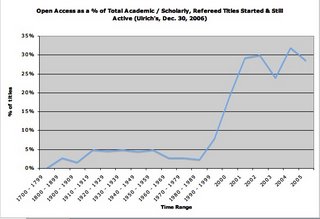
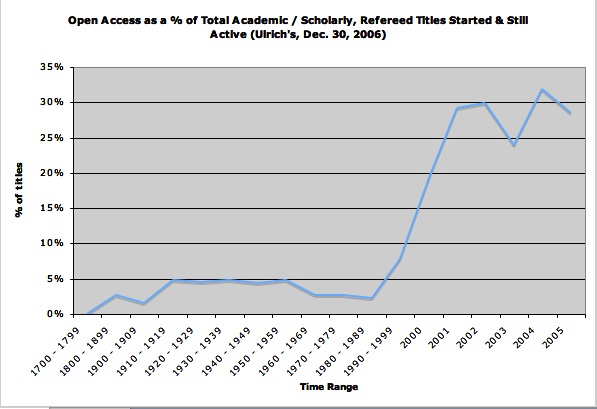
Data derived from Ulrich's Periodicals Directory illustrates a strong and positive correlation between the recency of a journal's start date and open access: the more recent the start, the more likely the journal is open access. None of the titles started in the 1700's that are still active are open access. The percentage of titles started from the early 1800's to the end of 1999 never rises to the double digits. The number of titles started in 2000 rises to 19%, while the percentage of new journals classified as open access by Ulrich's is about 30% in this millenium.
It should be noted that the accuracy of Ulrich's classification of journals as open access is limited; open access journals are likely understated. It may be of interest that, according to Ulrich's, new journals have been created in 2006 which are not even online, never mind open access.
Open data and a detailed explanation of the limitations of the data are available at:
http://spreadsheets.google.com/pub?key=pqCs8wrw32HE0P95TKgSsfQ&output=html
Basic data in spreadsheet and chart form follows.

This post reflects my personal opinion only and does not represent the opinions or policy of the BC Electronic Library Network or the Simon Fraser University Library.
It should be noted that the accuracy of Ulrich's classification of journals as open access is limited; open access journals are likely understated. It may be of interest that, according to Ulrich's, new journals have been created in 2006 which are not even online, never mind open access.
Open data and a detailed explanation of the limitations of the data are available at:
http://spreadsheets.google.com/pub?key=pqCs8wrw32HE0P95TKgSsfQ&output=html
Basic data in spreadsheet and chart form follows.

This post reflects my personal opinion only and does not represent the opinions or policy of the BC Electronic Library Network or the Simon Fraser University Library.
Ulrich's and DOAJ: an idea
To its credit, Cambridge Scientific Abstracts' for-profit Ulrich's Periodicals Directory, long considered an authoritative service on periodicals information by libraries, publishers, and others, is including open access journals. The Directory of Open Access Journals provides the highly valuable service of vetting journals both for appropriate scholarly quality controls, and open access status. Surely a business relationship would make sense here? The benefits would be consistent, quality information on open access journals for Ulrich's, saving Ulrich's staff time on the vetting process; and, funds for DOAJ, to help establish a sustainable business model for this essential service. This makes so much sense for us librarians ~ perhaps we should call our CSA rep with this suggestion?
Here is a bit of background explaining how I came up with this idea.
Ulrich's does not post their definition of open access on their web site. However, based on a bit of research, my best guess is that Urlich's practical definition of open access would appear to be "included in the Directory of Open Access Journals". For example, a Dec. 30, 2006 search of Academic / Scholarly, Online, Refereed, Open Access Journals with a start date of 2006, yields a list of 36 titles. All 36 titles are found in the Directory of Open Access Journals.
This is an excellent approach, as DOAJ is indeed considered an authority on open access, peer reviewed journals, as all titles are vetted for both criteria by a professional librarian before being added to DOAJ.
However, Ulrich's approach seems to be somewhat inconsistent. While DOAJ includes 2,514 titles as of December 30, 2006, an Ulrich search for Academic / Scholarly, Online, Refereed, Open Access titles, includes only 1,482 titles. There are indications that some of these titles are actually in Ulrich's, but the open access designation has been missed. For example, BioMed Central's new title, Chinese Medicine, is listed in Ulrich's, but does not appear on the 2006 start date / open access list. Another example: a search for "Hindawi" as publisher yields 51 titles, but a search for ""Hindawi" as publisher and open access" yields only 26 titles (Hindawi currently has 50 open access titles). Also, a search for "Public Library of Science" as publisher yields 8 titles; a search for "Public Library of Science and open access" yields only 6 titles.
So, here is the suggestion. Obviously, it benefits both Ulrich's and its customers to include open access titles. Since DOAJ is already doing the work of vetting titles both for scholarly quality control and for full open access, would it not benefit Ulrich's to contract with DOAJ to receive the DOAJ title lists on a regular basis? This would provide Ulrich's with quality, consistent information for open access titles - and, such a business arrangement should be helpful to DOAJ to establish a sustainable funding structure.
Considering the benefits of having this kind of consistent quality for open access titles in Ulrich's - shouldn't we librarians be asking our Ulrich's reps to make this happen?
This post is the sixth in the Transitioning to Open Access Series.
This post reflects my personal opinion only and does not represent the opinions or policy of the BC Electronic Library Network or the Simon Fraser University Library.
Monday, December 18, 2006
Transitioning to open access: beyond fear of change
Some of the opposition to open access appears to stem simply from a very human, and very natural, fear of change.
In a recent very well-written post to Liblicense, Sandy Thatcher, Director of Penn State University Press, expresses the viewpoint that a critical mass of self-archived articles will cause sudden, nonlinear change, "a point at which major disruption to the system could occur, with at least very harmful short-term consequences". Sandy is concerned about the possibility of "a real "tipping point," which would lead some major publishers to abandon the field of STM journal publishing in the belief (however erroneous) that they could not sustain their expected profit margins under the new regime thus legislated".
Sandy goes on to point out that an exodus of a few major publishers from the system, due to perhaps erroneous beliefs about cancellations, would cause major disruption in the scholarly communications system. Sandy worries that journals would not be able to find new homes, because "smaller publishers, especially university presses, simply do not have the capital to launch the kinds of sophisticated systems that these major players can provide..."
What Sandy is overlooking is the fact that if a few large, highly profitable publishers were to suddenly decide to go into other businesses - there would suddenly be large amounts of capital available from library budgets, to support university presses such as Penn State. So if, in such a scenario, there are "plenty of professors, administrators, and librarians appealing to us to expand our journals program", as Sandy predicts - no worries, they will have lots of cash!
Then again, it is always possible that the publishers who are making hefty profits from scholarly publishing will stay in the business after all.
Many thanks to Sandy for openly sharing this viewpoint. This kind of honest discourse will help us all to find the smoothest possible road through the transitional process.
This post is the fifth in the series Transitioning to Open Access.
This post reflects my personal opinion only and does not represent the opinions or policy of the BC Electronic Library Network or the Simon Fraser University Library.
Thursday, December 14, 2006
Linda Hutcheon: A democratized diffusion of knowledge
The University of Toronto's Linda Hutcheon is one of Canada's more modest leaders of the open access movement. Here are some of Linda's words of wisdom, from a SPARC Scholars Speak interview: "Open access removes barriers. I find this very politically attractive. The sharing of knowledge helps us get at economic inequities – experienced both by smaller academic institutions and, of course, by developing countries. Everybody wins. More access and resource sharing lead to a democratized diffusion of knowledge".
Linda also points out that the biggest barrier to change is simply time; people are just busy to learn and implement change. The good news here: in the medium to long term - this is no barrier at all.
Another topic Linda brings up that we don't hear about as often is the monographs crisis. As library budgets have been diverted from the purchase of monographs to meet the ever-increasing serials prices, fewere monographs have been purchased - and now, fewer are being published, even though this form remains critical in the humanities.
One of Linda's solutions: rethinking university presses, with more support from universities so that they do not need to compete with commercial companies, but rather focus on academic work.
Well said, Linda.
Thanks to Peter Suber on Open Access News.
This post is the third in the series Canadian Leadership in the Open Access Movement.
Monday, December 11, 2006
John Willinsky and the Public Knowledge Project
The University of British Columbia's Dr. John Willinsky, founder of the Public Knowledge Project (PKP), is - most remarkably - world-renowned for both theoretical and practical contributions to the open access movement. The idea of public knowledge embraces open access, but goes beyond to encompass the transformative potential of open access for society as a whole, while the free, open source Open Journal Systems has greatly facilitated the development of open access publishing.
While some open access leaders focus exclusively on increasing access for researchers, the public knowledge approach is broader. John talks about access to knowledge as transformative for society as a whole. Historically, it was an increase in access to knowledge that made public libraries, and subsequently public schools, possible. The transformative potential for our society with open access to our scholarly research is as difficult for us to imagine, as public universities might have been in the days before the printing press.
John Willinsky's outstanding theoretical contributions have been recognized by the American Library Association, who awarded the 2006 Blackwell Scholarship Award for John's book The Access Principle (also available in DLIST. Links to more of John's works can be found from the PKP Publications page.
The Public Knowledge Project (PKP) is best known for its open source software - particularly Open Journal Systems (OJS) , a free, open source journal publishing software platform. Since its release on November 8, 2002, an event noted on Peter Suber's Open Access Timeline, OJS has become the publishing platform for over 800 journals, in 10 languages, around the world, greatly facilitating open access publishing. Examples of projects and journals using OJS: AJOL, African Journals Online, Revista Brasileira de Entomologia.
OJS is used not only around the globe, but also right here in Canada - for example, by Theoretical Economics, hosted by the University of Toronto. OJS is the platform of choice for another Canadian open access leadership initiative, the International Coalition for the Advancement of Academic Publication at Athabasca University. OJS is also in use at the University of Alberta Libraries, publisher of Evidence Based Library and Information Practice, and the University of Guelph Library, host of Partnership: the Canadian Journal of Library and Information Practice and Research, both new open access journals.
PKP also produces the open source Open Conference Systems and Open Archives Harvester.
Initially developed at the University of British Columbia, in 2005 PKP became a joint project of the UBC Faculty of Education, Simon Fraser University Library, and the Canadian Center for Studies in Publishing at Simon Fraser University.
Recently, PKP was the sole Canadian winner of the first annual Mellon Awards for Technology Collaboration.
PKP is a partner of, and endorsed by, the Scholarly Publishing and Academic Resources Coalition.
To learn more about PKP, meet the PKP team and other open access leaders (myself included!) plan to attend the First Annual PKP Scholarly Publishing Conference July 11 - 13, 2007, in Vancouver, British Columbia - one of the three best cities in the world to visit or live, according to the Economist Intelligence Unit. There's still plenty of time to submit a proposal to the Call for Papers.
Disclosures: while I do not work for the PKP Project, I do work (indirectly) for one of the partners of the project - SFU Library, and I am on the planning committee for the PKP Scholarly Publishing conference.
This post is the second in the series Canadian Leadership in the Open Access Movement.
Sunday, December 03, 2006
Canadian Leadership in the Open Access Movement: Budapest
There have been several defining moments in the open access movement. The first of these was the Budapest Open Access Initiative, "a small but lively meeting convened in Budapest by the Open Society Institute (OSI) on December 1-2, 2001. The purpose of the meeting was to accelerate progress in the international effort to make research articles in all academic fields freely available on the internet".
3 of the 16 original signatories to the Budapest Declaration are Canadian: Leslie Chan, Program Supervisor for the International Studies program and the Supervisor of Studies for the Joint Program in New Media Studies at the University of Toronto, Jean-Claude Guédon, Professor of Comparative Literature at the Université de Montréal, and Stevan Harnad, Canada Research Chair in Cognitive Science, Université du Québec à Montréal.
Canada’s involvement in open access advocacy can be traced back to the early 1990’s. In 1991, Jean-Claude Guédon founded Surfaces, the first Canadian electronic scholarly publication. According to Guédon, "[I] began advocating open access as soon as I got involved with electronic publishing and this was because I came to realize that many academic journals were subsidized to the tune of 60-70% of their costs … you can argue that the money to support open access journals was present from the beginning”. What Jean-Claude is referring to is the fact that the majority of the work involved in producing the scholarly literature is contributed by academics and their institutions without financial compensation, particularly the writing of the article in the first place, and providing peer review.
More recently, Guédon has been very active with the Scholarly Publishing and Academic Resources Coalition (SPARC) and with the Open Society Institute, and gives about 25 – 30 conference presentations every year, worldwide. Guédon's In Oldenburg’s Long Shadow: Librarians, Research Scientists, Publishers, and the Control of Scientific Publishing, a detailed, thoughtful analysis on the history of scholarly communications, has been translated into 5 languages. A few of Jean Claude's other works can be found in E-LIS. Here, you can find The green and the gold: the case for mixing and matching, from Serials Review. This is a profound work, which talks about the two major approaches to open access - the "green" approach, or self-archiving, and the "gold" approach, or open access publishing - and makes a strong case for simultaneously pursuing both roads.
The other two Canadian leaders at that Budapest meeting happen to be world leaders on each of these roads to open access.
The work of the University of Toronto's Leslie Chan illustrates Canadian leadership in the global arena on the "gold" road to open access. Leslie is Associate Director of Bioline International, a not-for-profit electronic publishing service committed to providing open access to quality research journals published in developing countries; helping us to reduce the "south to north" knowledge gap. Leslie is also on the Executive of Project Open Source|Open Access. The object of Project Open Source|Open Access is to promote open access as a form of collaborative peer production. Some of Leslie's works can be found in E-LIS; for more recent works not yet in E-LIS, see the University of Toronto T-Space.
The Journal of Postgraduate Medicine, one of the oldest medical journals from India and now open access online, illustrates both the high quality of the work of Bioline International, and two of the benefits of open access. The author benefits from the greatly expanded access for readers, not only because the article is openly accessible, but also because the Bioline journals are included in key subject indexes. For all of the rest of the world, we have ready access to a valuable journal that we otherwise quite likely could not afford to subscribe to.
The Université du Québec à Montréal’s Stevan Harnad is among the world’s earliest and most vocal advocates of open access, the author of the Subversive Proposal of 1994, moderator of the American Scientist Open Access Forum, and author of the scholarly blog Open Access Archivangelism. While Harnad supports both the green and gold roads to open access, he is particularly known for reminding us that the faster road to open access is green. As Stevan would say, 92% of the world’s publishers have given the “green light” to self-archiving, so there is no need to wait. By doing so, authors will enhance their own research/impact. By making it easier for everyone to access and read your articles, your work is more likely to be read and cited. To find out if a particular publisher permits self-archiving, go to the Sherpa Romeo Publisher Copyright Policies & Self-Archiving.
This post is based on private correspondence with each of the leaders named, mainly from about two years ago. My apologies if not all details are up to date.
This small indication of Canada's early leadership in the open access arena is just the beginning! This is the first post in a series, Canadian Leadership in the Open Access Movement
Updated December 4, 2006
Tuesday, November 14, 2006
That day has arrived, and Canada must seize it (more on CIHR)
Another thought on the Canadian Institutes of Health Research Consultation on their Draft Policy on Access to Research Outputs (comments due November 24, 2006).
This policy is leading-edge in the area of open data. But, does it go far enough?
The Final Report of the National Consultation on Access to Scientific Research Data recommends a much stronger leadership role for Canada. Two paragraphs from this Report explain beautifully why open data is so important:
Complex and rich arrays of scientific databases are changing how research is done, speeding discovery and creating new concepts. Increased access will accelerate these changes, creating a new world of research and a whole new world. When these databases are combined within and between disciplines and countries, fundamental leaps in knowledge can occur that transform our understanding of life, the world and the universe.
For example, in the analysis of human genetics, the technology to capture enormous amounts of data and to mine them for new information is already showing the genetic make-up of life and the understanding of numerous diseases and syndromes. We will soon be able to analyze such complexities as the pre-disposition to disease in animal and plant populations based on genetics, social and environmental conditions, and demographics, so that all these factors can become part of new disease prevention strategies. With the ability to access and integrate data compiled in different fields, totally new knowledge regimes are being opened in ways that have historically been impossible.
Thanks to report authors David F. Strong & Peter B. Leach, for the report from which is drawn the title of this blogpost, and to Kathleen Shearer of the Canadian Association of Research Libraries.
This post reflects my personal opinion only and does not represent the opinions or policy of the BC Electronic Library Network or the Simon Fraser University Library.
Wednesday, November 01, 2006
CIHR draft policy: the leadership needed to overcome gridlock
SPARC's Senior Advisor, and former Founding Executive Director Rick Johnson, discusses CIHR's leadership in helping academia to overcome a kind of gridlock imposed by the prestige culture of the university to embrace the potential of the world wide web for open sharing and working together in so many new ways, from new research collaborations to open sharing of data for reuse.
In Rick Johnson's Will Research Sharing Keep Pace with the Internet?. The Journal of Neuroscience 26(37):pp. 9349-9351, recently self-archived in E-LIS.
All the more reason to support the CIHR Draft Policy on Access to Research Outputs!
This post reflects my personal opinion only and does not represent the opinions or policy of the BC Electronic Library Network or the Simon Fraser University Library.
Sunday, October 29, 2006
Response to CIHR Consultation on Access to Research Outputs
Here is my response to the CIHR Consultation on Access to Research Outputs:
Re: Canadian Insitutes of Health Research Draft Policy on Access to Research Outputs
Kudos to CIHR for your Draft Policy on Access to Research Outputs. As an open access advocate who follows policy developments and has participated in policy consultations around the world, I consider this policy to be exemplary, with elements that I hope will be a role model for future policy makers.
It is heartening to see that CIHR is requiring immediate deposit of peer-reviewed research articles funded by CIHR. In my opinion, the provision for up to a maximum 6-month publisher-imposed delay is more than generous. If I were to suggest one improvement to this policy, I would suggest not permitting any delay at all. This is reasonable given that the research is conducted using public funds, and there are many open access options – from publishing to archiving – available to researchers today.
The CIHR is a leader in requiring deposit of research data immediately on publication; an important step that will lead to more rapid advances in research.
CIHR’s suggestions that researchers consider retroactively archiving important articles, and that a researchers’ track record might be considered in future grant applications, are welcome innovations that other policy-makers might wish to consider in their own policy developments.
This policy will make the research made possible by Canadian taxpayer dollars more readily available to Canadians, as well as to everyone around the globe. Students and faculty members at smaller and more remote colleges will have more access to researchers, as will high school teachers and students, and professionals outside of the major research centres, among others.
Canadian researchers will benefit from increased impact and visibility.
Once again, congratulations on a well thought out policy.
This is an open letter, which will be published on my scholarly blog.
Sincerely,
Heather Morrison
The Imaginary Journal of Poetic Economics
Information about the CIHR Consultation can be found at:
http://www.cihr-irsc.gc.ca/e/32395.html
Here is a link to the draft policy:
http://www.cihr-irsc.gc.ca/e/32326.html
Comments are due November 24, 2006
This post reflects my personal opinion only and does not represent the opinions or policy of the BC Electronic Library Network or the Simon Fraser University Library.
Friday, October 27, 2006
Open Access and the Cost of Publishing
As posted to the American Scientist Open Access Forum, October 27, in response to a question about the approximate cost of the production, including
dissemination both in print and electronically.
Abstract: this post looks at the cost of publishing and dissemination in relationship with open access. The wide range of costs per article - from nothing, to thousands of dollars - is explained. A journal that relies on free, open source software, volunteer labor, and in-kind server support, may have no hard dollar costs. A commercial journal with paid editorial staff, profits and taxes to deal with, may have substantial expenditures.
The question of whether, and how much, to support open access processing fees is explored. The author concludes that researchers and universities should budget low for open access via author choice options, to allow market forces work to ensure that the transition from print to electronic, closed to open access looks for efficiencies such as automating publishing tasks, and that obsolete, print-based publishing tasks which may actually be counterproductive in the electronic environment, are dropped. Support open access publishers with true open access and reasonable costs, such as BioMedCentral, Hindawi, Public Library of Science, and many others. For journals with high processing fees and/or dubious open access status, author self-archiving is recommended as the only strategy for open access.
Full post:
This figure is highly variable, and in the process of change. With
ongoing developments in automation (publishing and word processing
software improvements, continuing decreases in per-byte costs for
storage of information), the cost of publishing an article is in a
process of decrease, and I do not believe we have yet seen equilibrium.
When considering publishers' "open choice" type arrangements -
payment for open access on publication - it is important to keep in
mind that open access does not apply to print. As long as journals
continue to be produced in print, this portion of the revenue stream
should come from print subscriptions.
The dollar costs of coordinating and disseminating a peer-reviewed
research article ranges from nothing to thousands of dollars.
The model that equates with zero costs is one based on voluntary
labor, free open source publishing software such as Open Journal
Systems http://pkp.sfu.ca/?q=ojs [disclosure - I am on the planning
committee for the First International PKP Conference), and in-kind
support. For example, your university or university library might
provide free server space for a journal local faculty participate in.
Models with dollar costs obviously involve payments of a variety of
types. Some journals have volunteer editors, others paid. One can
purchase publishing software and server space. Some publishers
(commercial, and also some not-for-profits) look to profit from
publishing. Commercial entities also need to factor in taxes.
Overall, the costs of publishing are decreasing dramatically, due to
the technology. The costs of disseminating an electronic-only
journal post-production are close to nothing per article, unlike
print which incurs per-issue printing and distribution costs. Many
of the tasks involved in publishing are either automated, or made
much easier by automation. Think of word processing software and the
difference this means for editing; copyediting is still needed, but
no doubt overall more articles are submitted with better spelling,
punctuation, and formatting than in the past. Word processing and
publishing software can automate much of the work that used to be
done manually. For example, thanks to citation software packages,
the work of switching from one bibliographic format to another to
prepare for publication in a particular journal can mostly be done
automatically.
I'm not sure how helpful this will be to your budgeting process,
Donat. Here is another suggestion: when budget for open access
dissemination, my advice is: budget low on a per-article basis. In
my opinion, this is important, partially to ensure best use of
current available funding, but more importantly, to ensure that
market factors work towards this efficiency in publishing. That is,
paying high per-article processing fees reflecting publishing
practices which should be in the process of becoming obsolete, is
counter-productive.
One way open access can be fully met with this low budget approach:
Most journals allow authors to self-archive, and there is no cost
involved to the researchers or their institutions.
I would encourage researchers to support open access publishing as
well. There are open access publishers who provide true open access,
and do not need to charge processing fees, or who charge reasonable
processing fees (such as BioMedCentral and HIndawi; also PLoS - more
expensive, but still reasonable considering they are aiming at the
top-quality market).
Not every open choice option is true open access, and not all fees
are reasonable. If a researcher (perhaps with help from their
university library) is able to distinguish the options that really do
move towards open access, these are worth supporting. If means are
not available to deal with all the complexities, my advice is to
stick with self-archiving, using tools such as the Sherpa Romeo list
and the new addenda for authors to keep their rights from JISC,
SPARC, and others, to ensure that authors keep their rights to self-
archive.
best,
Heather Morrison
This post reflects my personal opinion only and does not represent the opinions or policy of the BC Electronic Library Network or the Simon Fraser University Library.
Sunday, October 15, 2006
Chemists Without Borders Open Chemistry Position Statement
On Thursday, October 12, Chemists Without Borders endorsed an Open Chemistry Position Statement.
Synopsis
Within the vision of Chemists Without Borders, Open Access to the traditional scholarly, peer-reviewed journal literature is the library, a global library with equal access to our shared knowledge for all. Open Access is necessary to development of equitable access to chemistry education and research opportunities in both the developed and developing world. Chemists Without Borders strongly supports Open Access, as defined in the Budapest, Berlin, and Bethesda statements, and the measures necessary to implement open access, such as funding agencies requiring open access to the results of the research they fund, and educating researchers about Open Access.
Open Source Science promises more rapid advances in research through open sharing of research information at all stages of the reseach process. Open Source Science means more opportunities for collaboration, whether to facilitate Chemists Without Borders projects or provide researchers with more opportunities for participation in international research collaborations. Chemists Without Borders strongly supports Open Source Science within the context of Open Access.
Comment: as a member / open access specialist with Chemists Without Borders, it has been an honour and a great pleasure working with this group on what may be one of the strongest and most visionary of the "open" statements to date. The Chemists Without Borders Open Chemistry Position Statement fully endorses open access as defined in the Budepest Open Access Initiative, and goes beyond, for example, in specifying: "the freedom to extract data from the full-text, whether singly or in a collection of articles, and the freedom to download the supplemental data", as part of the definition of open access, and in supporting open source science and open data.
The Chemists Without Borders Open Chemistry Position Statement also articulates open access and open source science within the overall vision of Chemists Without Borders, for example outlining the importance of open access and open source science in a globally equitable approach to chemistry education. In this science, the Chemists Without Borders Open Chemistry Position Statement may be role model for other "without borders" groups.
On a personal note, my involvement with this group began with a question posed to the SPARC Open Access Forum, asking whether there might be a Chemists Without Borders. Chemists Without Borders Founders Steve Chambreau and Bego Gerber found my question through an internet search - my question kept coming up higher in a google search than the Chemists Without Borders' own blog! I first starting helping Steve & Bego to figure out ways to get the Chemists Without Borders blog to show up higher in a google search, but then became intrigued by this fledgling group trying to figure out how to change the world, and have been involved ever since. Kudos to Bego & Steve for all their hard work getting this group off the ground. Best of luck to all Chemists Without Borders members on current projects, such as AIDS Free Africa, research on using water hyacinth as water remediation (a weed that loves to soak up arsenic!), Useful Chemistry open blogging, and more.
Chemists Without Borders welcomes new members.
This post is part of the Creative Globalization series.
This post reflects my personal opinion only and does not represent the opinions or policy of the BC Electronic Library Network or the Simon Fraser University Library.
Subscribe to:
Posts (Atom)